AI’s supply chain takeover
Predictive forecasting, vision-guided robotics and digital trade modeling are enabling companies to move from reactive operations to more resilient networks.
It is hardly breaking news to say that the supply chain industry is experiencing a prolonged pattern of disruption and change. This encompasses both global manufacturing and agriculture, which means the impact may be even more significant across the pet sector.
Investment is vital
As the industry navigates a period of structural transformation, and the humanization of pets continues to drive demand for premium, fresh and specialized products, the underlying infrastructure required to deliver these goods gets more complex by the day. For C-level executives, the traditional supply chain – once viewed merely as a cost center – is now a critical lever for competitive advantage.
In an era defined by volatile trade policies and demanding consumers, AI has emerged as the primary tool for building resilience and improving customer experience. According to data shared with industry forum Supply Chain Brain, nearly 60% of global logistics leaders are now definitely prioritizing AI to manage the volatility of the post-pandemic market, while 96% of them agree that long-term AI investment is a necessity.
For the pet sector, adopting AI is no longer a luxury. It is a prerequisite for scale because of the unique pressures created by the short shelf life of fresh food, the logistical burden of heavy bags and the ever-changing landscape that must be navigated when importing from countries such as China.
Warehouse intelligence
For decades, inventory management relied on historical data. This meant, essentially, looking in the rear-view mirror to drive forward. In the pet industry, that often resulted in overstocks or debilitating stockouts of essential SKUs following slight shifts in consumer demand.
Modern, AI-driven, autonomous inventory management systems make use of demand sensing. Instead of looking at sales from the previous year, these algorithms ingest thousands of external signals to predict immediate demand and help retailers respond quickly to fast-changing conditions.
Connecting owner data to stock
Leading UK retailer Pets at Home is already moving toward this type of agentic model – an AI system that can act on its own, making decisions and completing tasks without needing constant human input. By connecting data from its veterinary clinics, grooming salons and retail stores, the company can use AI for predictive replenishment.
This enables it to move from broad segment marketing to individual pet profiles. The system can anticipate exactly when a specific customer is likely to run out of a bag of food, based on their pet’s breed and age, therefore optimizing inventory levels across its network.
Operational gains
Companies using AI-powered retail automation software have reported significant operational gains. For pet retailers managing upwards of 12,000 SKUs, AI-driven demand forecasting can lead to, for example, up to 50% less overstock by predicting seasonal shifts, e.g. tick and flea treatments.
Another real benefit seen by many businesses has been a waste reduction in fresh and short-dated products of up to 15%. And with inventory turnover observed as being 30% faster, capital that was previously tied up in slow-moving stock can be freed up.
Production lines to inventory scans
One of the most significant leaps in supply chain technology is the integration of AI vision. In pet food and treat manufacturing, quality control has historically been labor-intensive.
Mars Petcare has addressed this by investing heavily in Digital Twin technology. By creating a virtual replica of its production lines, Mars uses AI to ensure product consistency and to minimize waste during the extrusion process.
Visual intelligence is also taking flight in distribution centers. US online pet retailer Chewy recently addressed the industry pain point of handling heavy, non-rigid items like very large sacks of dog food with its CHAMP (Chewy Autonomous Mobile Picking) initiative.
By partnering with robotics firms to develop vision-guided systems, Chewy has deployed robots that use high-confidence object detection to identify, grasp and place heavy bags into boxes.
Autonomous drones are replacing the dangerous task of manual cycle counting. Various third-party logistics (3PL) providers serving the pet industry are deploying drones to perform ‘lights out’ inventory scans.
Equipped with high-resolution cameras, plus light detection and ranging (LiDAR), these drones navigate narrow aisles to scan barcodes on racks reaching 40ft high. This allows for 99.9% accuracy without the need for warehouse downtime.
Navigating the tariff minefield
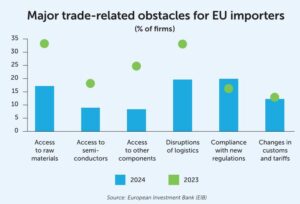
The most immediate application of AI today lies in its ability to find a way through the complex web of global trade. As trade tensions fluctuate and tariffs go on/off , pet brands are often caught in the confusion. Components of pet accessories or specific vitamins used in food formulation are frequently subject to sudden duty increases.
AI is now being used for Digital Twin modeling of entire supply networks. This allows executives to run ‘what if’ scenarios. For example, if a 25% tariff is applied to certain raw materials, the system can calculate the exact cost impact of shifting production to Vietnam or Mexico. AI-powered global trade management systems can automatically reclassify products under different harmonized system (HS) codes, to ensure compliance while identifying the most tax-efficient routes.
Beyond the data silo
The primary hurdle for many supply chain leaders – especially in the pet sector – is not the lack of AI technology but the fragmentation of data. AI is only as effective as the data it feeds from, and it’s likely that not only legacy pet brands are still operating with siloed data.
The executive mandate for 2026 and beyond is the creation of a unified supply chain. That involves integrating data from suppliers, 3PL providers and retail partners into a single AI-orchestrated platform. This transparency allows for exception-based management, where human intervention is only required when the AI identifies a significant anomaly such as a port strike or a sudden spike in raw material costs.
Creating future resilience
As we look toward the future, the goal is a regenerative supply chain. This is a system that not only reacts to disruption but anticipates it and self-corrects. We are moving into a world where AI-managed fleets optimize delivery routes in real time to avoid traffic and where smart warehouses manage their own energy usage based on peak utility pricing.
For the C-suite, the takeaway is clear. AI is not a technical upgrade, it’s a strategic imperative. The pet companies that will thrive in the coming decade are those that treat their supply chain as a living, breathing, thinking organism.
By investing in AI and piloting sci-fi sounding projects such as AI vision, autonomous drones and predictive trade modeling, leaders can turn their supply chain into a strategic advantage and ensure their brands remain resilient, regardless of what happens next in the world.
Share this story:
One click prioritizes GlobalPETS in your search results and AI answers.