Amazon pulse: the pet dental care boom
Keeping a pet’s teeth healthy has not always been top of the list for owners. But new formats and greater awareness are changing all that.
A chew tossed in the cart; a resolution made in January but forgotten by February. Recent Similarweb Shopper Intelligence data across Amazon in the US, UK and Germany suggests that pattern may be shifting, with dental product adoption varying widely by pet type and per market.
Dogs ahead, cats behind
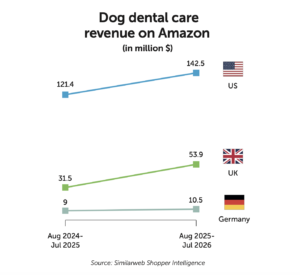
According to the Similarweb data, sales in Amazon US’s Dog Dental Care category topped 8.5 million units in the 12 months to July 2026, up nearly 19% against the same period a year earlier, with revenue climbing 17% to $142.5 million (€125.1M). Conversion improved too, rising from just over 25% to nearly 29%, so a growing share of shoppers who land on a dental product page are following through and buying.
Cats, on the other hand, haven’t kept pace. Over that same 12-month window, Similarweb data shows that sales in Cat Dental Care were essentially flat year over year (YoY) at 4.4 million units, even as revenue rose 8% on higher price points.
More strikingly, conversion for cat dental products fell from just over 26% to under 23%, despite a 16% jump in page views. Cat owners are looking more and buying proportionally less, a gap worth watching as more brands compete for a still underserved corner of the category.
Powder on the rise
On-site search data for the same 12 months on Amazon in the US suggests that dog owners aren’t just buying more dental products – they’re switching formats too. The new big thing in this pet segment is dental powder.
‘Dog toothpaste’ and ‘dog toothbrush’ remain the two biggest search terms in the category, but close behind them is a format that barely existed a few years ago: powder that is sprinkled onto food rather than brushed onto teeth. Together, ‘Dog teeth cleaning powder’ and ‘dog dental powder’ drove well over 3 million clicks over the period, and neither term is owned by a legacy pet health name.
Virbac, a veterinary-grade brand, still commands the toothpaste conversation, taking over a third of clicks on ‘dog toothpaste’ and close to 90% of clicks on searches for its own enzymatic formula by name.
In terms of powder, however, Virbac has essentially no presence, as that segment belongs to newer, social-first brands.
Unlike dogs, where powder has pulled ahead as the format to beat, cat dental spend remains split across dental treats and chews (such as Feline Greenies and Purina Dentalife), water additives (Oxyfresh) and powder (ProDen PlaqueOff). No format has consolidated the category the way powder has for dogs, which may be part of why conversion is struggling to keep up with interest.
Winning in non-branded searches
Pet Honesty is a useful illustration of this shift in dental product searches. Similarweb data shows the brand held roughly 8% of all on-site search clicks in Amazon US’s Dog Dental Care category over the 12 months to July 2026, and close to 6% of category revenue, a meaningful position for a brand that didn’t exist in most pet owners’ vocabulary five years ago.
Its edge isn’t brand recognition. Of Pet Honesty’s clicks in the category, 81% came from non-branded searches, terms like ‘dog dental powder’ or ‘dog teeth cleaning powder’ rather than the brand name itself, and 62% of its total clicks were organic rather than paid. The brand is winning the moment a pet owner searches for a solution, before they’ve decided who to buy it from – largely without paying for placement.
Different promotional calendar
Search interest for dental health products also runs on its own calendar. Across the past two years of Similarweb Shopper Intelligence data, on-site clicks built steadily from January into a spring peak, tracking closely with National Pet Dental Health Month each February in the US and Canada, and the wellness push that follows it.
That’s a different rhythm from the July and October spikes elsewhere in the pet category, which are tied to the annual Prime Day deal event in June and fall promotions. Brands running a February-forward promotional calendar for their dental health products are positioned to capture this demand well before a Prime Day-only strategy would even kick in.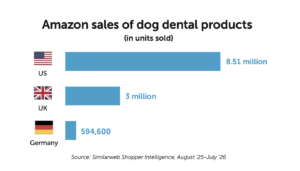
Beyond the US: UK and Germany
The picture outside the US looks even stronger. Sales in the UK’s Amazon Dog Dental Care category, for example, showed huge gains YoY in the 12 months to July 2026 – up 59% in units and 71% in revenue – with conversion improving alongside demand, rather than being diluted by it. Supply and interest are scaling together in the British market.
Germany tells a more complicated story. Unit sales grew a modest 10% and revenue 16%, but page views rose nearly 40%, pulling conversion down from under 10% to under 8%. The number of dental listings on Amazon.de grew 42% over the same window, at more than twice the pace of sales.
It looks like more products are competing for the same shopper attention on this Amazon site and, so far, that attention isn’t converting. That shows how assortment growth and demand growth don’t always move together, even in a category this hot.
Indications from the Asian market
Japan offers a glimpse of where this category may be headed next. Similarweb Google search data shows that a curated group of Japanese-language dental product and care behavior terms – ‘dog toothbrush’, ‘dog dental care’, ‘cat dental toys’, ‘how to brush a dog’s teeth’, etc. – grew 56% YoY, when comparing May-July 2026 with the same months in 2025.
So, looking at search interest rather than on-platform sales, these signals point in the same direction as the findings in the US, the UK and Germany. Pet owners are actively looking for dental solutions well ahead of most retailers’ assortments catching up to that demand.
Strategic priorities
A few takeaways follow from this. Lead with format, not just brand. The powder search terms driving dog dental growth aren’t dominated by legacy names, leaving room for a challenger brand to own the category conversation in the way Pet Honesty has.
Build a February-forward calendar in the US. The seasonal spike here tracks National Pet Dental Health Month, not Prime Day. Brands that only plan around July and October promotions will miss the window when purchase intent is actively building.
Don’t write off cat dental. Flat volume and softening conversion don’t mean demand is missing. Today’s assortment just hasn’t cracked what cat owners are actually looking for. That gap is an opening for a brand that gets the format right.
And in markets like Germany, watch assortment growth as an early-warning signal. When the number of listings grows faster than sales, it means more products are competing for the same attention – something worth tracking before it shows up in your own conversion numbers.
Strong rationale for growth
Pet dental care is part of a broader shift – the same wellness push driving pet owners toward fresh food, functional ingredients and preventive care more generally. The products winning right now make daily health maintenance easier rather than asking owners to do more work.
For the companies and brands that are willing to compete on both format and search visibility rather than just legacy trust alone, the online dental category still has room to grow. Dogs, cats and manufacturers will all benefit.
Share this story:
One click prioritizes GlobalPETS in your search results and AI answers.