Are dietary supplements living up to their promise?

Despite widespread awareness of potential benefits, recent research shows significant variations in the use of this type of complementary pet nutrition across different countries.
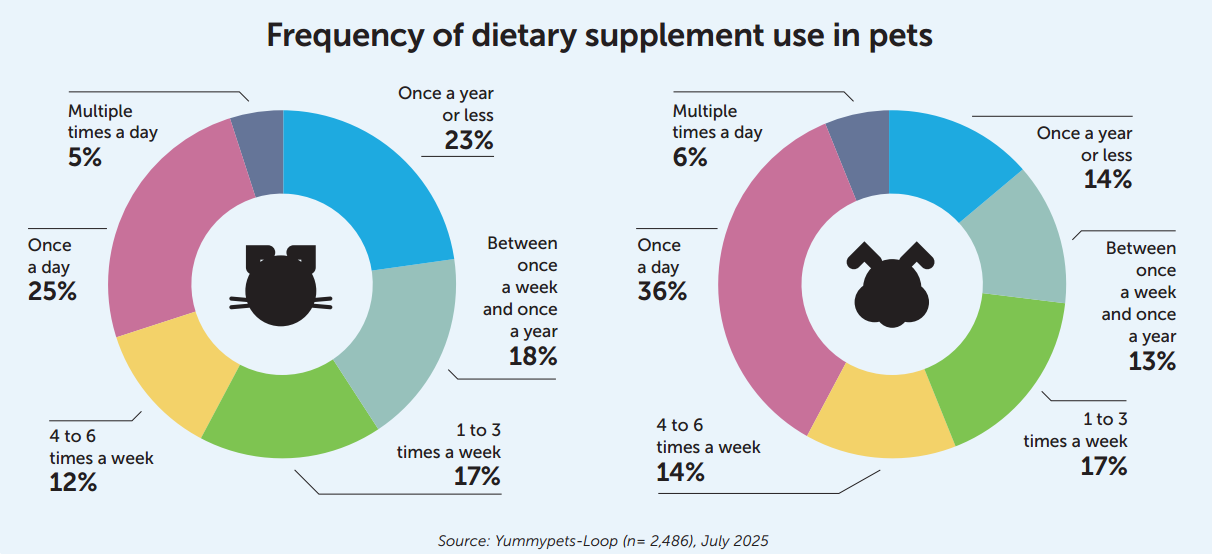
A new survey by Yummypets, powered by Loop, among some 2,500 pet owners in France, the UK, the US, Canada, Brazil and Mexico reveals that just 30% of cats and 42% of dogs are given dietary supplements every day.
How often are supplements given?
Pet owners in North America are the most likely to give their pet a supplement every day (40%), followed by European owners (37%). But just over three out of 10 pet parents in Latin America (32%) administer this type of product on a daily basis.
The majority of pet parents give supplements between one and six times a week. This is seen the most among the respondents in Mexico and Brazil (36%). At the other end of the scale, 23% of all cat owners in the survey, and 14% of all dog owners, only give a supplement to their pets once a year or less.
Expected health benefits
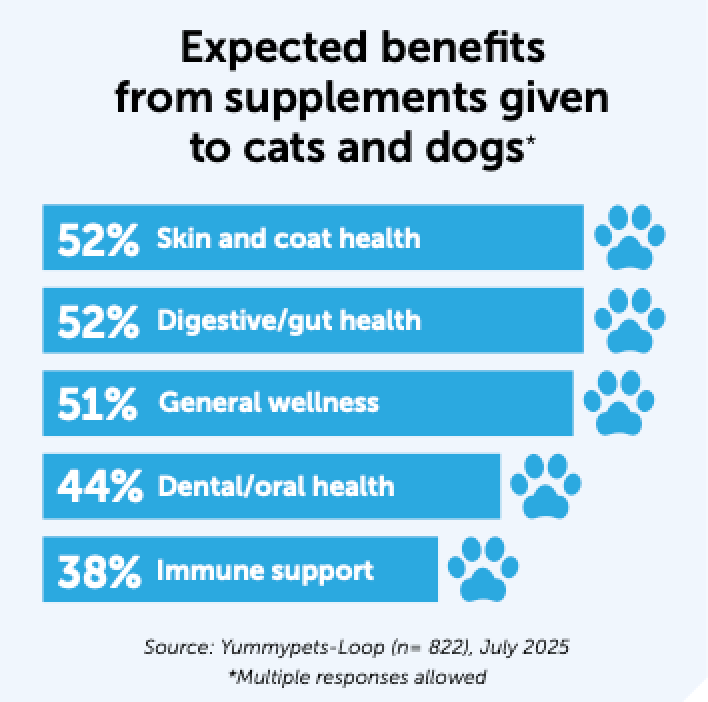
Of all the benefits the respondents expect from a dietary supplement for their pet, the ones most mentioned are skin and coat health as well as digestive health. These benefits are particularly valued among US pet owners, at 63% and 62% respectively. Digestive health is the most valued benefit in Mexico, at 60%.
General wellness and dental health also rank highly among pet owners’ expectations, according to the survey. Brazilian (60%) and French (53%) owners have the highest expectations for general wellness, while dental health tops the list of expectations in the UK, at 51%.
Generation X (aged 44-59) pet owners agree that these four benefits are why they use supplements. Meanwhile, Gen Z (18-27) pet owners are more likely to give supplements for stress, urinary health, appetite, cognitive health and, to a certain degree, heart health.
Canine vs feline wellness
There are significant differences between owner expectations of benefits for dogs and cats. Dog owners often use supplements for joint health (49%) whereas for cats this figure is just 21%. Cat owners see the urinary and kidney health benefits (33%), while this is of less interest to those who own dogs (13%). It’s a known fact that cats can be difficult eaters, so unsurprisingly their owners use supplements for appetite stimulation (22%) more than dog owners (12%).
Preferred formats
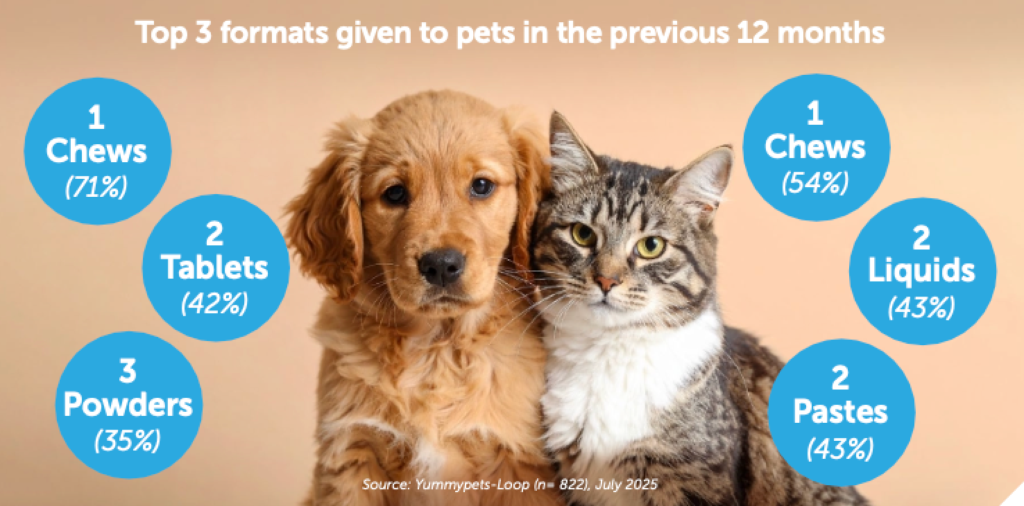
While chews are the most preferred globally – particularly among dog owners (71%) – the survey shows that pet owners are open to other formats too. The second most popular for cats is liquids and pastes (both 43%). For dogs this is tablets (42%).
Preferences differ in global regions and among subgroups. For instance, Latin American and Gen Z pet owners are more likely to give pastes to their pets, while North American, female and millennial (those aged 28-43) pet owners prefer powders. In Europe, pet owners are more likely to give tablets, while male North American pet owners favor chews.
Mix to taste
In terms of administration, 65% of all cat owners mix dietary supplements into wet food, while 39% do so with dry food. Other methods for cats include placing directly in the mouth (30%) and spreading on a treat or coating it (27%). Some 17% of the respondents mix supplements with water or other liquids to give to their cats.
Dog owners also mostly administer a dietary supplement by mixing it with wet food (49%) or dry food (51%), while 40% directly place it in their pet’s mouth. About three in 10 of them add the supplement to a treat in some way, while 15% give it to their dog mixed with a liquid.
Positive feedback
Globally, more than eight in 10 (81%) cat and dog owners believe their pets respond positively when given supplements. About one in seven (14%) say their pets respond neutrally, while 5% say they get negative reactions.
The survey noted no differences in the observations of subgroups, except that cat owners notice more negative reactions overall (8% vs 4% for dogs) and women do too (8% vs 1% for men).
Share this story: