Birds and hamsters: small pets, big opportunities
With the European market for smaller companion animals evolving, industry leaders weigh in on how businesses can capitalize on emerging trends.
While dogs and cats continue to dominate ownership statistics, the market for smaller, low-maintenance pets has been steadily expanding across the continent.
Looking at the past five years, we talk to experts about how the market has evolved and what future developments can be expected.
The importance of good advice
For the Germany-based Wagner Pet Products Group, a producer of food and other supplies for birds, cats, dogs and small pets, the segment has recently undergone a “structural” change.
“During the pandemic years, we saw a significant increase in demand for both hamsters and birds, mainly driven by families and first-time pet owners. Since then, the market has normalized, but on a clearly higher-quality level,” COO Markus Wagner tells PETS International.
According to Wagner, consumers have become more conscious about animal welfare and the longevity of products. “We’ve noticed that our aviaries and cages, which are designed for proper flight space with stainless steel feeding systems and natural wood perches, have maintained stable sales.”
Wagner regrets that many brick-and-mortar pet stores have drastically reduced their cage assortments.
“Customers are increasingly forced to buy such products online, where advice and product experience are lost,” he explains. “This shift is unfortunate, because proper housing requires guidance and professional recommendation – something the specialized retail trade once did exceptionally well.”
Emphasis on quality
Stefan Versele, Sales Manager at Versele-Laga, a Belgian company specializing in pet nutrition and care, has a different opinion on the status of the market: “The pet birds category is decreasing, but there is good news too: quality prevails. The trend is going toward more expensive, nicer, harder-to-breed birds. There is also a decrease in the small mammals segment, but still I see the same quality trend there.”
According to Versele-Laga, there are two main reasons for the decline in the small pet and bird markets: a lack of belief among business people and pet shop owners in these categories, and a tendency to focus only on the costs of keeping live animals in stores rather than recognizing the advantages, such as attracting more customer traffic and increasing overall shop experience and spending.
“We live in an insecure world, and our business is more insecure than it used to be,” says Versele, who nonetheless strikes a note of optimism. “It’s not the moment to cut down on lines. We should realize that if we add value to the pets, the pet business will also add value to the world. So not putting birds in a small cage, but in a fantastic wide cage so people can admire them.”
Growth in hamster numbers
Small pets continue to show a positive population trend, although not at the same level as dogs and cats. For hamsters, there is no solid aggregated data at the European level, as the species is typically grouped with other small pets, but national data can be analyzed.
According to the global data platform Statista, hamster ownership in the UK – approximately 600,000 hamsters – rose from 1.5% to 2.1% of households between 2022 and 2024, while in Italy hamsters represent approximately 3.4% of household pet ownership.
“The hamster population peaked during the pandemic and has since settled at a level slightly above 2019. Growth was particularly strong in Central and Eastern Europe, where space constraints and family demographics make small pets popular,” says Wagner.
Stable bird populations
For the bird segment, the trend has been more stable. The latest data from the European Pet Food Industry Federation (FEDIAF) shows a total figure of 48.2 million ornamental birds in Europe, with Italy as country leader with 12.9 million birds.
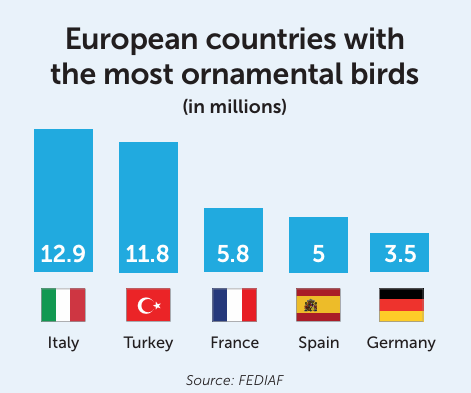
Wagner says that “moderate growth” has been seen in Southern Europe, in countries such as Spain, Portugal and Italy, and “renewed enthusiasm” in markets like Poland and Romania. “The DACH region remains mature, but focused on quality and long-term keeping,” he adds.
Small pet owner profiles
The demographics of the niche segment of hamster and pet bird owners is very different to that of owners of more common pets. German pet business Vitakraft specializes in the production and distribution of species-specific food, snacks, toys and accessories.
Sarina Hamann, its Head of International Marketing, explains that small mammals are particularly popular in families with children. “They are often considered starter pets, helping children gain their first experience in responsibly caring for living beings.”
For pet birds, there is a greater variation of owners, largely influenced by regional factors. “It is especially older individuals who appreciate birds as companions, but younger audiences also choose to have pet birds on a regular basis,” Hamann says.
Wagner agrees about the different demographics of bird owners who range “from young hobbyists keeping budgerigars to experienced parrot owners with a deep emotional bond and strong willingness to invest in quality and enrichment”.
Speaking about hamsters, Peter Lancaster, Head of Marketing at UK manufacturer Burgess Pet Care, says: “While traditionally seen as children’s starter pets, we’re increasingly seeing hamsters being purchased by adults who have a greater understanding of their welfare needs and are more likely to invest in suitable housing, enrichment and nutrition to support healthy, happy pets.”
He believes that this trend may partly be driven by the return to work following the pandemic. At the time, many people recognized that their lifestyles, as well as their homes, were less suited to having other pets.
Challenges and opportunities
The market today is facing challenges across the board. “A key issue is the declining market size,” says Hamann. “At the same time, the demand for product quality and functionality is increasing. Opportunities arise through targeted innovations, such as functional snacks or new packaging concepts.”
Hamann emphasizes the need to respond to the customer: “We need to stay close to the shopper and the pet, understand their needs as best as possible, and offer tailored, varied products.”
Lancaster sees that the difficulties also represent the greatest opportunity. “The biggest challenge – both historically and currently – is the low perceived value of hamsters due to their relatively low purchase cost. This can lead to owners being unwilling to invest in proper care, resulting in a short or disappointing pet-owning experience and reduced likelihood of purchasing other pets.”
He believes that by making hamster ownership a positive experience, supporting natural behaviors and promoting longer, healthier lives, you can drive repeat purchases and encourage further pet ownership. “In this scenario, hamsters benefit, owners benefit and the pet trade benefits.”
Wagner points to the need for education: “That’s the main challenge. Too many entry-level products still fail to meet the species’ actual needs. Retail space for larger enclosures is disappearing, and online-only sales can’t fully replace personal consultation.”
On the other hand, he sees immense opportunities – especially for brands that combine design, education and animal welfare. “The next generation of consumers is better informed, more responsible and willing to invest in quality. The hamster category will likely remain cyclical, but at a higher-value level.” For pet birds, Wagner expects stable to moderate growth, with innovation in enrichment, lighting and housing design as the key drivers.
What will the future bring?
PETS International asked the four small pet and bird segment experts we spoke to for this article to give their thoughts on the development of this niche market and their own plans for the future.
Hamann states that the small mammal and pet bird segments remain very important to Vitakraft. “We are market leaders in these segments and manufacture our products in our own facilities in Germany. We’re expanding into new markets and introducing new variations.”
Wagner from the Wagner Pet Products Group, meanwhile, says: “Long term, I believe that sustainability, design and welfare will define the future of this market.
We’re proud to contribute to that evolution through our brands such as Montana Cages and HappyBird.”
Lancaster says that Burgess Pet Care’s triple-benefit philosophy makes the company optimistic about the future for all pet species – but especially for smaller animals such as hamsters. “As a business, we know we can make a significant difference to their welfare and help these pets bring joy to their owners.”
Versele and Versele-Laga are convinced that success for stores selling supplies for small pets rests on the expertise of the staff working there. “If you have live animals in a shop, you need employees who know all about them. And with knowledgeable staff who are enthusiastic about something, you will automatically sell more.”
Market size projections
Market Report Analytics states that the European hamster products market represents a substantial segment within the broader pet industry.
The global pet hamster products market is estimated at $500 million (€435.6M) in 2025 and is projected to grow at a Compound Annual Growth Rate (CAGR) of 5% from 2025 to 2033.
This growth aligns with data from Market Data Forecast for the overall European pet market, which is expected to reach $12.7 billion (€11.1B) by 2033 from an estimated $6.74 billion (€5.87B) in 2025, growing at a CAGR of 8.24%.
The growth of the European bird food market segment is more moderate. According to Cognitive Market Research, in 2024 Europe accounted for a market share of over 30% of the global revenue with a market size of $705.4 million (€614.5M), with an expected CAGR of 2.5% by 2033.
Share this story: