Cashing in on social commerce

Online influence is transforming how consumers discover, evaluate and purchase products, creating significant opportunities – but also new risks – for pet players.
Social media channels are changing how people learn about products, with pet-related posts emerging as a particularly engaged corner of the market. As TikTok and other platforms increasingly combine content, creators and checkout, brands have an opportunity to reach highly connected communities directly.
Understanding the numbers
Pets are, by their very nature, ‘content gold’: emotionally resonant, consistently surprising and endlessly shareable. There’s a corner of the internet where a golden retriever opening a new toy gets 5.2 million views. Where a cat reacting to a new puzzle feeder goes viral overnight. Where the hashtag #PetsOfTikTok is linked to nearly 15 million posts, and #CatsOfTikTok to as many as 57.5 million. Where, increasingly, views convert directly into sales: no Google search, no separate checkout, no friction.
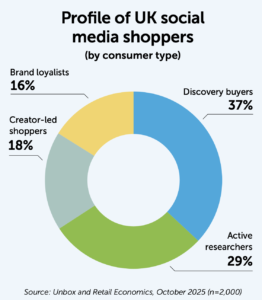
Research from social commerce agency Unbox and research consultancy Retail Economics among 2,000 UK consumers puts the scale of the shift in sharp relief. Almost half of the adults surveyed (47%) have already bought directly through a social platform. That figure rises to 78% among Gen Z consumers.
TikTok is the dominant force, accounting for 53% of all UK social commerce spend. Its seamless in-app checkout – where a viewer can go from discovery to purchase in under 30 seconds – has fundamentally changed how products get found and bought.
Over half of UK adults (51%) expect that social platforms will account for a greater share of their online purchases in 2026. At 66%, that figure is even higher among TikTok users. These numbers mean that social platforms are no longer a niche, but a mainstream retail channel.

PetTok: a ready-made audience
For pet brands specifically, the opportunity has a name: PetTok. Around the world, the pet content ecosystem on TikTok and Instagram is one of the most engaged communities on social media.
Consider what this means in commercial terms. A pet food brand partnering with a creator whose rescue greyhound has 600,000 followers isn’t just buying an impression – it’s buying into a community of highly engaged, passionate pet owners who take that creator’s product recommendations seriously.
The research confirms that trust has fundamentally shifted: Gen Z consumers are now twice as likely to trust a content creator (43%) as they are a brand’s own advertising (22%).
The pet category is particularly well suited to this trust economy. Owners are deeply invested in the health and happiness of their animals. A vet-trained creator recommending a joint supplement, or a dog trainer walking through why a particular harness fits better, is content that converts, because it’s content that genuinely helps.
Turn paradox into opportunity
And yet, here’s the paradox: despite all that organic consumer passion, pet care remains one of the most underserved categories in social commerce relative to consumer demand. Fashion, beauty and other fast-moving consumer goods dominate social commerce spending today. Pet brands, by and large, are still watching from the sidelines. That gap is an opportunity.
The pet brands that start working to establish a credible, scaled presence in social commerce will accrue significant first-mover advantages. Creator relationships take time to build. Affiliate networks take time to optimize. The algorithms reward consistency. The players that move decisively now will find themselves in a structurally stronger position as the channel matures – and as competitors begin to catch up.
The risks are real
Unbox research shows that a significant proportion of affiliate content produced by global brands contains some form of reputational safety risk – from unverified product claims to misrepresentation of brand values. This is why the conversation needs to become more serious – because, in the pet category, the brand safety stakes are higher, more acute and more consequential than in almost any other sector.
For pet brands, the specific risks are:
Unverified health and ingredient claims
Pet nutrition is a complex, regulated area. A creator claiming that a pet food is “grain-free and vet-recommended” without verification is not just a brand safety issue; it’s a potential regulatory and reputational crisis. Misleading claims about ingredients, allergens or health benefits can cause real harm to animals and expose brands to significant legal liability.
Pseudoscientific veterinary endorsements
The pet category is particularly vulnerable in cases of content that implies veterinary endorsement without substantiation. A creator in a white coat saying “As a vet, I recommend…” – when they are not a vet, or a product not being independently assessed – is precisely the kind of content that can spread rapidly on social platforms, and exactly the kind of content that regulators are increasingly scrutinizing.
Animal welfare
The treatment of animals in the content itself matters. Pets dressed in restrictive clothing for entertainment purposes, animals placed in stressful situations for comedic effect, training methods shown in videos that conflict with positive reinforcement or welfare standards – all of these create the risk of reputational damage for any brand whose products appear in that content.
The challenge is one of scale. With hundreds or even thousands of creators participating in TikTok Shop’s affiliate program, it is operationally impossible to manually review every video. And yet every unreviewed video carries these risks.
The answer: better governance
For risk-averse pet brands, the temptation is to move slowly or stay away from social commerce altogether. But that is precisely the wrong conclusion. The answer to the risks of unmanaged scale is not less scale; it is better governance.
For pet brands, governance across the creator ecosystem means:
-
Automated content review for claim verification and brand safety flags
-
Structured briefing frameworks that give creators clear guardrails on ingredient language, health claims and animal welfare standards
-
Creator vetting that goes beyond follower counts to assess alignment with brand values
-
Performance analytics that link creator activity directly to verified commercial outcomes
This isn’t about constraining creativity. The best-performing content in social commerce is authentic, entertaining and genuinely useful – not corporate. The goal is to create the conditions under which creators can be themselves, while the brand remains protected.
Three priorities for pet brands
For pet retailers and brands looking to build a serious social commerce presence, the strategic priorities are clear:
1. Move now, but move deliberately
The category is underserved and the moment to establish presence is now. But the answer is not to open the affiliate floodgates and hope for the best. Build your creator program with the same rigor you would apply to any other sales channel – with clear criteria, proper briefing and systematic review.
2. Make trust your differentiator
The broader consumer trust challenges in social commerce – authenticity concerns, skepticism about product claims – are an opportunity for reputable pet brands to stand out. Verified ingredients, genuine veterinary partnerships and transparent welfare standards are credentials that resonate powerfully in a creator-driven environment where trust is currency.
3. Invest in infrastructure, not just content
The brands winning in social commerce treat it as a core business function, not a marketing experiment. That means bringing together commerce, marketing and data teams, investing in technology that provides visibility and control across the creator ecosystem, and building the operational capability to move at the speed the channel demands.
The bottom line
The pet industry has one of the most passionate, engaged consumer communities on social media. PetTok is not a niche phenomenon. It is a commercial ecosystem of extraordinary scale and reach, and it is still comparatively untapped by serious players.
The brands that understand both the opportunity and the specific risks offered by the pet category are the ones that will define this channel. The infrastructure to succeed in doing this now exists. The question is simply: who moves first?
Share this story:
One click prioritizes GlobalPETS in your search results and AI answers.