China: Pets in a powerhouse economy

With the Chinese pet market showing healthy numbers, the government is investing in the sector as one that offers valuable growth opportunities.
Urban dog and cat market sales in China reached approximately $43.4 billion (€38.2B) in 2025, marking a 4.1% year-over-year (YoY) increase – higher than the overall retail sales rise – despite pet population growth slowing to below 2%, according to the 2026 China Pet Industry White Paper.
Premiumization drives sales
The pet market figures also highlight a continued rise in per-pet spending, reflecting the market’s transition from volume-led expansion to value-driven growth. Premiumization remains strongest in first-tier and pet-friendly cities such as Beijing, Shanghai, Chengdu and Guangzhou, while consumers in lower-tier markets remain more price-sensitive.
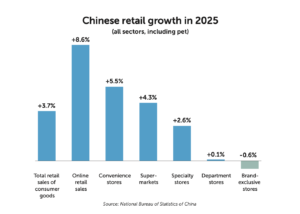
Total retail sales of consumer goods in China also continue to rise, reaching $7.5 trillion (€6.6T) in 2025. This was, according to the National Bureau of Statistics of China (NBS), a 3.7% YoY increase. Data for the first half of 2026 gives total retail consumer goods sales of $4.3 trillion (€3.8T), a further increase of 1.2% YoY.
This data fuels official preliminary estimates of a GDP of $20.9 trillion (€18.3T) in 2025, an increase of 5% YoY. The tertiary sector (the service and distribution industry, which includes retail) recorded the best performance and growth rate in the country last year, up 5.4% YoY.
Felines at the forefront
Cats continue to outpace dogs in both population growth and consumer spending. China’s urban pet population reached 126 million in 2025, up 2.2 million or 1.8% YoY. The dog population rose by 1.6% YoY to 53.4 million, while the cat population reached 72.9 million, increasing by 1.9% YoY.
Spending grew across both market segments. The White Paper reports an annual increase of 1.5% in spending per urban pet dog, reaching $448 (€394) in 2025. Annual spending per cat was $311 (€273), up 3.2% YoY.
The overall Chinese market in 2025 was led by convenience stores (5.5%), supermarkets (4.3%), specialty stores (2.6%) and department stores (0.1%), proving the strength of formats that offer proximity and utility. Sales at brand-exclusive stores, on the other hand, fell by 0.6% YoY.
The H1 figures for 2026 show some interesting differences in the growth of channel sales compared to last year. Convenience stores, for example, are up by 6.1% YoY, supermarkets by 3.8% and specialty stores by 1.8%. Sales in department stores have gone up by 2.4%, and brand-exclusive store sales seem to have picked up a lot, with a substantial 9.3% rise YoY.
Annual online retail sales reached $2.4 trillion (€2.1T) in 2025, which represents a strong 8.6% YoY growth. NBS reports that physical goods accounted for 82% of online sales during the year, and that this was driven by food, clothing and daily necessities.
Pet parents more likely to buy online
Sory Park, Project & Content Manager at market research company Daxue Consulting, tells PETS International that online channels are dominant in the pet segment. According to KPMG’s 2025 China Pet Industry Market report, 68.1% of pet owners prefer online channels when purchasing products, including pet food.
Suki Tan, Account Executive at market research provider Kantar Worldpanel, points out that the importance of e-commerce in the pet food market significantly exceeds the FMCG industry average. As a comparison, while almost seven in 10 pet owners buy products and food online, only three in 10 consumers make online purchases overall.
Promotions and trials
Tan believes that online has become the first choice for consumers thanks to the convenience of home delivery, diverse product offerings and the numerous promotions available. “Data from 2024 shows that Chinese pet e-commerce has a promotion index of 117,” she explains. That means the share of discounted products online is 17% higher than the average in the whole omnichannel chain.
The Account Executive also highlights the role of e-commerce in allowing producers to try new formats. “It serves as a critical platform for brands looking to launch trial-sized packs, especially in the dry pet food category, where the e-commerce sales volume share of trial packs is significantly higher than offline.” For instance, sales of packs smaller than 200g are 17% higher for cat food and 8% higher for dog food compared to other channels.
The role of physical stores
Brick-and-mortar options are still relevant for reaching the Chinese pet owner, especially in a discovery phase. “Convenience stores, supermarkets and specialty stores complement online. These offline channels remain important, largely due to the high-trust and service-based offerings that online can’t fully provide,” Park says. She notes that pet retailers providing services like grooming, medical care and boarding can justify assortments with fewer SKUs and higher price points than online channels.
Kantar data shows that offline channels represent less than 30% of total outlet value share. “Within the offline landscape, it is pet stores, pet hospitals and hypermarkets that serve as the dominant retail channels,” Tan states. This type of retail also serves a purpose in attending to immediate needs.
Smaller sizes and premium
According to Kantar, this is backed up by the sales performance of sub-2kg product sizes – which usually fulfill short-term requirements. These have a 10% higher share of cat food sales and a 27% higher share of dog food offline, in comparison to the omnichannel average.
Chris Li, Global Marketing Director at China Great Wall International Exhibition, says that while pet specialty stores and veterinary clinics drive the growth of premium staple food, functional nutrition products and higher-value pet supplies, it is instant retail and online-to-offline integrated formats that are expanding rapidly for daily consumer products.
According to the US Department of Agriculture Foreign Agricultural Service report, China: Pet Food Market Update 2026, food is still the largest segment within China’s pet care market, accounting for 53.7% of total spending. This is driven by rising demand for food, treats and other nutritional products.
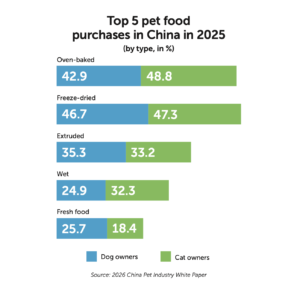
Pet consumers are now showing a stronger preference for poultry-based recipes and high-quality protein sources. Both cat and dog owners are more interested in freeze-dried, baked and fresh products, while among dog owners there is also demand for wet staple diets, with fresh food and wet staple products recording the fastest growth.
Cat owners increasingly favor air-dried products, while baked diets and fresh food remain the fastest- growing categories in this group. The trend is driven by perceived benefits, which include improved nutrition, digestibility and palatability – particularly a factor among younger urban pet owners.
Market dynamics and import costs
Last year, the Customs Tariff Commission of the State Council announced that China had increased the import tariff on retail packaged pet food, including dog and cat food, from 4% to 10% under the MFN (most favored nation) provisional tariff rate, applying the measure to all countries of origin.
The tariff hike, combined with higher logistics expenses and currency fluctuations, has put further cost pressure on imported pet food and prompted price-sensitive consumers to shift toward domestic alternatives.
This has created additional opportunities for Chinese brands to gain market share in categories traditionally dominated by imports.
Foreign brands priced above $16.70 (€14.70) per kg continue to dominate the premium segment, particularly among higher-income pet owners. Meanwhile, domestic brands are leading the mid- priced segment, with products ranging from $4.20 (€3.69) to $8.30 (€7.29) per kg, according to data from the US Agricultural Trade Office in Shanghai.
Concerted development efforts
The Chinese government sees the pet segment as a key sector for development. In November 2025, the Ministry of Industry and Information Technology, alongside five other government departments, unveiled a “comprehensive plan to improve the alignment of the supply and demand of consumer goods”, as an attempt to “tap the potential of its super-large market and provide sustained momentum”, according to the government press release at the time.
The plan defines investments to foster new consumption sectors, promote consumer goods in rural areas and increase the supply of certain goods in the Chinese market. Apart from the total amount of $440 billion (€390B) to be allocated to segments such as elderly care products and consumer electronics, the government will invest $14.9 billion (€13.1B) in categories that include pet food and products.
Consumer behavior will also be a key driver for the country in the coming years. The government approved its 15th Five-Year Plan for National Economic and Social Development in March, a document that establishes guidelines for the period from 2026 to 2030.
This plan emphasizes China’s economic goal of expanding domestic demand to increase consumer spending.
Share this story:
One click prioritizes GlobalPETS in your search results and AI answers.
