Circling back: rethinking pet food packaging
As Europe enforces stricter recyclability and recycled-content requirements, the industry needs to balance cradle-to-cradle principles with safety, shelf life and operational demands.
The EU’s Packaging and Packaging Waste Regulation (PPWR) started to come into effect in August. It is accelerating the transition to sustainable practices right across the pet industry’s packaging sector, while prompting companies to reformulate products and adapt their packaging strategies.
From voluntary to mandatory
The PPWR’s goal is to move circularity from a voluntary corporate objective to a regulatory requirement for market access across EU member states. In practical terms, this represents a significant milestone for the European packaging industry.
As voluntary sustainability ambitions become market access requirements, companies face a range of challenges, says Martina Schildendorfer, Innovation & Product Sustainability Manager at Constantia Flexibles, a manufacturer of flexible packaging for consumer and pharmaceutical products.
“Food protection remains the top priority, and the challenge is to develop packaging materials that both protect the product and can be effectively recycled at the end of their life,” she explains. Schildendorfer goes on to say that features designed to protect food can make recycling more difficult in some applications. “The task is to engineer solutions that achieve both.”
Fitness for purpose
For the pet food industry, one of the key challenges is balancing circularity with packaging performance. Adam Ferguson, Senior Global Marketing Manager at Huhtamaki, a supplier of sustainable packaging headquartered in Finland, says: “Improving circularity cannot come at the expense of the essential functions. The packaging must remain fit for purpose.”
For Coveris, the challenge is to balance three priorities: maintaining the product protection required by pet food applications, delivering the visual and functional performance expected by brands and consumers, and ensuring that packaging can be effectively recycled. Renaud Gautier, Key Account Manager for Pet Food at the Austrian packaging company, explains: “Recyclability is no longer an additional sustainability feature. It is becoming a core design requirement.”
Designing for recyclability
As Gautier says, this means that recyclability needs to be considered from the earliest stages of packaging development, rather than being addressed once the design is already established. “High-quality graphics, finishes and shelf appeal remain important for pet food brands, but inks, coatings and decorative elements must increasingly be assessed for their impact on recycling,” he points out.
The industry is therefore moving toward eco-design: “Where material selection, product protection, branding and end-of-life performance are considered together,” says Gautier. The goal is not necessarily to eliminate all complexity, but to use it more selectively: fewer incompatible materials, carefully engineered barrier layers and packaging structures designed to work within established recycling streams.
No universal response
For packaging suppliers and pet food manufacturers, compliance requires significantly more than replacing non-recyclable laminates with recyclable alternatives. It demands a full re-engineering of flexible packaging structures to balance regulatory requirements with rigorous product safety, shelf life and processing standards.
Carlos Trubacz, Head of Product Sustainability, Flexible Packaging at Mondi Group, explains that the regulatory impact on pet food packaging goes “far beyond” replacing a material with a recyclable alternative: “The common thread is that circularity is becoming another core performance requirement. The task is to address it alongside product protection, machinability, convenience and cost rather than optimize one at the expense of another.”
Trubacz also says that meeting circularity criteria requires sophisticated material engineering rather than basic substitution. “Pet food demonstrates particularly clearly why recyclability cannot be considered in isolation,” he states. Industry insiders agree that the challenge is to engineer recyclability into structures that continue to perform under demanding conditions. “There will, therefore, not be one universal packaging response to PPWR across pet food,” Trubacz adds.
Multi-layer to mono-material
The PPWR’s impact on dry and wet pet food formats varies significantly. Dry pet food packaging, which includes large-format bags and stand-up pouches with resealable zippers, represents the area most active
in material conversion. The traditional multi-layer laminates used for dry food have been replaced in recent times by mono-material polyethylene (PE) or polypropylene (PP) structures.
This new type of packaging must, of course, maintain the resistance needed to protect products, while remaining compatible with existing filling and packing processes.
Mondi partnered with French dry pet food producer Saga Nutrition in 2025 to transition a product line to a mono-material structure designed for recycling. This provides high-barrier protection against moisture, fat and odor, while also offering secure sealing and durability for storage, shipping and handling.
Retort pouch sterilization
Mono-material retort packaging is now an established commercial option, although its adoption remains subject to demanding technical requirements. Packaging suppliers have developed recyclable mono- PP structures for retort applications – including stand- up and sealed pouch formats – designed to withstand thermal processing while maintaining seal strength, structural integrity and the barrier properties needed to protect product quality and shelf life.
Retort pouches are exposed to aggressive heat sterilization, typically at temperatures above 120°C, placing demanding requirements on the packaging structure, seals and barrier layers. Some solutions are also designed to run on existing filling equipment at industrial speeds, helping manufacturers to adopt recyclable structures without fundamentally changing their production lines.
The role of aluminum
Mono-material structures do not eliminate the need for conventional barrier materials in all applications. Where very high barrier performance and direct contact with products during high-temperature processing are required, aluminum-based formats remain widely used. As aluminum is highly valuable and retains its material properties through recycling, the PPWR imposes no minimum recycled-content targets for aluminum packaging.
The regulation does, however, require the European Commission to – by 2032 – review whether measures or targets should be introduced for recycled content in non-plastic packaging, and this could potentially include aluminum.
Gerald Griessler, Product Manager Pet Food with responsibility for aluminum development at Constantia Flexibles, says: “The recycling content for aluminum is an important lever, but it primarily drives decarbonization rather than improving the material’s already very high recyclability.”
Prospect of secondary legislation
A significant operational challenge for the packaging sector is the timing of the EU’s secondary legislation. While the PPWR establishes the 2030 deadline, many of the detailed rules defining how packaging must be designed and assessed for recyclability are being developed separately.
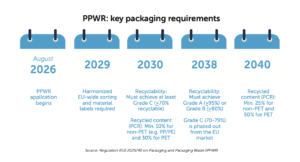
From 2030, packaging placed on the EU market will need to comply with harmonized Design for Recycling criteria. This means that manufacturers will need to make investment and packaging decisions before all the technical requirements are fully established.
Another complication is that the delegated acts detailing the precise testing protocols and criteria for evaluating each packaging format’s recyclability are not scheduled for adoption by the European Commission until January 2028. Ferguson says: “Huhtamaki would be cautious about describing any specific product as fully ‘PPWR compliant’ at this stage, because several technical requirements and implementing acts are still being defined.”
Trubacz echoes the complexity of planning during this transition window, saying it creates a “significant implementation” challenge for Mondi and other manufacturers, as packaging development takes time, and companies need to prepare now, while some of the criteria against which future packs will ultimately be assessed are still being finalized.
Industry support
The European pet food industry broadly supports the PPWR objectives. According to the European Pet Food Industry Federation FEDIAF, manufacturers have already been working for years to improve packaging. “Packaging performs an essential function for our sector. It’s crucial for delivering safe pet food, preserving nutritional quality and maintaining product integrity throughout the shelf life,” Deputy Secretary General Franco Garbelotto tells PETS International.
Creating a clear way forward
Garbelotto says that any transition “needs to be delivered in a way that maintains these functions while improving recyclability and reducing waste”. With the PPWR’s phased requirements now beginning to apply, FEDIAF is focusing on helping pet players to navigate implementation by providing practical and harmonized support.
“Clear and consistent guidance, realistic timelines and the European Commission’s timely adoption of implementing and delegated acts are essential to give companies the certainty they need to invest and adapt,” Garbelotto adds. FEDIAF will continue to engage with European institutions to support the regulation’s environmental objectives, while ensuring that changes to packaging safeguard the safety and integrity of pet food.
Meeting recycling targets
Minimum post-consumer recycled (PCR) content mandates represent another major consideration under the PPWR. While mechanically recycled polyethylene terephthalate (PET) is approved and widely used for direct food contact, mechanically recycled PE and PP thin films currently lack the purity and performance needed for demanding applications such as retortable pouches.
Supplies of high-purity PCR material are expected to become limited as deadline dates approach. Constantia Flexibles warns that a material supply gap is likely by 2030, while official EU calculation and verification methodologies for PCR percentages are only expected by late 2026. The company offers some clear guidance. “Our message to customers is simple: start now so you’re ready in 2030, instead of competing for material at the last minute,” Schildendorfer says.
Waste infrastructure challenges
The PPWR introduces a requirement that packaging must be recycled “at scale” across EU member states by 2035, tying product design directly to waste management infrastructure. “To realize the full benefits of the regulation, Europe will also need continued investment in collection, sorting and recycling infrastructure, stronger markets for recycled materials, and well-functioning extended producer responsibility schemes,” Ferguson says.
Coveris has a No Waste vision and strategy, which focuses on advancing circular packaging solutions and keeping plastic in the value chain. Gautier explains: “Closing the loop requires not only designing packaging for recycling, but also matching packaging structures with the most appropriate recycling technologies.”
Mechanical, chemical and solvent-based recycling can play complementary roles depending on the application. Through its ReCover waste management process, Coveris is also developing its own recycling capabilities and models, helping to recover plastic waste and return it to the packaging value chain.
Rethinking the role of suppliers
When asked about the evolving role of packaging manufacturers, Trubacz points out that suppliers must now serve as strategic partners through this transition. He concludes: “Overall, PPWR changes the design equation for pet food packaging.”
For packaging producers, that means “moving beyond simply supplying a material or format” and increasingly helping customers to navigate the transition from regulatory requirements to packaging solutions that are technically robust, industrially viable and compatible with the recycling systems of the future.
Share this story:
One click prioritizes GlobalPETS in your search results and AI answers.