Country report: Vietnam and Cambodia – Rising middle class drives pet boom in neighboring nations

Increased ownership of cats and dogs in the big cities is boosting demand for premium food, accessories and services as well as for online shopping.
Shifting cultural attitudes to pets, a greater understanding of their health and wellness, and more disposable income are the factors driving Cambodia and Vietnam’s pet industries. Both markets show significant signs of growth and maturity, especially in urban hubs such as Phnom Penh and Ho Chi Minh City.
Retail and services boom
Industry players in the region have seen a rise in the number of pet owners in recent years – especially among the younger generation. In Cambodia, with a population of 17.6 million, this trend is going hand in hand with an increased number of pet accessory stores and grooming businesses in the country’s main cities.
“Just 10 years ago, there were only a couple of vets operating in Phnom Penh, and a handful of pet supply stores,” says Yulia Khouri, founder and CEO of Animal Mama, a large shelter with multi-service veterinary clinics in Phnom Penh and Siem Reap. “Today, you can find a groomer, pet shop or boarding kennel on pretty much every corner. There’s been a huge boom.”
Urban dog parents
In Vietnam, a country with 101 million inhabitants, it is very much the same story as in Cambodia. According to TGM Research, awareness of health and quality – as well as an increase in pet parenting – are driving rapid market expansion.
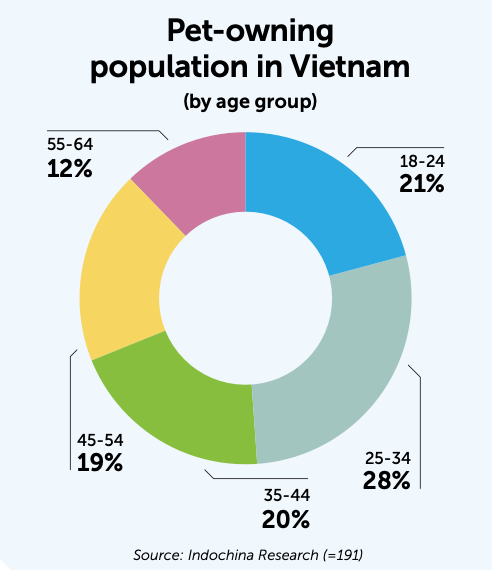
Indochina Research has found that pet ownership is higher in urban areas, with about 25% of the residents of Ho Chi Minh City keeping pets and 18-19% in Hanoi and Da Nang. Interestingly, dogs are twice as popular as cats among urban respondents to a survey conducted at the end of last year.
Growing appetite for better quality
Figures from Statistica reveal that Cambodia’s pet food industry is projected to hit $25.8 million (€22M) by the end of 2025, with the market predicted to reach a CAGR of 10.1% between 2025 and 2030. Industry experts say this highlights the vast opportunities for international and domestic expansion, with continued growth forecast for the future.
While Khouri believes there is an oversaturation of pet food products on the market, there has also been a change in pet owners’ attitudes to food. “People are now asking better questions than even 5 years ago, in terms of what do you feed your animal? We’re slowly moving from feeding cats rice, for example, to realizing that they are obligate carnivores and need animal protein,” she says.
“There are only a few brands that are made in Cambodia,” says Pov Bun, Sales Manager at Royal Canin Cambodia. “About 5 years ago, most pet food products were imported from Thailand and Vietnam, but this wasn’t good quality. Many owners also used to feed their pets rice, scraps of food or bones. Now they have a better understanding of animal health and are seeking higher-quality products.”
Bun attributes this shift to an increase in disposable income, heightened exposure to social media showcasing designer dogs and cats, as well as increased public awareness about pet care. As pet parents become better informed, demand for higher-quality products is changing the market.
Natural and organic
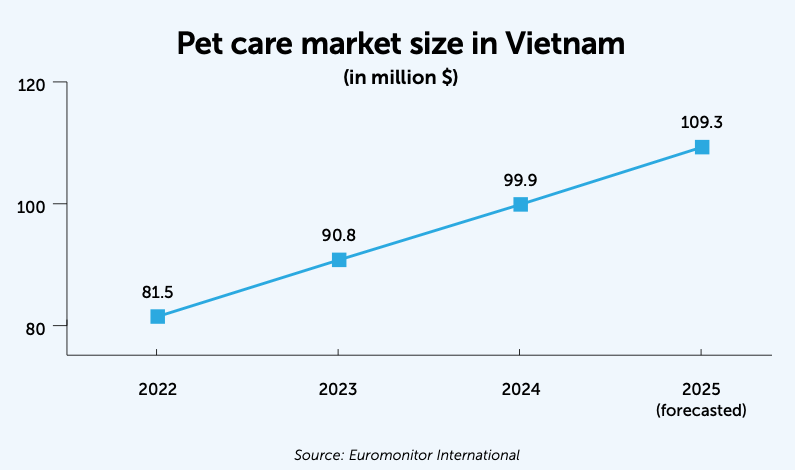
In Vietnam, pet food market revenue is estimated to reach $87.3 million (€74.5M) this year, growing annually at a CAGR of 7.8% through to 2030. It is expected to show a growth in volume of 5.2% in 2026. The country’s rising number of pet owners are often looking for specialized food products that cater to specific health issues. This is predominantly driven by the younger generation.
Nguyen Thi Anh Phuc is Brand Strategy Team Leader at Fusion Group, a distributor of pet food and accessories based in Hanoi. “There is growing demand for premium food that has natural and organic ingredients. We’re also starting to see more pet owners wanting to feed their pets with human-standard food.” She says this has come with the rising awareness of pet health and care.
Highlighting the shift in demand, US pet food exports to Vietnam rose by about 60% between 2021 and 2024. However, China – with its lower production costs – remains the dominant market supplier, with Chinese exports to Vietnam shooting up by 497% during the same period.
Pet care products peak
Cambodia’s pet care products market is also on the rise. According to 6Wresearch, the market size is forecast to reach a CAGR of 6.5% between 2025 and 2031. Meng Chou of Pet Store Cambodia has noted a surge in demand in recent years, not only for high-quality pet food, but also for grooming products and accessories.
“The number of dog and cat owners has grown in Cambodia in the last 5 years. We have noticed that middle-class youth in particular – often influenced by what they see on social media – want pet accessories such as outfits and toys,” she says, adding that hamsters and rabbits have become the pets of choice for young people.
Grooming and fashion
Khouri says that a major factor driving this shift in attitude derives from an increase in the humanization of pets in Cambodia. “Before, dogs and cats had to work. A cat was only useful if it caught mice and rats, and a dog was supposed to guard the house. More and more, we’re seeing pets being regarded as family members – and cared for as such,” she adds.
TGM Research findings show that the youth in Vietnam are also driving the growing trend of pet clothes and accessories, with 72% saying they buy these products.
“Owners are starting to take more notice of their pet’s health and wellness. This has led to an increased interest in grooming services. Young people also want to personalize their pet’s look, so are buying pet clothes and accessories for them,” says Thi Anh Phuc.
Online sales soaring
Cambodia is home to one of the youngest populations in Southeast Asia, with approximately 60% under the age of 35 as of April 2025, according to the UN. The country has 19.6 million internet subscriptions and 21.9 million mobile phone subscriptions, with the nation’s e-commerce industry predicted to grow from $1.1 billion (€0.9B) in 2024 to $1.8 billion (€1.5B) by 2029, according to a report by Phnom Penh-based consultants Profitence.
It attributes this growth to a rise in young, tech-savvy people drawn to the convenience of online shopping. The increase in e-commerce platforms, such as Shopee and Lazada, as well as a surge in Facebook sellers and dedicated Cambodian-based online pet stores, including Petzo, has contributed heavily to market expansion, according to Chou.
“The younger generation has a habit today of buying everything online. It’s convenient, competitively priced and offers home delivery. This has also been helped by the expansion of digital payment systems in Cambodia, especially since COVID-19,” she says.
In contrast, Vietnam has a much larger population and a higher average age of 32.5. As of February 2024, it had 80 million internet users and 127 million mobile connections. Its e-commerce industry is projected to reach $27.7 billion (€23.6B) in 2025, growing to about $44 billion (€37.5B) by 2027.
While online sales are showing definite signs of growth, making up about 30% of revenue share in 2025, pet shops and supermarkets remain the dominant choice. However, with online expected to account for more than half of the market share by 2029, e-commerce in Vietnam holds massive potential.
Share this story:
One click prioritizes GlobalPETS in your search results and AI answers.