Emotional gifting drives growth during key shopping events

Pet parents are increasingly likely to buy gifts at special moments – both as a display of their affection and to take advantage of attractive discounts and promotions.
Do holiday periods and promotional days like Black Friday really boost the sales of pet products? US and European findings from recent surveys monitoring purchase intent, plus analysis of online product searches and retail sales reporting, help to quantify the extent of this phenomenon.
US owners love Valentine’s Day
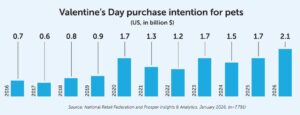
A record 35% of consumers planned to purchase gifts for their pets during Valentine’s Day in the US this year, according to a survey by the National Retail Federation (NRF) and consumer-based intelligence firm Prosper Insights & Analytics. This percentage is the strongest in recent years, continuing a steady rise that started with a jump from 20% in 2019 to 27% in 2020.
Not surprisingly, total spending on Valentine’s pet gifts was also set to hit a high. The survey, conducted among 7,791 consumers in January 2026, revealed that these American pet parents were planning to spend a total of $2.1 billion (€1.8B). That is a huge increase when compared to sales amounting to $0.9B (€0.8B) in 2019 and $1.7 billion (€1.5B) in 2020 and again in 2025, even when taking inflation into account.
For Phil Rist, Executive Vice President of Strategy at Prosper Insights & Analytics, holidays such as Valentine’s Day tend to “underscore the value of relationships”, celebrating not only love, but also connection and affection. So purchases on occasions like these are very much driven by emotion, which explains why pet gifts are increasingly taking a larger share.
This emotional dimension is reflected in how pets rank among all gift recipients. For instance, they are given more presents than the respondents’ other social groups, such as friends (33%), children’s classmates or teachers (27%) and co-workers (21%).
Treats and special occasions
The US is not the only country where owners celebrate with their pets. On average, half of the pet parents in the UK planned to buy them gifts for Christmas and Valentine’s Day in 2025, according to findings from two separate surveys of 2,000 consumers conducted by pet insurers Petplan and Agria Pet Insurance.
Agria found that some 39% of pet owners would consider their pet their true love, and this is even higher among female owners (43%). Petplan reported that Christmas gifts last December averaged £42 ($57/€48) per dog and £28 ($32/€38) per cat. But the company found that one in four pet owners spend less at between £10 ($13.4/€11.6) and £20 ($26.8/€23.2).
A survey of 2,000 adults conducted by the UK pet retailer Pets at Home in October 2025 showed that one in five owners were planning to spend more on their pets at Christmas than on any other family member. The retailer then saw a 258% surge in Valentine’s Day gift purchases in January 2026 compared to the same period last year.
According to the company, dog customers are spending on average £4.72 ($6.4/€5.4) on themed products – a 3.5% increase compared to 2025. Spending on a cat’s gift was slightly less, £3.63 ($5/€4) on average, but a 66.1% rise year-over-year (YoY).
Dressing up for Halloween
Although they don’t necessarily receive gifts, pets are sometimes included in consumers’ Halloween shopping in a different way. In the US, 23% of owners planned to dress up their furry friends for the occasion, according to a survey by NRF among 8,045 respondents in September 2025.
This intent led to a total forecast of $860 million (€738M) in spending on pet costumes, up from $700 million (€645M) the previous year. And a survey of 1,000 owners conducted by MetLife Pet Insurance in the same month revealed that one in five (20%) Americans say they invest over $50 (€46) in their pet’s Halloween costume.
What kinds of items are pet parents buying?
According to a Deloitte survey of 4,270 consumers in the US regarding general holiday spending last year, almost one quarter (23%) of all respondents planned to purchase pet food and treats as gifts, while 22% planned to buy toys, decor and accessories.
These numbers are slightly down from 2024, when food and treats were chosen by 26% of respondents and non-food items by 25%. This could have been partly the result of a new category in the Deloitte survey: pet tech (e.g. GPS trackers, auto-feeders and smart collars), which was chosen by 2% of respondents.
The Petplan survey in the UK showed a similar pattern, with 64.5% of pet parents saying they typically buy treats for their dogs and cats at Christmas, and 59.5% showing a preference for toys. Other popular gifts included beds and blankets (27.5%), personalized items (18.5%) and grooming products (17%).
UK dog food manufacturer Pooch & Mutt, which sells holiday-themed limited-edition treats, says these products perform well because they are low priced, increase the buyer’s basket size and give retailers “something fresh to merchandise”, according to CEO Paul Dennison.
Holiday retail peaks worldwide
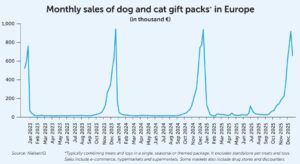
Consumer intelligence firm NielsenIQ’s European market data for 2025 also showed that, within the pet food sector, gift and selection packs and bundles reached a sales peak of almost €1 million ($1.15M) during the Christmas weeks, while the annual average is €112,000 ($129,400).
The broader festive retail period shows a similar dynamic for total pet care, as activity peaks. According to NielsenIQ, the six weeks of holiday sales in the US (last two weeks of November and four weeks of December) in 2025 reached a revenue of $8.6 billion (€7.4B). This represents a 6% rise from an average six-week period in the full calendar year, which stood at $8 billion (€6.9B).
The biggest differences were reported in pet accessories other than beds, toys and travel items, with purchases of these during the holiday period up as much as 119% more than the average, followed by toys (up by 75%) and beds (up 46%).
In Europe, NielsenIQ reported a rise of 5% in sales for main meals during Christmas 2025, compared to the off-season average, and a surge of 11% in care and treats, “indicating that holiday gifting and indulgence behaviors extend strongly to pets”, the company notes. Globally, weekly pet food activity during the Christmas period (the four weeks ending 28 December 2025) corresponded to 8.11% of annual sales.
Seasonal comparisons
Despite the growing inclusion of pets in other celebrations, Andrea Binder, Thought Leader in Pet Care for NielsenIQ, says that the trends in pet gift purchasing are still not as strong during those periods as the upticks that have been reported for Christmas and Black Friday.
“We do know there are seasonal influxes of products for holidays such as Halloween and Easter in the US, but we don’t see these products driving a significant enough lift to change the average category spend in those weeks or months,” she explains.
Across all channels
Extra pet gift spending for special moments is spread across virtually all retail channels in the US, with the weekly average outlay on pet care items generally higher during November and December compared to the annual average, according to NielsenIQ data. But the difference is greater for Amazon, with revenue that was 10% higher during holiday periods, followed by retail giants such as Walmart and Target, at 9%.
In Europe, the biggest revenue growth during the holiday season was reported on e-commerce platforms, mostly coming from online sales at grocery retailers, where sales increased by 11.41% YoY. The category also saw a more modest increase in pet stores, at 3.12%.
Surges in search demand
In addition to actual purchases, holiday season momentum is reflected in online searches for pet supplies. This means that more owners are actively looking for particular items as gifts for their pets rather than just buying on impulse.
According to Algolia, an AI-powered platform that provides retailers with search software, online searches for pet products and accessories during last year’s Black Friday and Cyber Monday period surged by 81% across the e-commerce sites it serves in the US compared to 2024.
This was the biggest leap among all the product categories it measures, the company says. For example, the apparel and fashion category jumped by 51%, health and wellness climbed by 41%, and home goods rose by just 16%.
The data intelligence platform Similarweb also found an increase in visits to three major pet retailer websites in the last quarter of 2025. Among US online retailers, Chewy went from 41.5 million visits in October to 47.4 million in December, while PetSmart rose from 14.4 million to 17.2 million in the same period. And UK-based Pets at Home saw an increase from 4.2 million to 5.2 million hits.
Data points to opportunities
Although celebrations such as Halloween, Valentine’s Day and even Easter are emerging as activity drivers for the pet category, revenue growth remains concentrated in the traditional Christmas holiday period.
Binder mentions another reason for these gift purchases: “Humans spending more on their pets during holidays is likely also tied to decreased birth rates and couples choosing to acquire a pet as they delay or choose not to have children.”
For brands and retailers, data showing the appeal of bundles and gift packs points to an opportunity to increase sales by focusing on promotions and seasonal merchandising. Binder concludes: “Gifting occasions offer opportunities to drive value-led growth, with consumers increasingly opting for premium brands across many categories.”
Share this story:
One click prioritizes GlobalPETS in your search results and AI answers.
