Gaining an edge in Amazon Vendor Negotiations

Despite making high demands, the e-commerce giant is significantly reliant on pet brands. How can producers leverage this dependency to their advantage?
Manufacturers often enter negotiations with Amazon believing that the online marketplace holds all the commercial clout. But according to new research, pet companies can secure stronger outcomes by preparing well and negotiating proactively and with confidence.
Tightening the grip
Every year, AVNs set the tone for a brand’s profitability in the year ahead. They were never a routine alignment on commercial terms. But now more than ever, AVNs have become a clear profitability checkpoint for European pet brands, as volume growth slows and Amazon applies renewed pressure on margins.
Against this backdrop, Amazon is doubling down on its own priorities: tightening its grip on retail margins, demanding CPDs and reallocating resources towards vendors who can deliver on net PPM ambitions.
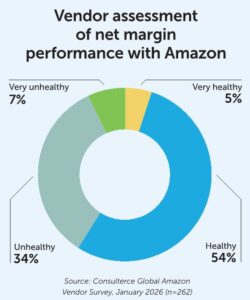
In a recent survey conducted among Amazon 1P vendors, only 59% rated their net margin performance with Amazon as ‘healthy’ or ‘very healthy’, down 1,400 basis points compared with the same period last year.
This reality requires manufacturer brands to treat Amazon for what it is: an online marketplace retailer that mandates a proactive approach to effectively protect and grow their top and bottom line.
Continued focus on profitability
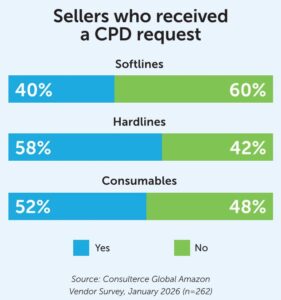
In the 2026 AVNs, 52% of surveyed CPG brands report receiving CPD requests from their vendor managers, with an average ask of -5.4% year over year.
While this is 85 basis points lower than in 2025, cost prices remain a material pressure point. For pet industry vendors from Europe in particular, this trend reflects the reality that US tariffs and broader geopolitical uncertainty have had a far more limited impact on selling prices than initially feared.
Crucially, Amazon is now using this regained certainty to roll back previously accepted cost price increases. Reinforcing that, vendor managers are actively reopening negotiations where external cost pressure arguments have weakened.
Negotiate proactively
In this environment, passively responding to Amazon’s margin asks is no longer a winning strategy. Instead, being proactive is the defining characteristic of successful vendor negotiations.
If your team understands the commercial levers and has the confidence to ask for initiatives that will help achieve your sales targets with the online retailer, you’re set to achieve much better outcomes than your less prepared peers. It is important that this preparation extends beyond your commercial team. Your finance, supply chain and marketing departments all play a direct role in shaping your profitability with Amazon.
Vendors who evaluate customer profit and loss through a holistic cost-to-serve lens are better positioned to uncover otherwise hidden cost centers and address them during negotiations. This may involve securing chargeback waivers or the introduction of supply chain initiatives such as WePay or Amazon Freight. This might not sound like much, but it can hold the potential to reduce shortages and improve your operational efficiency during peak periods.
Break down net PPM
Net PPM is the online retailer’s preferred profitability measure and the most consequential metric in every negotiation. Vendors who treat net PPM as an abstract formula will find themselves outmaneuvered. Those who break it down into its individual components can actively improve their negotiating position.
This includes leaning into retail promotions that favor high-margin ASINs, reviewing the introduction of online channel exclusives or adjusting advertising spend to amplify profitable segments of the existing catalog.
These actions don’t only improve your net PPM in the short term. They also provide evidence points for your brand’s successful portfolio mix management that can counterbalance Amazon’s requests for trade term increases or CPDs during negotiations.
Evaluate the ROI of trade investments
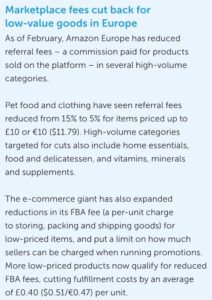
Still on the topic of trade terms, Amazon recently announced the reduction of FBA and referral fees for European 3P sellers, averaging -€0.17 ($0.20) per unit. At the same time, 1P vendors won’t see a reduction in trade terms unless they’re positioning this ask in their trade negotiations. Whether for base accruals, freight or damage allowances, make sure your team reviews and quantifies the return on investment (ROI) of each of these initiatives.
Vendor managers will often argue that certain investments are ‘mandatory’. However, the variance of these investments across brands and categories can be significant. Vendors that underpin their investment preference with data-led ROI examples, rather than anecdotes, create negotiating leverage and avoid being locked into unfavorable trade terms that negatively impact their net margins for years to come.
Reframe the AVS
One of the most debated investments in recent years is the Amazon Vendor Service. Its role in successfully navigating Amazon remains critical, yet its ROI has come under scrutiny. Many brands view AVS as a costly overhead. But when structured and managed strategically, it can become a powerful lever to unlock growth and protect margins.
The key lies in defining clear SLAs during the AVN. If AVS support has fallen short of expectations, this is the moment to set out the business-critical tasks you expect Amazon to deliver.
For example, if your brand frequently encounters product safety related PDP suppressions, get AVS to agree to reinstate listings within 48 hours of your team submitting the necessary documents.
Framing the ROI of AVS this way establishes clear guardrails. It defines what success looks like, ensures accountability and provides a structured basis for deciding whether your continued investment is justified, or whether your investment in AVS should be reviewed.
The key to AVN success
As outlined above, the key to profitable growth on Amazon is to negotiate proactively and with confidence. Too often, brands enter negotiations under the impression that Amazon holds all the commercial leverage.
In reality, Amazon’s dependence on leading pet brands remains significant. Vendors who approach discussions with clarity on their strategic value, backed by a robust understanding of their category position and relevance, are in a stronger position to push back on Amazon’s margin demands.
But remember: confidence is not about confrontation. It’s about professional assertiveness that’s grounded in (a lot of) preparation.
Share this story: