How can manufacturing facility projects better meet deadlines?

A recent survey indicates that 1 in 3 manufacturers now miss their target date when launching a new product or expanding production.
‘Move fast and break things’ might be a tech industry motto, but speed matters to any company looking to launch innovative products and capture market share in new and emerging categories – from software and seltzers to raw and clean-label pet food.
Obstacles to delivering on time
Yet in spite of this need for speed for companies looking to win market share, 1 in 3 manufacturers miss more than half their deadlines on projects such as production line retrofits and expansions, according to a survey of 396 US manufacturers conducted this spring by CRB, a global provider of sustainable engineering, architecture, construction and consulting solutions.
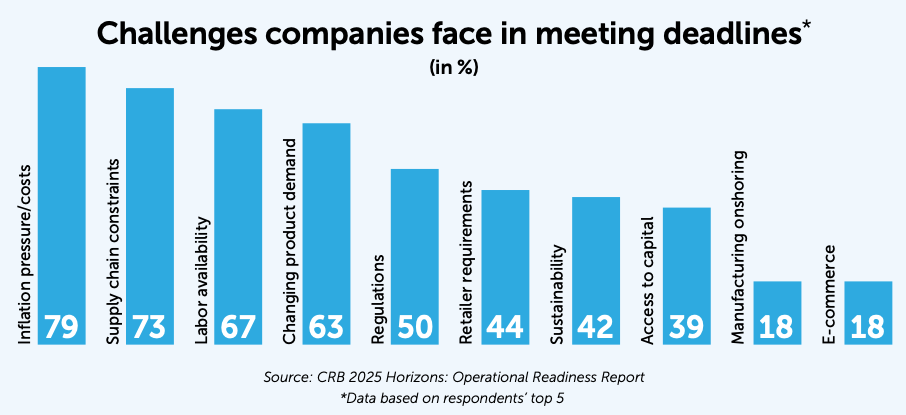
Although the survey was a first for CRB, Director of Client Engagement Ken VonderHaar suspects the situation is getting worse. A growing number of obstacles, such as inflation and lingering supply chain disruptions, mean companies are more likely to miss their deadlines than in the past.
“We do believe that it is now more challenging to meet in-service dates and to meet ramp-up volumes,” says VonderHaar. “There is a lot of pressure on the project team to deliver for lower cost, in less time and to promise a higher yield the first year, because you won’t get your project funded if you don’t.”
Planning ahead is vital
As with any deadline-driven project, planning ahead is key to success. But Drew Blank, Vice President of Product Management at engineering and building design company WEBBER/SMITH, says many of the corporate projects he’s seen miss production deadlines simply didn’t allocate enough time to the production line overhaul in the first place.
“Usually, for a renovation, expansion or new build, we would recommend a much longer timeframe,” Blank explains, adding that he would expect line process upgrades to take at least a year. Larger-scale renovations on existing facilities could span 2 or more years.
Finding workarounds
In his experience, companies set short deadlines for retrofit projects because company leaders want to cut costs and avoid downtime. But labor shortages and lingering supply chain disruptions can prevent manufacturers from realizing those deadlines.
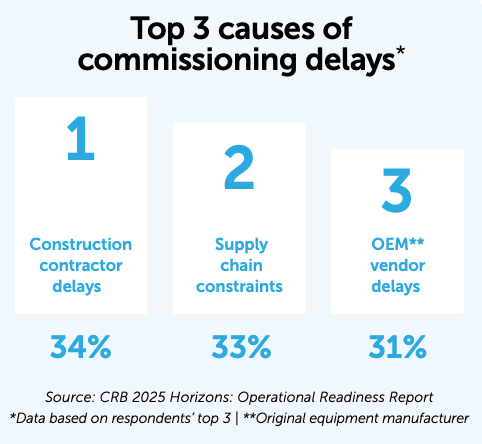
Transformers and electrical switches may require up to 52 weeks of lead time, Blank says, and this leads to potential delays when equipment isn’t ordered sufficiently early.
But VonderHaar says that there are some potentially creative workarounds. He has seen clients manage to keep projects on tight schedules by buying back-ordered equipment on eBay or even by 3D printing the parts and equipment that are needed.
Budgetary constraints
WEBBER/SMITH works for companies in the food and beverage industry, including pet food manufacturers. Budgets have become another major sticking point for many of its clients. Costs have not returned to their pre-pandemic norms, and companies that haven’t upgraded their processes or equipment since 2019 often find that their money doesn’t go as far as they might expect.
Projects can fall behind when clients decide to redesign or scale back after receiving the first round of estimates and being shocked by the price, Blank explains. So researching current costs upfront can keep projects on schedule. VonderHaar agrees: “A $10 million (€8.5M) project in 2019 could be a $20 million (€17M) project today.”
Companies with tight budgets and timelines might consider what they can do without major renovations, Blank says. For example, a pet food company that wants to move to human-grade processes could meet food safety standards with their existing facilities by simply retooling their procedures. Workers can be directed to avoid moving raw ingredients into an area with finished products, and standing water could be mopped up instead of installing drains and sloped floors.
Automation and AI
As with many industries, CRB has turned to automation and artificial intelligence to streamline and reduce time spent in the planning and design phases of a project. But, in many cases, VonderHaar says that automation has also become something of a project bottleneck. “Automation was a wonderful thing 20 to 30 years ago… and honestly we didn’t think, gee, someday they’re not going to make those anymore,” he says.
Ideally, companies would regularly remove and replace obsolete equipment. But, in reality, many have just kicked that can down the road, according to VonderHaar. That means a substantial number of CRB’s clients face a “deep hole” of outdated equipment that is difficult to replace. And this backlog may delay new projects when it becomes apparent that the automation on a new line won’t be able to communicate with existing systems.
Processes but also people
While there is ample opportunity for issues with supplies or construction to delay a project, the main reasons companies miss production deadlines relate to employee training, according to CRB. VonderHaar says: “If I have to buy new equipment, I’m going to spend a lot of time making sure it is made right, installed right, and utilities are run to it. I’m really going to focus on that machine. Most owners are pretty good at that.”
He has found that companies often miss their production deadlines – or fail to hit early production quotas – because they neglect the human elements of a facilities redesign. A machine might clog soon after a new line opens because the materials fed into it were out of spec. Or simply because the operators and maintenance teams don’t know how to address the clog when it happens.
Early employee training is key
Beginning employee training earlier in the process could help address this. And not just for employees who work the new line directly. Adding or renovating a production line also means updating maintenance teams on which parts they need to stock, quality control teams on the testing equipment they need, and so on, VonderHaar says.
Yet, according to CRB’s 2025 survey, just 51% of companies start thinking about things like employee training or updated operating procedures in the early stages of renovation or expansion. “What we’re seeing is that it’s not being done adequately,” VonderHaar says, “and the results are showing up as a delayed startup or extended ramp-up curve.”
Share this story:
One click prioritizes GlobalPETS in your search results and AI answers.