How to get the most out of online ratings

As the competition intensifies, brands that manage feedback strategically can gain an edge in visibility, credibility and conversion.
Online reviews have become a critical factor in shaping consumer decisions and retailer strategies. As the ranges of pet brands expand worldwide, research data shows that people of all ages are looking for reassurance from other buyers before making their own purchases.
Popularity among US owners
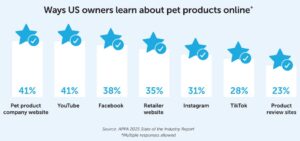
Data from the American Pet Products Association (APPA) reveals that more than four in 10 (40.9%) pet parents in the country learn about new products through company websites, which often feature product reviews in their online content.
With the rise of social media and broader internet use, reliance on dedicated product review websites has declined over time. According to the APPA’s 2025 State of the Industry Report, 23% of US pet owners relied on product review sites to learn about new products in 2024, compared with 44.4% in 2018.
“In the increasingly crowded pet market, online reviews are a key differentiator for brand competitiveness. People don’t like surprises and want to ensure that they are getting the best value with their purchase and that is even more pronounced when it comes to purchases for their pet,” Patrick O’Brien, Chief Marketing Officer at APPA tells PETS International.
Central role of social media
Today, the data shows that top sources of product discovery are social media and search engines. TikTok, for example, which 28% of pet owners cite as a source of new product information, incorporates five-star reviews in its TikTok Shop product listings.
“Brands who respond uniquely to their online reviews are able to show an elevated level of customer relationship management that not only allows them to put reviews in context, but also relieves fears a consumer may have if they encountered a negative experience. The end result is typically higher sales and increased customer satisfaction,” adds O’Brien.
Driving first-time and repeat purchases
Canadian data insights platform Caddle published its 2025 Consumer Insight Report after surveying more than 2,000 shoppers across all generations and provinces. The findings show that ratings and reviews are critical in driving both first-time trial and repeat purchases for pet products.
After a launch, reviews establish user-generated content (UGC) coverage right away, helping to build credibility and improve SEO visibility, which gives shoppers the confidence to try something new. But recency matters just as much as coverage. In the survey, 90% of all shoppers say they care about how recent reviews are, with 48% wanting them from the past month, and 25% from the last one to three months.
Gaining a competitive advantage
Caddle says that the most common mistake brands make is treating reviews as a one-time campaign: “Reviews must be an always-on strategy embedded into an omnichannel marketing plan. This ensures UGC remains fresh, relevant and recent – continuously driving credibility, discoverability and conversions.”
Brands that treat reviews as a must-have (not nice-tohave) gain a significant edge in SEO, AI-driven discovery and conversion rates. Caddle reports, for example, that a pet brand that invested in reviews saw a 67% increase in organic page ranking, a 140% surge in organic search impressions, an 80% increase in click-through rate from organic search, and a 28% increase in conversion rate.
Top marks in Italy
Research published in July 2025 by review platform Trustpilot in Italy shows that an average of 81% of pet-focused shop and service reviews in the past year were five-star evaluations. “This result reflects not only customer satisfaction but also the growing proactivity of companies, which are increasingly focused on actively engaging their customers and requesting feedback after the purchase experience,” the company says.
“Inviting customers to leave a review means opening a dialogue, highlighting positive moments and addressing any issues with transparency. In this context, excellent reviews become a strategic lever to strengthen trust, build customer loyalty and stand out in an increasingly competitive market.”
Tool for enhancing reputation
According to Trustpilot, an analysis of review keywords used between May 2024 and May 2025 shows recurring themes. The most frequently used terms are ‘product’ (18%), ‘delivery’ (16%), ‘price’ (15%) and ‘order’ (13%), highlighting consumers’ focus on practical aspects of the buying experience. Mentions of ‘service’ (7%) and ‘quality’ (6%) appear less often but remain central to overall evaluations. Trustpilot also found that 85% of reviews express positive sentiment.
“Double-digit growth in reviews throughout the entire period suggests that the pet sector is not only healthy, but also increasingly aware of the role of reviews as a tool for continuous improvement and as a driver of online reputation,” says Nicoletta Besio, General Manager of Trustpilot in Italy.
Dealing with the negative
While star ratings are important for consumers, Caddle’s data reveals that a perfect 5.0 can raise skepticism. “Negative reviews actually build trust, with 95% of shoppers seeking out at least one negative review before making a decision,” says the report.
O’Brien admits that the most common issue online reviews have had to face recently is the flood of bot reviews. According to him, they are often fairly obvious to the end consumer, but even if the brand did not solicit the reviews, they can damage its credibility.
“This is why it’s important for brands to seek out verified customer reviews and embrace negative reviews online,” he adds. “Negative reviews can be an opportunity to place a potential customer’s concerns in context. By responding to those reviews, even if they’re not legitimate, you can show future customers how you would work with them if they were to experience that same issue.”
Second only to price
The Caddle report notes that reviews are already the second most important factor in purchase decisions across categories, ranking just behind price. In the pet sector, reviews are even more influential: 64% of pet owners consider them when buying wet dog food (58% for dry), 17% discover new pet food through reviews and 12.5% say they motivate their initial trial.
Shopping behaviors further highlight the importance of reviews. Some 39% of pet consumers always or often use ratings and reviews when shopping in-store (with another 23% doing so sometimes), while 44% frequently use them when shopping online (with another 22% sometimes doing so).
Impact on consumer behavior
Interestingly, millennials are the most likely to check reviews while shopping in-store, with about seven in 10 (72%) doing so, according to the Caddle data. They are followed by Gen Z (67%), Gen X (63%) and baby boomers (48%), who also frequently read reviews before making a purchase.
The data also shows that, in the absence of reviews, roughly half of Canadians – 48% of millennials and up to 56% of Gen X and baby boomers – remain undecided, while about 10% in each group abandon the purchase entirely. Younger shoppers appear slightly more likely to still proceed: 43% of Gen Z and 42% of millennials, compared with 35% of older generations.
Reviews play a particularly important role for higher priced products, with 96% of Canadians saying they read more reviews as the price increases. Millennials lead the way, at about 99%, followed closely by Gen Z (98%), Gen X (94%) and baby boomers (93%). As prices rise, so does perceived risk – and shoppers offset that with the reassurance gained from the real-world experiences shared in reviews.
Share this story: