Indonesia: Pet food players raise their ambitions both at home and abroad

Local manufacturers are not only intensifying their domestic efforts, further fragmenting the market, but are also looking further afield.
After years of multinationals dominating Indonesia’s pet food scene, regional brands are growing more ambitious, aiming to secure a share of both the home and export markets. That ambition is being strengthened by a rising demand for premium products, access to venture capital and government stimulation of local companies to become more competitive.
Government encouragement
With the world’s fourth largest population at 285.7 million and with GDP growth of 5.1% in 2025, Indonesia has a strong economic base for developing its pet industry.
In 2024, imports of dog and cat food in Indonesia were valued at $172.1 million (€153.5M) with a volume of 98.85 million kg, according to data provided by the Trade Ministry. By 2025, this had fallen to $110.7 million (€96.4M) and a net weight of 59.12 million kg.
Nevertheless, the size of imports remains high relative to exports. For the country’s Trade Ministry, this reflects strong domestic demand and creates interesting opportunities for local producers.
To support the nation’s economic growth, the Ministry recently urged pet industry players to continue to develop. “The domestic market for pet food is very large, and we encourage local producers to enter this market more optimally,” said Indonesia’s Trade Minister Budi Santoso at the 2026 Indonesia International Pet Expo (IIPE), held in September.
Countries of origin
In 2025, the top three origin countries of dog or cat food imported to Indonesia were Thailand, France and China, according to Statistics Indonesia.
Previously, US manufacturers had a greater share of the market. A 2025 United States Department of Agriculture (USDA) report on the Indonesian pet food market notes that imports of US animal feed (including pet food) declined by 70% to $44 million (€38M) from 2011 to 2024, despite growing local demand. Thailand has also benefited from preferential tariffs, reduced prices and shorter lead times, the report notes.
Multinational brands have long dominated Indonesia’s pet nutrition market. In the cat food segment, the top three companies account for over 50% of the share, according to Euromonitor International. Central Proteina Prima leads the market with a 25% share, followed by Perfect Companion Indonesia at 23% and Royal Canin Indonesia at 9%.
The first two companies are part of the Thai-based Charoen Pokphand Group. Central Proteina Prima is also the biggest player in the dog food category, with an 18% share, followed by Mars Food Indonesia at 15%.
Today, the market is becoming more fragmented, with new brands emerging. The newcomers – both local and foreign players, the latter being most notably Chinese – are growing on the back of e-commerce sales, supported by the rise of online shopping among Indonesian consumers.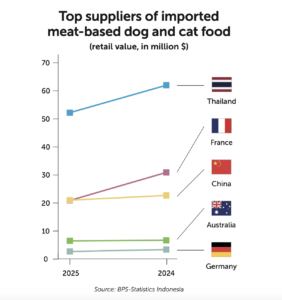
Increasing sales and ranges
One Indonesian pet nutrition company that has witnessed strong growth in recent years is Compawnion, which positions itself in the premium segment. Co-founder and CEO Stephani Herman tells PETS International that sales have increased by seven to eight times since 2023, when the business raised an undisclosed amount in a funding round.
Over the past three years, Compawnion has expanded its product range from 40 SKUs to more than 100. The current portfolio includes Pawmeals (a cooked food range for dogs and cats covering different life stages and specific dietary needs) and cat food brand Catto.
The company reports customer retention rates of around 50% for Catto and 80% for Pawmeals, and has plans to launch another brand this year. Today, about 60% of Compawnion sales come from the online channel. This is in sharp contrast with the broader market, where offline channels still dominate.
Premiumization potential
Ridarrahim Nirwandar, Country Manager Indonesia at Japanese pet food and treat company Inaba Foods, sees further potential for premiumization in the Indonesian market. Before joining Inaba, he spent around eight years as head of Royal Canin in Indonesia.
“When Royal Canin entered Indonesia, it really helped boost the category in terms of being able to help convert a lot of animals from eating table scraps into eating manufactured food. That’s the ambition I see with Inaba,” he says.
The rise of premium brands makes sense in view of the growing consumer demand for high-quality products and producers’ own push to grow the segment.
Whereas treats make up an estimated 25% of the pet food category in Japan, that segment only accounts for about 2-3% in Indonesia. Inaba is now also doubling down on growing the treat market, specifically for cats. Indonesia is a predominantly cat-oriented society, with Indonesia’s Muslim-majority population widely cited as a factor discouraging dog ownership. In fact, a Rakuten Insight survey notes that Indonesia has the lowest dog ownership rate of the 12 Asian markets studied.
Competition is welcome
When asked about the emergence of local operators in Indonesia’s premium pet segment, Nirwandar says he welcomes the increased competition, stating that more companies can help grow the overall category.
“It’s always good to have more players coming in to grow the category. We’re not going to be able to do it alone,” he says. “Indonesia is a very large market, and most of it is still untapped. There is enough pie to be shared with different players.”
Moreover, there is a significant economic moat around the product category. “Since we position ourselves in the smart premium sector, we can grow and still be profitable. We are not in direct competition with the Chinese brands, so it’s quite safe for us,” adds Compawnion’s Herman when asked about the changing competitive landscape and the arrival of new businesses.
Pinpointing the right customers
As the market becomes more fragmented, identifying the right customers is becoming a key challenge for pet food brands. “Finding exactly who would buy your product, which target market specifically, without you giving promotions, without you doing extra marketing, but because they really connect with your product – I think it’s very important,” says Herman.
Compawnion has responded by refining its targeting for individual brands. For one of its brands, for example, the company focuses on newly married couples who do not have children or are considering starting a family within the next two to three years.
The strategy is aimed at consumers who treat their pets as part of the family and are looking for products that reflect that relationship. Indonesia’s relatively young population provides a sizeable potential consumer base for this approach, with a median age of 30.7 years.
Herman argues that this level of targeting is important in a market where many brands still rely on broad marketing campaigns. “Most brands are doing a very massive kind of marketing, not targeted and specific,” she says.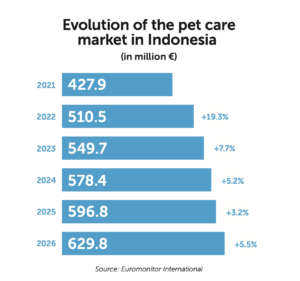
Higher-value exports
The Indonesian government also sees the export market as offering new opportunities for local brands. Indonesia currently ranks 59th among global pet food suppliers, with a market share of just 0.03%, according to data from the Indonesian Trade Ministry. Between 2021 and 2025, however, Indonesia’s exports of pet food grew by 31.98%.
Fajarini Puntodewi, Director General of National Export Development at Indonesia’s Trade Ministry, tells PETS International that several factors are supporting the country’s pet food export prospects.
Besides the strong growth between 2021 and 2025, she points to an established export base across several markets – with India, the Philippines, Japan and Malaysia as Indonesia’s top export countries – and expanding market access through a range of trade agreements.
“We want to shift strategy from merely increasing the number of exports to increasing the value added and export quality,” she says.
International expansion
Some local brands that have seen robust growth domestically have already begun to explore export markets. Compawnion has shipped its products to Singapore and Hong Kong, with Malaysia and Vietnam its next targets. But at the moment, the company is merely testing the water.
“The global economic situation has made the export market not as interesting as it was two years ago,” admits Herman, noting that shipping costs are now very high.
The overseas markets also come with unique challenges for an Indonesian player. In Herman’s view, for example, many people are not aware that Indonesia can produce good, export-quality products. “We want to focus locally first,” she adds, hinting that the company’s global foray may have to wait until 2028, when the market is projected to be more stable.
Another pet food manufacturer building on its strong local foothold to develop the export market is Evopet. In February 2026, the company shipped three containers of pet food to the Philippines in a consignment worth $176,000 (€153,000).
The shipment comprised 2,300 boxes of canned wet food, 11,200 boxes of pouch pâté and 12,000 boxes of pouch chunk-in-gravy. Trade Minister Santoso attended the inaugural export shipment.
Brand switching offers opportunities
Rising shipping costs have not only discouraged some local businesses from venturing abroad but have also made it more challenging for foreign labels looking to build their presence in the Indonesian market.
Compawnion’s CEO has seen multinationals adjusting their price points and observed a trade-down story unfolding, with some consumers preferring to switch brands rather than pay higher prices. This presents an opportunity for local players to grow their market share, but is not necessarily a straightforward win.
Back in 2023, pet ownership in Indonesia grew significantly on the back of pandemic-driven lifestyle changes. The pet food category’s expansion accelerated in parallel with that trend and attracted new players interested in capturing a share of the growth.
According to Herman, 400 new brands had been launched since 2023, but about half of them have ceased in the past year. They include Pawprints Inspired, an Indonesian direct-to-consumer pet-food startup launched in 2023 with a focus on insect-based nutrition.
Recent fluctuations
And despite the positive growth trend between 2021 and 2025, a closer look shows Indonesia’s pet food export activities have struggled more recently.
According to official data, pet food exports fell from $10.8 million (€9.4M) in 2024 to $8.7 million (€7.6M) in 2025 – a drop of 20.13%. Between January and July 2026, pet food exports decreased to $4 million (€3.5M), compared with $6.3 million (€5.5M) during the same period last year, amounting to a year-on-year decline of 36.4%.
“We view the correction in pet food product export value as a performance fluctuation over a specific period. That correction is not an indication that Indonesia’s pet food industry is losing its prospects,” concludes Puntodewi.
Share this story:
One click prioritizes GlobalPETS in your search results and AI answers.