New data unpacks consumer habits in pet toys

Exclusive research explores spending patterns, safety concerns and the other factors that are currently driving sales among cat and dog owners.
Findings from a recent survey conducted by PETS International and Loop seem to indicate a modest shift toward more conservative toy spending in 2025 compared to 2024.
This is particularly evident among pet parents who have spent higher amounts in the past.
Multiple pet ownership
Almost 2,000 pet owners from the UK, France, the US, Canada, Brazil and Mexico took part in the research. Of those surveyed, 67% own cats, 58% own dogs, 4% have fish, 2% have rabbits, 1% have guinea pigs and another 1% have hamsters.
The respondents answered the questions based on their toy purchasing for 1 or more dogs or cats. Among cat owners, 45% had 1 cat, 28% had 2, and 26% had 3 or more. Among dog owners, 64% had 1 dog, 23% had 2, and 13% had 3 or more.
Spend and retail channel preferences
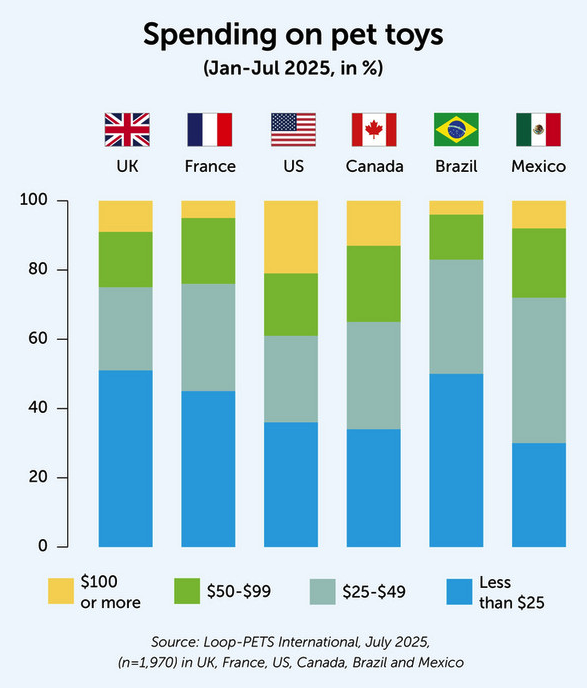
Cat and dog owners who have spent between $50 (€43) and $99 (€85) on pet toys so far this year represent 18% of the respondents. A further 10% have spent $100 (€86) or more up to now, according to the data.
More than 41% have spent under $25 (€21), with 31% spending between $25 (€21) and $49 (€42). Comparing these 2 quarters of spending to the whole of 2024 shows some increases in the lower price ranges and decreases in the higher price ranges.
Many pet owners buy toys in more than 1 retail channel. Pet specialty stores is the preferred option for purchasing toys, with nearly 7 in 10 survey respondents (69%) buying there.
This is followed by online retailers (62%), discounters (45%) and supermarkets (37%). Some 27% also buy from independent or local shops and 13% buy from vet clinics.
Less frequency and more budgeting
Some 3 in 10 respondents say they bought toys 2-3 times during 2024, with 19% indicating a frequency of 4-6, and 26% making purchases more than 6 times last year. Only 15% say they never bought toys, and 9% purchased them once.
When asked about their plans for purchasing toys within the next 12 months, 19% of the dog and cat owners say that they’re expecting to cut back. Over 7 in 10 (71%) expect to spend the same, while 10% plan to spend more. Currently, pet owners appear to be buying toys less frequently, but whether that will continue for the rest of the year remains to be seen.
Specific groups of respondents are planning to buy pet toys more frequently in the next 12 months: Gen Z (24%) and Brazilian cat and dog owners (24%), while the global average is 17%. Meanwhile, baby boomers (15%) and French pet owners (18%) plan to spend less on pet toys over the same period.
Interestingly, male pet owners seem to buy toys less frequently, with nearly 3 in 10 (28%) only making one-time purchases (the global figure is 20%) and 12% never buying toys at all, compared to the 19% and 8% respectively indicated by female pet owners.
Practicality vs loyalty
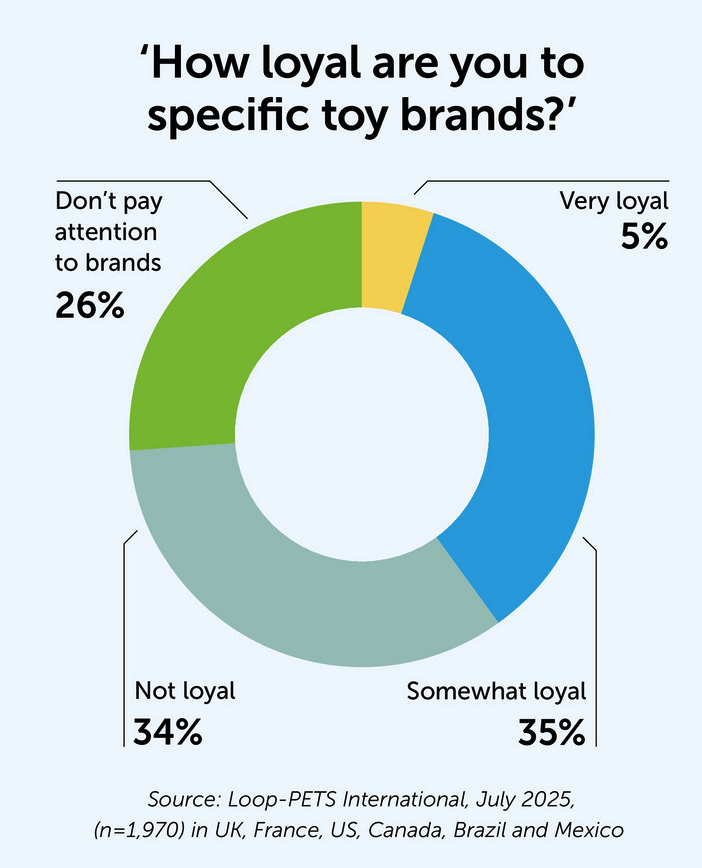
Pet parents value practicality over brand loyalty when it comes to purchasing pet toys. About a third (35%) say they have brand preferences but are open to trying new options. This is most notable among millennial (38%) and US (41%) respondents.
Meanwhile, 34% say they’re not at all loyal to brands, basing their purchases solely on availability and price. Only 5% of respondents to the Loop-PETS International survey say they are very loyal to specific brands, while 26% of all cat and dog owners don’t pay attention to brands at all.
Where there is brand loyalty, it is seen more among male pet owners (8%) than female pet owners (4%).
Influence of product reviews
Product reviews are the most notable influence on pet owners when they purchase toys (57%). This is followed by peer recommendations and packaging design (both 34%), social media platforms and vet advice (both 25%), online ads (18%) and store staff (16%).
The influence of social media (34%), veterinary advice (32%) and packaging design (40%) is most significant among Gen Z respondents. Petfluencers and pet events are evidently not yet seen to be very important among this group (7% and 8% respectively) – at least not when it comes to toys.
Other significant global findings are that peer recommendations are the most influential among Canadian (43%) and UK (44%) respondents. And product reviews are particularly highly valued by US pet owners (64%), while UK owners trust the information given at pet events or fairs (14%).
Veterinary advice is commonly cited by Brazilian respondents (36%), while store staff recommendations also have a significant influence on Canadian (24%) and French (23%) respondents.
An eye for quality
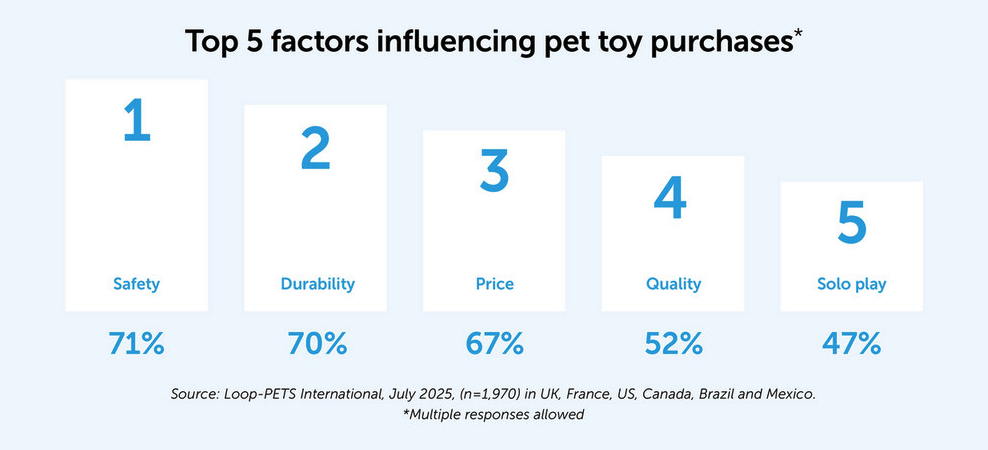
Pet owners don’t only buy what’s available – they also look for quality in general. More than 7 in 10 (71%) of the survey respondents say they look into the safety of pet toys before buying, followed by durability (70%), price (67%) and the quality of components (52%).
On the flip side, few respondents look at recycled/eco-friendly components (13%), brand (6%), origin (6%) or packaging (5%) when purchasing toys for their pets.
Some cat and dog owners say that a pet toy needs to be suitable for solo play (47%). Design and utility are less important, both at 33%. While electronic toys are starting to gain traction among pet owners (34%), the majority (66%) haven’t yet bought one.
Notably, durability and utility are most frequently cited by Gen Z pet owners as important factors for purchasing, at 74% and 38% respectively. Brand is more often a consideration for millennials (8%) than for older or younger pet owners, while product origin is most often mentioned by boomers (17%).
Country-wise, price is most valued by Canadians and Americans, with 75% of respondents in each country citing it as a key factor. Utility ranks the highest among respondents in Brazil, France and Mexico.
Americans place the most importance on durability (77%) and safety (78%), as well as price (75%), although they also value design (39%). Design is similarly valued by UK (42%) and Mexican (41%) respondents.
Mental and physical benefits
For the vast majority of respondents (88%), pet toys serve as a way to relieve their pet’s boredom. Beyond entertainment, toys are also seen as beneficial to a pet’s health, encouraging physical exercise (76%), providing mental stimulation (70%) and helping reduce separation anxiety (45%).
Additionally, pet parents say that toys help distract pets from destructive behavior (44%), support dental health (39%) and assist with training (20%).
Half of Gen Z cat and dog owners agree that they use pet toys to reduce separation anxiety (50%) and distract their pets from destructive behavior (48%), while nearly 8 in 10 boomers (78%) say that toys are important to provide their pet with mental stimulation.
Safety considerations
There are safety concerns too, with more than half of pet owners (56%) reporting having had concerns with a pet toy.
The most common issues are ingestion of parts (83%) and choking hazards (76%), followed by sharp or dangerous parts (58%), poor quality materials (51%), eye damage (27%) and allergic reactions (20%).
As a safety precaution, pet owners avoid specific materials when buying pet toys. For chewy toys, these include rawhide bones (53%), marrow bones (42%), stuffed plushies (33%) and rope toys (14%).
In general, respondents say they avoid laser toys (28%), string toys (22%), feather toys (20%), stuffed plushies (15%) and wand or fishing rod toys (9%).
The impact of delivery on demand
Delivery platforms such as Deliveroo, Uber Eats and Just Eat have begun expanding their offerings to include pet supplies, partnering with pet retailers to deliver a selection of items directly to people’s homes.
This channel is still niche, with just 4% of the survey respondents stating that they buy pet toys through these platforms regularly, and 11% saying they do so occasionally.
Brazilian pet owners show the highest interest in delivery platforms, with 18% of the respondents there buying pet toys on these platforms occasionally, and an additional 6% saying they do so regularly.
Pet parents in the UK and the US are not yet very keen on using the platforms for pet toys, with only 9% buying toys that way occasionally. Canadian respondents have the least interest, with 90% never using them.
Most of these 300 respondents (46%) buy pet toys on delivery platforms 1-2 times per year. 45% of respondents do so sometimes (3-6 times) and 10% use them often (more than 6 times).
Looking ahead, nearly 4 out of 10 respondents (38%) say they don’t plan to use delivery platforms at all over the next 12 months, while 36% intend to buy rarely, 21% sometimes and only 6% often.
Share this story: