Pet food innovations lead the consumer pack

Despite inflationary pressures and supply-chain challenges, thousands of new offerings still launch in the sector each year. And their ability to stay the course rests on whether they can respond to evolving customer needs.
In a year marked by economic uncertainty and changing consumer priorities, pet food stood out as a resilient and innovation-rich category within the fast-moving consumer goods (FMCG) landscape. Producers continue to invest in new product development – focusing less on creating brands and more on enhancing existing portfolios.
Meeting the needs of today’s pet
The global pet food market is projected to grow at a CAGR of 3.5% (constant 2025 prices) between 2025 and 2030, reaching $181 billion (€155B) by the end of the decade. To drive growth and sustain long-term momentum, brands should use innovation to deliver targeted, personalized solutions that meet pets’ needs across life stages, adapt to demographic shifts and balance premiumization with affordability.
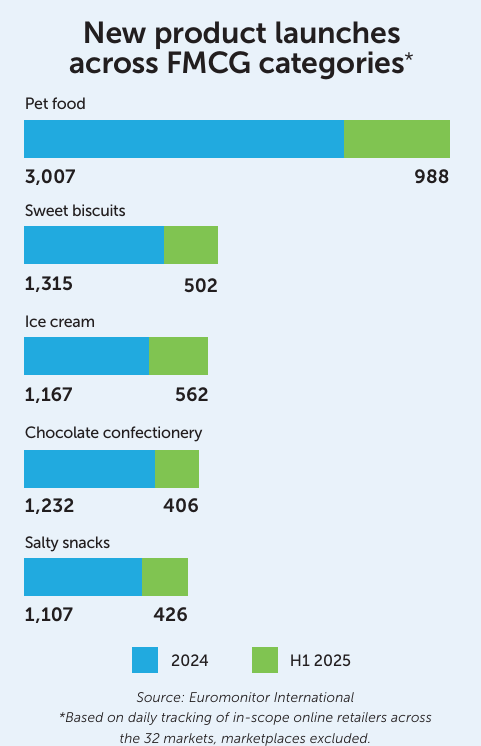
Despite economic headwinds and competitive pressures, innovation in pet food remains robust. Rising volumes of new product launches, and their increasing share in total category assortments on e-commerce, signal a competitive and attractive category, drawing both established players and new entrants.
New brands vs sub-brands
Euromonitor defines new brands as entirely new entrants to the category, while sub-brands include extensions of existing portfolios, such as new formulations, flavors or formats introduced under established brand umbrellas. The rising share of new products within the total category assortment on e-commerce reflects the growing proportion of recently launched items – whether new brands or sub-brands – across the online retail landscape tracked by Euromonitor’s Innovation system.
Although consumer demand remains resilient, rising costs and supply-chain challenges have prompted manufacturers to strengthen existing brands rather than build new ones. Efforts are now centered on enhancing formulations, adding functional benefits and introducing new formats that align with evolving pet owner expectations while minimizing financial and operational risk.
This is reflected in a consistent increase in the number of new sub-brands between 2022 and 2024 (around 9% per year), while the number of completely new brands launched in that period shows what you could call spikes and troughs – up by nearly 23% between 2022 and 2023 and down by the same percentage in the following year.
Country and regional differences
The US, Germany and France ranked as the top three markets for new product introductions throughout 2024 and into the first half of 2025. Germany maintained a steady volume of launches compared to 2023, while the US and France posted increases of 5% and 6% respectively. This underscores the continued appetite for innovation in mature markets, though growth is flattening due to market saturation and rising pet ownership costs.
In contrast, emerging markets such as Thailand, Saudi Arabia and India are poised for strong expansion, supported by low market saturation and evolving attitudes toward pet ownership. In e-commerce channels, these markets still represent largely untapped opportunities, having recorded comparatively lower volumes of new product launches in recent years than established markets in North America and Western Europe.
Taking innovation online
At the same time, digital channels are becoming increasingly critical for product introductions. In 2024, pet food brand launches declined by 23% on e-commerce, while the volume of new sub-brands grew by 10% year on year. E-commerce now accounts for a third of global pet care sales, fueled by younger, digitally native pet owners, social media influence and brand investment in online engagement.
Retailers are expanding digital capacity, while brands leverage platforms to connect, build loyalty and drive conversion. To capture this growth, pet care players must pair innovation with a strong digital strategy, one that ensures discovery, convenience and variety, while establishing a scalable online distribution base.
Staying power
Even though rising cost pressures and shifting pet preferences have limited volume growth, pet food did remain one of the most dynamic FMCG categories for innovation in 2024 and early 2025.
Increasing numbers of new product launches, and their growing share within the pet food assortment on e-commerce, have underscored the segment’s competitiveness and continued appeal for brands.
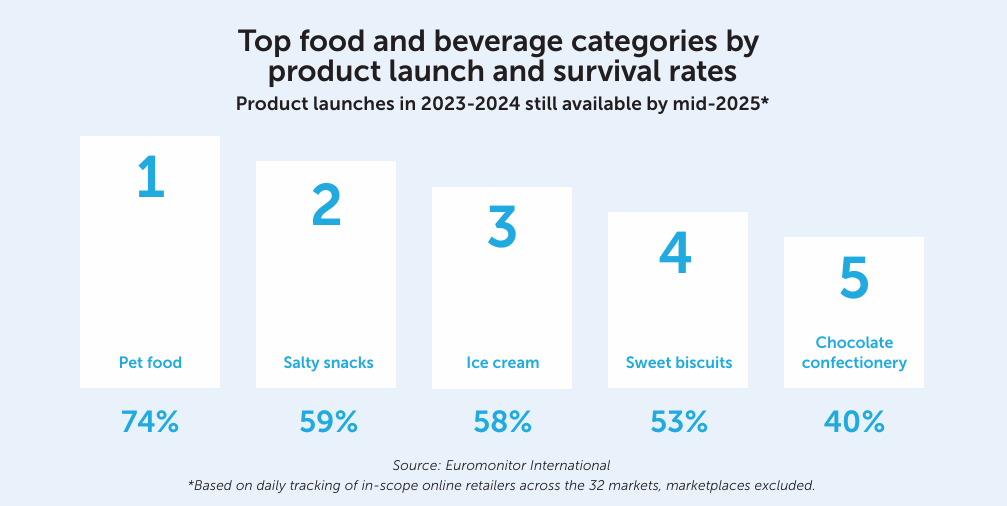
Another important metric is product longevity, which indicates whether new launches truly resonate with consumers and sustain demand beyond the initial launch phase. Pet food is a strong performer in this regard, as 74% of launches from 2023-2024 were still available on e-commerce by mid-2025.
By comparison, other leading packaged food categories recorded much lower longevity rates, constrained by shifting preferences, competition and regulatory hurdles. This highlights the strategic weight of pet food within FMCG portfolios – an arena where innovation delivers returns and successful launches can enjoy longer life cycles and sustained demand.
Why new products may fail
In recent years, the failure rate of new pet food product launches has risen slightly, underscoring the increasing difficulty of maintaining new market entries. This shift suggests that heightened consumer expectations and intensifying competition are raising the bar for successful innovation.
Pet owners are becoming more discerning, prioritizing higher-quality ingredients, functional benefits and transparent brand values, while affordability concerns continue to influence purchasing decisions.
Rising competition from regional brands and private labels has further fragmented market share, and brand extension and premiumization strategies from established players have narrowed the window of opportunity for newcomers.
Shifting pet landscapes
Cats now represent 47% of the combined global cat and dog population, reflecting a more balanced distribution between the two types of pet. At the same time, small dogs are emerging as the fastest-growing segment, with 2% growth projected for between 2025 and 2030.
This shift is particularly evident in traditionally dog-centric regions like North America, Western Europe and Latin America, where the share of large dogs is declining – from 32% in 2020 to a projected 27% by 2030 – while the proportion of small dogs is expected to grow from 42% to 46%.
Market performance further underscores the shifting landscape. Dog food still holds the largest share in global retail value, yet cat food is driving growth. From 2020 to 2025, cat food volumes grew at a CAGR of 3.4%, outpacing dog food at 1.6%. In value terms, cat food rose by 6% CAGR (constant 2025 prices), compared to 3.8% for dog food.
Innovation reflects demographic shifts as well as ownership patterns and living environments, with new product development increasingly focused on products tailored to smaller sized pets. In 2024, launches targeting small pets rose by 4%, in contrast to double-digit declines in new products for medium and large pets. This momentum has carried into early 2025, with small pet food maintaining a 47% share of new launches.
Largest launch segments
Between 2022 and 2024, dog food continued to dominate new product activity, accounting for 65% of launches. But innovation is catching up with the growing demand for cat food, with 30% of the launches, while the remaining share comprised other pet food categories, including products for birds, fish, reptiles and other small pets.
Dog food launches rose by 11% year on year in 2024, while cat food launches accelerated from 1% volume growth in 2023 to 7% in 2024. Niche segments such as food for rodents, including guinea pigs, hamsters and chinchillas, also saw growth in new product launches, although only from a relatively small base.
Like cats and dogs, other pet food categories are seeing innovation around functionality. In the US, you find claims like ‘foraging blend’ for small pets or ‘parasite and disease free’ for fish foods. Functional treats are also emerging, targeting very specific needs such as odor reduction for ferrets.
In the UK, bird food sales are being challenged by a growing preference for homemade mixes and a shift toward feeding wild birds instead of keeping pet birds. This is resulting in category innovation that is increasingly focused on wildlife.
Functional pet foods
Pet humanization, accelerated by demographic shifts such as declining birth rates, is still fueling demand for high-quality products, even at premium prices.
In mature markets, in particular, producers are seeking growth by focusing on functionality and health benefits to elevate product value. The premium segment has remained resilient due to relative price inelasticity, with new pet food products carrying a ‘premium’ claim rising 40% year on year in 2024.
Leading pet food markets for innovation, such as the US, Germany and France, all recorded growth in the share of products positioned as premium. Within this segment, differentiation is driven by single-source and novel proteins, including insects, kangaroo, deer, bison and cultivated meat, alongside minimal-ingredient formulations that emphasize transparency and purity.
The use of scientifically backed and wellness-focused ingredients that mirror human health trends further enhances credibility and consumer trust.
Frozen ready meals
Innovation is further expanding with the rise of fresh, frozen-style meals, reflecting growing consumer demand for natural, less-processed pet nutrition. Recent launches of these meals for dogs by major players signal the mainstreaming of a format once led by niche startups.
Sold frozen and then thawed before serving – much like human ready-to-eat frozen meals – the products are positioned as a premium yet convenient alternative to traditional kibble and canned foods. They mark a strategic evolution in pet food formats.
Affordability concerns
At the opposite end of the scale, affordability concerns are reshaping the market. Elevated price levels are putting pressure on pet owner budgets. As a result, mid-priced products are being upgraded with more targeted claims, advanced formulations, functional ingredients and premium-style packaging.
Meanwhile, private label players are gaining traction with their competitive, health-oriented alternatives at considerably lower price points. These are often multifunctional products, such as treats that deliver specific health benefits, which further reflect this balance between value, function and innovation.
Promoting wellbeing
Positioning around physical and physiological wellbeing remains at the core of pet food launches. Frequently, product claims highlight weight management, plus immune system and gut health support. Other products promote their protein content, vitamin fortification and ‘natural’ or ‘free from’ positioning.
These claims often stress the use of natural, organic and responsibly sourced ingredients, aiming to reduce exposure to artificial additives and preservatives while promoting overall pet health.
Health-focused claims are expected to expand further by addressing specific needs across different life stages, breeds and pet sizes. Emotional and mental wellbeing is gaining importance too, with stress relief, behavior support and enrichment activities becoming important components of holistic pet care.
Looking ahead, functionality and health benefits are set to remain key drivers of innovation. Deeper insights into pet needs, both physical and emotional, will enable more specialized benefits and greater personalization. Demand for affordable yet premium offerings will continue to fuel growth, while technologies such as AI could unlock hyper-customization – shaping the next frontier of premiumization in pet food.
Share this story: