Precision coating and aroma control take center stage
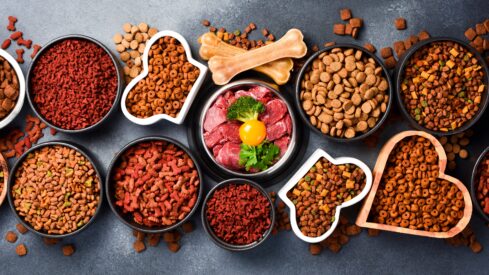
A heightened focus on specialized, high-quality pet nutrition is prompting development of innovative techniques for enhancing flavor and smell.
With the pet food palatants market expected to grow by 5.2% by 2035, manufacturers are looking for new ways to meet pet owners’ expectations of taste and palatability. Palatant composition, fat compatibility, uniform spraying and coating, and even AI can all play a role.
Pets drive sector growth
Transparency Market Research identifies pet food as the largest segment and one of the strongest drivers of the palatant market’s continued growth. Meanwhile, a Future Market Insights report put the value of the pet food palatant market at $2.4 billion (€2.1B) in 2025, projected to expand to $4 billion (€3.5B) by 2035, which reflects a compound annual growth rate (CAGR) of 5.2% over the forecast period. India is expected to be the fastest-growing market for pet food palatants in the coming years.
Realistic flavor profiles
Animal-based palatants are dominant, accounting for around 71.6% of the global market. This is fueled by consumer preferences for high-protein diets that mimic natural feeding patterns.
“We’re seeing a clear shift toward more realistic, ingredient-driven flavor profiles rather than overly strong or artificial aroma cues,” says Ava Wang of Profypet, a supplier of pet food palatability enhancers based in Jiangsu Province, China. She adds that aroma authenticity and top-note release are important for cats, while dogs show greater acceptance of savory, roasted and umami-forward profiles.
This trend is reflected in recent feeding trials, too. Ohly, a supplier of yeast-based palatability enhancers, which is headquartered in Germany and has two sites in the US, reports that dogs show higher fi rst-bite preference and greater overall consumption when offered yeast-coated kibble. According to the company, this reflects a broader shift to natural umami sources that enhance palatability and mask off -notes in functional diets.
Dr. Dina Krüger, Innovation and Health Technical Expert at Ohly, says that yeast-based ingredients enhance palatability, support consistent nutrient intake and improve overall diet adherence.
Supporting clean-label pet food
Yeast also fi ts in with the greater demand for cleanlabel pet food. Overall, plant-based coatings are forecast to grow at 10.6% CAGR globally, according to Mordor Intelligence. Besides yeast extracts, other natural palatants derived from liver, poultry fat and hydrolyzed proteins are becoming more popular.
Liver hydrolysates and Maillard-reaction flavors support premium positioning while offering good solubility and aroma persistence in modern spraying systems.
Meeting dietary demands
In addition to the premiumization trend and a focus on high-quality ingredients, another key driver of palatant growth is the rising demand for therapeutic and functional pet diets. Palatants play an important role in boosting feed intake, particularly for pets who are on therapeutic diets or are selective eaters.
Highly tailored palatability enhancers are increasingly being developed to support functional and therapeutic diets, such as grain-free formulations, according to Morgane Piriou, Global Palatability Marketing Manager at Symrise Pet Food.
Tackling application challenges
Specialized formulations can present new challenges. In the case of dry kibble, which remains the dominant form of pet food with 83% of owners opting for it, Piriou explains that “the characteristics of the kibble composition play a critical role, directly influencing palatant selection and application levels”.
Similarly, Profypet’s Wang says that high-protein and grain-free diets offer challenges due to “changes in surface porosity, fat absorption and kibble hardness”, while functional ingredients can suppress aroma release. For this reason, manufacturers are increasingly tailoring palatant systems to specific base formulations instead of relying on one-size-fits-all solutions.
The growing need for formulation-specific, precision coating is prompting manufacturers to adopt advanced uniform spraying and aroma-controlled coatings. However, Wang points out that “shelf-life performance is determined as much by formulation as by the coating process”.
Enabling greater flexibility
Despite the popularity of kibble, Symrise reports high growth in alternative formats including freeze-dried, fresh, baked and soup-style products. These all require different approaches to palatability.
In the case of fresh and wet food, liquid palatants help to overcome formulation challenges by allowing for more precise flavor layering and controlled release of aromas. According to Piriou, frozen and refrigerated products “require aroma systems that perform in low-temperature or fresh matrices while maintaining indulgent sensory cues”.
Technology boosts predictability
Innovation in coating technology is accelerating as manufacturers strive for more predictable palatability outcomes. Continuous drum coating systems, for example, can improve flavor distribution by up to 20% compared with powder systems, reducing overspray and enabling more uniform coverage. Coating homogeneity is vital to ensure consistent sensory perception, but the overall approach must combine formulation, processing, storage and handling.
Internet of Things-enabled quality control systems are further improving consistency and reducing variability across batches. AI-guided optimization also holds potential. Machine-learning tools are being used to predict palatability responses and tailor flavor profiles to specific pet demographics.
Wenger and Extru-Tech’s EXPRO AI platform uses predictive modeling to analyze processing data and set ideal extrusion parameters. Optimizing the extrusion parameters enables manufacturers to control kibble texture and surface characteristics as the basis for further improving adhesion and palatant-coating uniformity.
The direction of growth
As pet ownership and the humanization trend accelerate, demand for premium sensory experiences is likely to grow further. In anticipation of this growth, Symrise recently expanded its palatant manufacturing capacity in São Paulo, Brazil.
The company expects the most successful solutions to combine strong palatability performance with greater operational value. Indeed, by moving toward natural, species-specific and formulation-specific palatants while also continuing to invest in R&D and capacity expansion, manufacturers will be well positioned to capitalize on the ever-rising demand for palatability enhancers in pet food.
Share this story:
One click prioritizes GlobalPETS in your search results and AI answers.