Retail transformation in India powered by speediest type of commerce

Currently operating across 70 cities, the quick commerce market is set to reach 100-120 urban areas in the world’s most populous nation by the end of the decade.
The Indian retail market, now valued at $1,000 billion (€861B), is poised for rapid expansion over the next 5-6 years. E-commerce is growing on the back of multiple factors, with quick commerce (q-commerce) as one of the key growth enablers.
Q-commerce vs e-commerce
E-commerce refers to an online purchase or sale of goods or services, which can take 1 or more days to deliver, whereas q-commerce aims to deliver in a 10 to 30-minute time span. It is therefore e-commerce in a new, faster form, and is sometimes also referred to as ‘on-demand delivery’.
Instead of traditional warehouses on the outskirts of towns and cities, q-commerce players operate from micro-warehouses (‘dark stores’) strategically located near the point of delivery, to ensure a quick turnaround from order to doorstep. These can be anywhere between 300-700 sq m in size and tend to stock 10,000-12,000 different items.
Their staff are a fleet of individuals ready to spring into action at any moment. This provides the q-commerce business with the ultimate agility and flexibility required to adeptly respond to customer demand, round the clock.
Rising number of users
The q-commerce sector in India is currently valued at $5 billion (€4.6B), less than 1% of the overall Indian retail market. But it is expected to grow between 50-60% from 2024 to 2030, reaching $59 billion (€51B) to $87 billion (€75B)* by 2030. This will mainly result from major expansion in the larger cities, but the gross merchandise value (GMV) contribution of non-metro areas has already increased by 7% year-on-year, now accounting for 13% of GMV.
Rising user interest in q-commerce is due to the appeal of its key offerings – faster service and a wider assortment per dark store – and providing consumers with their favorite product at the click of a button. Add to this convenience the promise of better pricing and you have key drivers for strong user growth.
The number of monthly transacting users rose from 10 million in 2023 to over 20 million in 2024, signaling the growing adoption and integration of these platforms in daily routines. While q-commerce is predominantly used for everyday items such as staples, fresh food and fast-moving consumer goods, the emergence of new categories such as clothing, beauty and personal care, electronics and pet care shows how the system can also be used.
Growth predicted for pet care
India has approximately 32 million pets, with pet ownership rising. According to a report by Redseer Strategy Consultants, India’s pet care market reached $3.6 billion (€3.1B) in the 2024 fiscal year, doubling since 2020, and is projected to grow to $7 billion (€6B) to $7.5 billion (€6.5) by 2028 at a CAGR of around 20%.
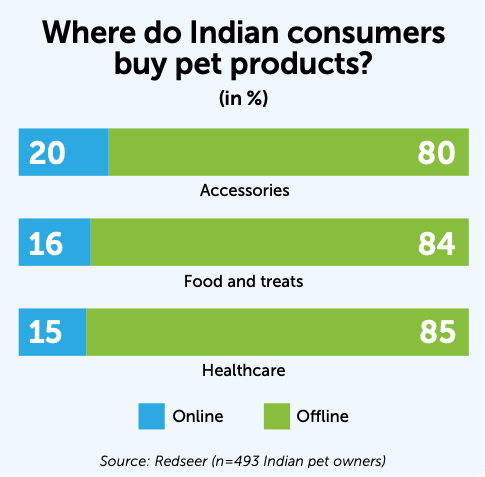
While offline, constituting around 94% of the market, remains the dominant channel for pet products and services, the online channel is now fast emerging to be a growing segment driven by e-commerce and q-commerce expansion. The online channel is expected to grow at 40-50% for the next 5-6 years, potentially capturing 25-35% of the overall pet care market by 2030.
As of 2022, offline pet food distribution stood at 75,000 retail points, which was minuscule compared to 10 million retail outlets nationwide. However, with online channels now covering most of the pincodes (postal codes) in the country, it has never been so easy for consumers to access online services.
Wider range on offer
Q-commerce is a fast-mobilizing channel with multiple brands seeing more than double-digit sales coming from it. Redseer data on one of the q-commerce businesses shows a 52% increase in the SKU assortment of pet care products on the platform.
Dog-related products make up 75% of the SKU assortment of pet care products and have seen an approximate 65% year-on-year increase in q-commerce assortments. Within this channel, brands such as Pedigree, Drools, Heads Up For Tails and Whiskas are some of the key players offering a wider and premium assortment.
Share this story:
One click prioritizes GlobalPETS in your search results and AI answers.