Retail under pressure: Turning disruption into opportunity

Leaders in the pet sector share how they are embracing AI, automation and omnichannel strategies to drive growth while safeguarding margins.
As the global pet retail sector navigates an increasingly complex market, companies are grappling with issues that span technology, data, AI and profitability. For many players, these pressures do open new doors to digital transformation, smarter data use and innovative ways to enhance customer experiences.
Five key challenges
A survey among 200 business executives in the UK and the US, conducted by e-commerce platform Rithum, outlines five key findings on challenges that brand and retail players are currently facing. These cover external and internal pressures, current manual processes, rapid AI developments, squeezed margins and the cost of customer journeys.
External forces and internal misalignments appear to limit growth at similar rates. For instance, 48% of the retailers surveyed admit difficulties with economic instability and inflation when expanding into new markets, and 47% attribute this to technology and data challenges.
Resolving data issues
Reliance on manual processes and workflows leaves companies vulnerable to inefficiency, errors, lost revenue and outdated or incomplete data. In fact, 24% of the retailers admit to often facing data quality issues, with another 12% saying they are dealing with this all the time.
In the pet sector, companies are currently working to overcome these hurdles and integrate better practices into their operations. “Today’s competitive value comes from the ability to turn data into insight and insight into action,” says Guillaume Seneclauze, CEO of pet retailer Arcaplanet.
For the Italian company, technology has become a strategic lever for business growth. “It’s necessary to build a modern, scalable and resilient architecture based on a single corporate data model, enabling a modular and flexible ecosystem capable of supporting omnichannel and enabling new sales channels,” Seneclauze explains. “The quality of our data is good, but we are striving for excellence with a truly datadriven approach.”
Frédéric Le Guen, CEO of French pet retailer Animalis, emphasizes that the availability and reliability of data “is not yet perfect”, but progress made in the past two years has been “tremendous”. This is the result of the efforts of a new, highly data-driven leadership team.
“Today, our decisions are systematically backed by data. But we operate in a sector driven by passion, where perception, attachment and field intuition matter as much as hard numbers – and not everything can or should be modeled,” he adds.
Continuing digital transformation
Belgian retailer Tom&Co has invested in broader digital transformation and connected all customer interactions, both online and in-store, into a central customer data platform. “By unifying transaction history, digital behavior, loyalty engagement and service interactions, we’re able to generate reliable customer profiles,” says CEO Jean Richard de Latour.
Some other retailers admit that there is still room for improvement. “We have very good data and we process it on numerous fronts, but not so much from a customer perspective,” explains Pipa Nogaró, CEO at Argentinian retailer Puppis.
This particular challenge is mainly concentrated in the brick-and-mortar business, especially regarding sales being allocated to the right customer. Although Puppis does have the technology to analyze omnichannel behavior, store staff sometimes fail to fulfill the company’s digitalization objectives.
AI automation is top priority
Another survey finding is that three out of four business leaders say that AI is advancing faster than their organizations can adopt it.
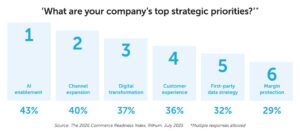
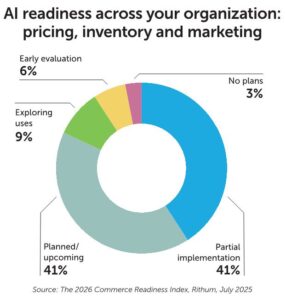
This is also where the biggest opportunity lies, as only 41% of the retail respondents are already using AI automation across several functions. AI enablement is their top strategic priority (43%), with digital transformation coming third (37%).
In Brazil, Petz has plans to increase efficiency by automating and digitizing its operations plus using data and AI for smarter execution, whether in pricing, assortment or customer service. “The AI agenda is extensive, with many opportunities, but the company’s already working with it on some fronts in its day-to-day operations,” says former CFO Aline Penna.
The Brazilian player still has “significant room for advancement”, and Penna highlights four areas of focus: demand forecasting and inventory optimization, back-office productivity, personalized recommendations to reduce customer journey losses, and loss prevention for slow-moving or soon-to-expire products.
Smart applications
At the UK’s Pets at Home, AI use is integrated in personalized customer experiences and streamlining operations. “We’ve embedded AI across our business for nearly a decade. In the past year, we’ve accelerated our efforts with programs like AI-powered customer assistants in our Pet Care Centres, fraud detection systems in the support office and colleague support tools,” says Simon Ellis, Head of AI Transformation and Enterprise Architecture.
Customer experience is also the focus of attention for Arcaplanet. The company increased its conversion rate by offering a personalized navigation experience across its digital touchpoints. “Our goal is to leverage AI in our physical stores as well, where traffic is significantly higher and where the biggest opportunities lie,” Seneclauze states.
Tom&Co’s strategy is to adopt AI where it strengthens efficiency, enhances customer experience and supports long-term business value. De Latour asserts: “By combining AI-driven efficiency with stronger digital infrastructures and the development of new revenue opportunities, we aim to deliver consistent, long-term value to our customers.”
Puppis is also leveraging smart AI applications in marketing and customer service. The company plans to add more third-party apps and develop its own products. “We’ve launched a supply chain tool powered with AI, and we expect significant improvements from that,” says Nogaró.
Moving slowly but surely
Retailers are cautious when deciding the speed at which to implement AI in their business. For the Tom&Co CEO, gradual incorporation of AI is a result of periodic reviews of repetitive tasks. “We don’t position ourselves as first movers, but we clearly recognize the necessity to embed AI as a logical component in every project and process,” he concludes.
Spanish pet retailer IskayPet thinks along the same lines, believing in laying the foundations to enable it to pursue smarter decision making and more efficient operations. “Before unlocking the full value of AI, we must ensure our data is robust, accessible and fit for advanced use,” says Caroline Arrú de Caveda, Chief Marketing and Chief Customer Officer.
The debate about AI and the risk of replacing employees is something the pet retail sector is also taking into account. “The real challenge will be bringing AI into our back-office processes – not to replace employees, but to equip them with tools that enhance their operational effectiveness and improve process efficiency,” says Arcaplanet’s CEO.
Margins under siege
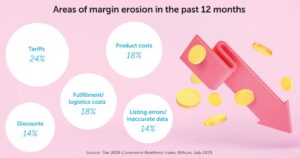
Another survey finding concerns eroding profitability. Protecting margins is the top priority for 29% of retailers, and many attribute margin erosion in the past year to tariffs (24%), fulfillment or logistics costs (18%), product costs (18%), discounts (14%) or inaccurate data (14%).
In order to improve profit and competitiveness, Petz in Brazil sees the way it competes with marketplaces as a key challenge to address in 2026, and points to loyalty programs and services (primarily health plans) as ways to achieve that goal.
Puppis is also moving its business forward by further developing its health plan sales. But Nogaró says that investing in private labels and buying directly from non-major international brands are Puppis’ main drivers of better margins, and will help them in the promotions and pricing war. “Big brands are everywhere, and there’s very tough competition on price, providing very low margins for retailers like us,” he explains.
The right pricing is key
For Animalis, price is an important differentiator in a market where both the company and its competitors are trusted by consumers. “We believe this is increasingly true, and are investing heavily in sustaining a strong price image,” the CEO says.
IskayPet tackles the balance between prices and margins with a combination of product mix optimization, strong brand positioning and disciplined pricing governance, maintains Arrú de Caveda. “Finding the right equilibrium between private label ranges and external brands allows us to sustain healthy margins, while offering our customers variety and value.”
Arcaplanet is similarly investing in the development of its private label, to strengthen customer loyalty while ensuring better margin optimization. “We’re also shifting away from broad, undifferentiated promotions toward more targeted initiatives for specific customer clusters, increasing both effectiveness and relevance,” says Seneclauze.
Improving the customer journey
The survey found that customer journeys are “bleeding revenue”, mainly in ad-to-product (26%), payment processing (19%) and customer care (17%). Nogaró notes that, in emerging markets such as Argentina, enhancing the customer experience through better designed stores and a more thoughtful in-store journey – plus expanding product availability by adding more SKUs – is crucial to retaining customers. IskayPet’s strategy is to improve in-store efficiency with better trained teams and offer a fully integrated omnichannel experience.
Ultimately, the research points out that companies which invest smartly in technology, efficiency and customer experience will go through transformations with less turbulence. And pet players are showing that they are already making the necessary structural changes to adapt.
Arcaplanet is going a step further, and is considering augmented reality, virtual reality and ‘phygital’ solutions – which combine physical and digital experiences – to enhance the way customers interact with the brand across all channels and boost consumer engagement. “We’re implementing a more localized approach to pricing and introducing dynamic pricing capabilities, enabling us to respond more precisely to market conditions and competitive pressures,” adds Seneclauze.
The path forward for pet retailers lies in balancing technology with human insight, automation with thoughtful strategy and efficiency with customer centricity. As the sector continues to evolve in 2026, those who embrace innovation while staying true to their core values will be ready to thrive in an evolving market.
Share this story:
One click prioritizes GlobalPETS in your search results and AI answers.