Review reality check

A recent survey reveals how much consumers rely on online assessments posted by previous buyers – do they trust them and how do they affect purchasing decisions?
Today, before buying anything, many people search for indications of others’ positive or negative experiences. This feedback helps to reduce uncertainty, signal quality and support confident decision making across a wide range of products and services. It can even affect willingness to pay a higher price.
Evaluating influence
Despite their growing importance, the value of online reviews has long been difficult to measure. Research findings from a study conducted in April 2024 by multinational consumer interest group Euroconsumers, among more than 4,200 customers aged 18-64 in Belgium, Italy, Portugal and Spain provide some interesting insights.
In a report published in September 2025, these findings have been combined with economic modelling and behavioral experiments to measure the influence of reviews on business performance, consumer trust and willingness to pay for the products reviewed – an effect which differs across the product categories included in the study.
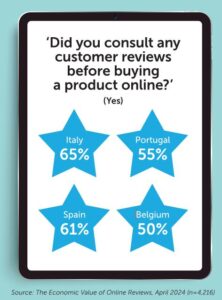
The study, funded by Amazon, shows that online reviews are widely consulted in purchasing decisions. Approximately six in 10 consumers read reviews before buying a product online, with higher use in Italy (65%) and Spain (61%) than in Portugal (55%) and Belgium (50%). Overall, 78% of respondents report that reviews influence their final decision when buying from a web shop.
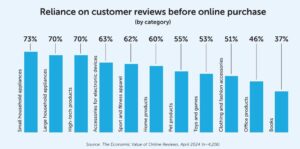
Survey respondents could share their experiences with up to two products they’d purchased online in the past two years, resulting in a total of 8,257 buying experiences. The findings show that consulting reviews increases for higher-priced and higher-risk categories (70-73%), such as household appliances and high-tech products. Other categories have lower levels of review use, despite being frequently purchased items. Pet products (55%) are among these lower-use categories.
Online or brick-and-mortar
Pet products show a distinct trend in the use of reviews. While they rank toward the lower end of regular review consultation compared with other categories, ratings still play a meaningful role in online purchasing decisions. More than half of the respondents say they consult reviews, indicating that online feedback remains an important source of information.
When it comes to buying a pet product in a physical store, only 23% of the consumers say they frequently or always consult reviews beforehand. That places pet products alongside books, toys and office products at the lower end of review use. This pattern does not necessarily indicate weak trust or disengagement. Rather, it may reflect a different decision-making logic, in which consumers rely less on extensive pre-purchase information.
Preferred review sources
Not all reviews are created equal. The study finds that the most commonly used source is reviews hosted directly on the platform or online store where the purchase occurs, with usage between 53% and 68% – an average of 61%.
Expert opinions do still matter: 51% of the respondents say they trust professional sources such as consumer organizations, and 44% rely on external expert sites. By contrast, these findings show that social media influencers are trusted by only 17% of consumers.
Factoring in fake reviews
Although reviews are widely consulted, consumer trust is not unconditional. 75% of the respondents say that fake reviews undermine their confidence, and 63% believe that brokers selling fraudulent reviews do exist. Around 72% feel somewhat able to detect fake reviews, although only 3% believe they can identify all fakes.
At the same time, consumers show a nuanced form of trust. 61% trust that verified reviews are really made by people who bought the product, and 52% believe platforms can effectively filter fraudulent content. This highlights the importance of verification and moderation mechanisms, particularly in categories where trust and safety are critical.
Exceeding expectations
Online review systems depend on consumer participation. Overall, three out of four respondents reported having posted at least one review for a product or service in the past two years. Many of these were for restaurants and accommodation, and consumers tend to write about a positive experience rather than a negative one.
On average, 75% of the respondents say they’ve rated or written a review about a product they bought online during the last two years. Reviews are also more likely to be written when products exceed expectations (64%) than when they meet (44%) or fall short (45%) of expectations, contributing to a generally positive distribution of ratings.
Pet category specifics
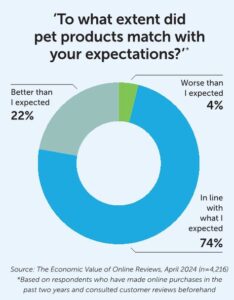
Overall, the findings suggest that online reviews are an important source of information for consumers in the pet product market, with more than half of the pet consumers consulting them. Those who do read reviews beforehand report positive experiences with the products they purchase, with 22% of the online pet product buyers saying that what they bought was better than expected.
The 35% of respondents who left a rating or wrote a review gave an average score of 4.34 out of 5 for an online purchase. This pet product rating is one of the lower average scores among the categories surveyed, higher only than home products and office products.
Having said that, pet products are among the categories most likely to exceed expectations among review users. This indicates that reviews can contribute to informed and confident decision making in the pet sector, even if they are not consulted systematically for every purchase.
Value of positive feedback
To assess the value of reviews from an economic perspective, survey respondents were also asked to choose between products with different prices and different kinds of review information. The results show that consumers are willing to pay up to around 7% more for products supported by strong and verified reviews.
Beyond individual transactions, reviews function as market infrastructure. They reduce information asymmetry, improve decision making and support fair competition. Where reviews are credible and well moderated, markets become more efficient. Where they are manipulated or misleading, trust and value are undermined.
The study re-frames the discussion on online reviews, by shifting attention from risks alone to the conditions under which reviews generate value. When trust is supported through verification, transparency and quality controls, reviews contribute to consumer confidence and sustainable business performance.