Seeking out opportunities for wet pet food

If marketers sharpen their value proposition and innovate across health, convenience and feeding strategies, this category can hold – and even expand – its position.
Wet pet food is facing a battle on multiple fronts. The rapid rise of fresh and refrigerated pet foods has reshaped how owners think about feeding their companion animals. At the same time, there’s a shift in how they use this type of nutrition in their pet’s feeding program.
Repositioning to appeal
Wet pet food has traditionally been positioned as the moisture-rich, premium sibling to kibble. While pet parents are now drawn to the human-grade appeal of fresh, gently cooked foods – as well as the health and wellness benefits of functional, science-based formulations – opportunities do exist for the wet pet food industry to position itself along similar lines.
Growth trajectory
Overall, wet pet food has held its place as the second most common formulation after dry food for decades. Wet dog food usage in the US has shifted in the past 5 years, dropping between market researcher MRI- Simmons’ spring surveys of 2021 and 2023, and rebounding in 2025 to just under 39% of dog-owning households. Wet cat food has made steady gains during the same period, from 59% to nearly 61% of cat-owning households.
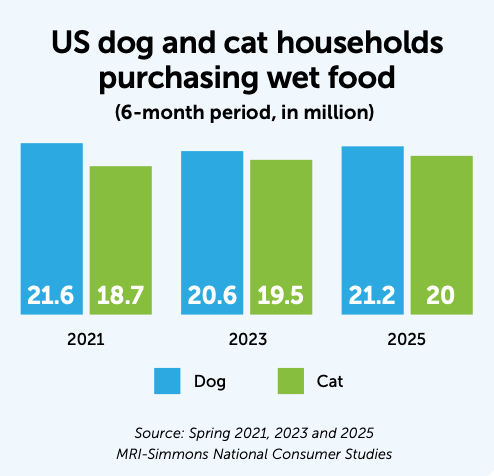
From a number of households perspective, the picture is a little different, with the number of dog-owning households dropping between 2021 and 2025, while the number of cat-owning households increased. These shifts illustrate the growing opportunity for wet food marketers in the cat space, where both population shifts and pet owner attitudes have created an advantageous environment.
Fresh hits the mainstream
In one of the biggest challenges to wet pet food, the use of fresh pet foods has grown significantly in the past decade, moving from the fringe to the mainstream. US brands such as The Farmer’s Dog, Nom Nom and JustFoodForDogs have gained market share with direct-to-consumer models, while refrigerated food specialist Freshpet is now a mainstay in both pet specialty and mass-market stores.
The rise in popularity of fresh options has cast wet food’s traditional premium status into question. Where wet food once offered clear superiority over dry kibble in moisture, palatability and meat content, fresh has now established itself as the super-premium winner.
Science-based and therapeutic
The pet food industry is benefiting from a reinvigorated focus on super-premium, science-based and therapeutic diets and treats, which is not surprising given pet food’s premier role in pet health and wellness. In Packaged Facts’ January 2025 survey, pet food was cited as a most important pet health product by 80% of dog/cat owners, with 50% viewing pet treats in the same way.
Given pet food’s position as the number one health and wellness product, it follows that pet foods with functional and condition-specific properties have grown in popularity over the past decade.
The findings show that 23% of dog owners and 22% of cat owners use pet food formulations targeting specific health and wellness needs. This includes freeze-dried, air-dried and dehydrated formulations, which offer more ‘whole’ unprocessed ingredients than traditional kibble and wet foods.

Brand responses
As a way to benefit from fresh pet foods’ positioning tactics, marketers of shelf-stable products are now co-opting ‘gently cooked’ in their own marketing appeals and even product names. Putting the claim front and center, for example, Texan company Nulo’s Gently-Cooked Meals are billed as “a healthy, shelf-stable alternative to refrigerated or frozen foods, without the special storage or messy clean-up”.
Functional wet foods address pet owner interest in health and wellness products, not just providing condition-specific benefits but also adding value for cost-conscious consumers. Hip and joint, skin and coat, and probiotic/digestive health formulations are among the more popular targeted products pet owners are seeking.
Flexible feeding
For many pet owners, the cost of wet pet foods is prohibitive. In economically challenging times, not only do wet pet marketers need to be conscious of value-added propositions, such as gently cooked and functional formulations, they also need to provide consumers with financially feasible options.
Enter ‘flexible feeding’ – the use of alternative formulations to enhance a pet’s current diet. Packaged Facts’ survey results show that among the roughly two-thirds of pet owners who at least occasionally add something to their pet’s dry food, 69% choose wet pet foods.
Among these, 56% do so to add variety and interest to their pet’s kibble, 43% do so for overall health and wellness benefits, and 41% want to add hydration or moisture. A significant share (39%) add wet pet foods to ensure that their pet will eat the dry food.
This type of supplemental feeding holds considerable opportunity for wet pet food brands, allowing pet owners to continue to feed their pets the same diets, while using wet foods as an extra flavor or health boost.
Redefining wet food’s value
Wet pet food is not in decline, but it is at a crossroads. In order to compete with fresh and functional offerings, brands must redefine wet food’s role in a pet’s diet. That means taking a number of steps.
First, they should make use of the freshness appeal, by embracing ‘gently cooked’ wholefood messaging – even in shelf-stable formats. They need to align with wellness trends through targeted functional benefits such as digestive health, joint support and hydration.
Promoting flexibility is also advisable – by positioning wet food as a valuable supplement to kibble that offers convenience, taste and health benefits without the need to commit to a full dietary overhaul.
Retailers and marketers who adopt these themes – while communicating value and versatility – will find that they can not only protect wet food’s relevance, but that they can even expand its market share in a competitive, health-conscious pet care ecosystem.
Share this story:
One click prioritizes GlobalPETS in your search results and AI answers.