Belgium: Stability defines an evolving pet landscape

Ownership levels remain high while younger consumers drive the latest adoption trends and reshape attitudes toward health, sustainability and spending.
A 2025 study provides a structured overview of Belgian pet ownership levels, purchasing behavior and consumer attitudes. The results confirm that this Western European nation of around 11.8 million people has a mature and stable pet market. Household penetration remains high and the emotional attachment to pets is significant.
Ownership levels up since pandemic
Last year, 58% of Belgian households said they owned at least one pet. This represents a clear increase compared to 2021, when 52% of households indicated pet ownership.
This is one of the main conclusions of a survey conducted by the Belgian Pet Food Association (BEPEFA) and market research agency iVOX among 1,500 adults and is representative in terms of language, gender, age and education.
Since 2023, ownership levels have stabilized (59% in 2023, 58% in both 2024 and 2025), suggesting that the market has consolidated at a structurally higher level following the pandemic period.
Demographic breakdown
Pet ownership varies across demographic groups. Among respondents under 34 years of age, 73% say they have a pet, compared to 39% among people aged 55 and over.
French-speaking respondents report higher pet ownership rates than Flemish-speaking owners – 65% vs 52%. These differences illustrate how generational and regional dynamics continue to shape the Belgian pet landscape.
Pet-owning households have an average of 3.1 companion animals. Cats and dogs remain the most popular: 33% of respondents own at least one cat – more women than men – and 28% own at least one dog. Ownership levels for these categories have remained relatively stable in recent years.
Significant part of the household
For the first time, the 2025 survey measured the perceived importance of pets in daily life. Among pet owners, 25% describe their pet as ‘the most important’ part of their life or family life, while 45% describe them as ‘very important’. In total, 70% of the owners attribute a very high level of importance to their pet.
This strong emotional dimension is consistent across the country, with French-speaking respondents reporting slightly higher levels of importance. The data confirms the central role pets play within Belgian families and provides context for the purchasing and spending behavior observed elsewhere in the study.
Reasons for pet adoption
Between March 2024 and March 2025, 17% of Belgian households welcomed a new pet. The proportion is significantly higher among younger respondents – 30% among those aged under 34 – and lower among older respondents, at 7% of people aged 55 and over.
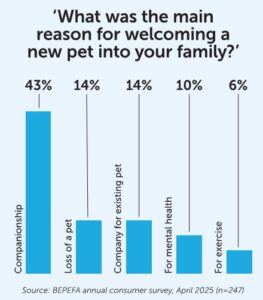
Cats and dogs account for the majority of newly acquired pets. The primary reason for welcoming a new pet remains companionship for family members (43%). Other frequently cited reasons include coping with the loss of a previous pet (14%) and providing company for another pet (14%).
There has been steady growth in recent years for two other reasons the respondents give. Some get a new pet for their mental health (10%, up from 6% in 2024) or for exercise purposes (6%, up from 4% the previous year). This is perhaps a sign of changes in society regarding attitudes to both mental and physical health.
Breeders, friends and family, and other private individuals remain the main channels for acquiring a pet. Compared to the previous survey, the share of pets in Belgium adopted from shelters has increased, with rescued animals now representing 32% of all pets – a figure that reflects a continued willingness within the Belgian market to give a home to an animal in need.
Functionality over sustainability
When choosing pet food, Belgian consumers primarily focus on functional suitability. The most important criteria in their choices are food tailored to the pet’s life stage and food adapted to the pet’s size, sensitivities or health issues.
Taste and price follow these functional aspects as important choice factors. While price is clearly considered, it does not rank as the primary driver in purchasing decisions. Less attention is also paid to packaging size and meat quality, as well as whether the food is adapted to a specific breed.
Sustainability-related attributes receive lower average scores in direct purchasing criteria. However, when asked separately, 47% of pet owners indicate that they would definitely or probably be willing to pay more for pet food that is sustainable or has a lower ecological footprint. Among younger pet owners, this share increases to 54%.
The value of recommendations
The survey indicates that 43% of pet owners have already decided which brand to purchase before going to a store or visiting a website. An additional 32% compare brands in-store or online before making their final decision. Recommendations also play a role in the decision-making process. Advice from a vet accounts for 14% of pre-store decisions, while 8% purchase the brand used by friends or family.
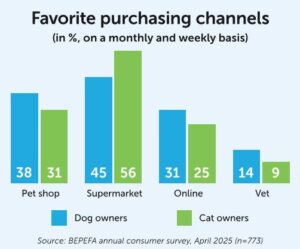
Pet shops and supermarkets remain the most frequently used purchasing channels in Belgium, confirming the continued importance of established retail formats. There are significant differences between dog and cat owners, however, with the former buying more often online, from a pet shop or at a vet’s practice, while cat owners show a definite preference for supermarkets.
Dealing with price pressures
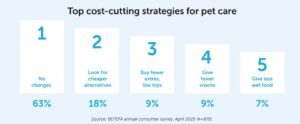
If the cost of pet care were to increase, 63% of pet owners indicate that they would not change anything and would be prepared to pay more. Another 18% say that they would start looking for a cheaper alternative, while a smaller number of respondents would adopt other cost-cutting methods, such as reducing extra purchases of specific product categories.
It appears that, for many households, pet-related expenditure is not always closely monitored in detail. Over half (51%) of the owners surveyed say that they do not know exactly how much they actually spend on their pet each month.
Emotional and practical challenges
Among the Belgian pet owners, the challenges most frequently cited are coping with the illness or loss of their pet (47%), feeling guilty when leaving the pet by themselves (32%) and the limited travel flexibility that comes with pet ownership (30%).
The main barrier to owning a pet is being away from home too often to care for one properly (39%), followed by respondents not considering themselves animal lovers. Other reasons given are unsuitable living situations and that a pet would make their life too complicated.
In conclusion, the 2025 BEPEFA survey confirms that Belgium is still a structurally stable pet market with high household penetration, strong emotional attachment and consistent spending patterns.
Share this story:
One click prioritizes GlobalPETS in your search results and AI answers.