The battle for the US basket

While the pet category continues to expand, grocery retailers are capturing a mere 20% of the market. However, recent data highlights significant opportunities to grow their share.
The competition for pet care spending is increasingly being shaped by where and how consumers shop. It is notable that grocery is hardly benefiting from rising sales, as pet owners turn to mass retailers and online channels for their purchases.
High demand, changing expectations
The challenge is not declining demand – pet remains one of the most resilient growth areas across retail – but changing consumer expectations around convenience, subscription, pricing and assortment. As pet ownership continues to drive humanization trends, retailers must rethink how they position and serve the category to gain a greater share of the pet basket.
Recent research from the US food industry association FMI, in partnership with NielsenIQ and the market research company Circana, reveals the key factors influencing pet purchasing decisions. It also highlights why digital capabilities, loyalty-driven replenishment and specialized product offerings will define the next phase of competition in pet retail.
Large consumer base
The US pet category represents a $35.7 billion (€31.3B) retail market that is growing in sales value at a year-over-year (YoY) average of 2% across every sub-segment. Food, treats and supplies are all moving in the right direction at a time when many home, health and lifestyle categories are stagnating.
The consumer base is enormous: nearly seven in 10 US households have a pet.
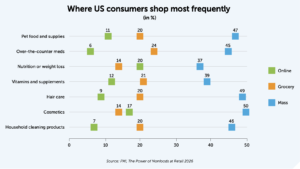
Yet grocery’s share of that spending tells a different story. According to FMI’s report The Power of Nonfoods at Retail 2026, mass retailers lead as the primary purchase channel for pet products at 47%, while grocery sits at just 20%, followed by online outlets at 11%. And grocery stores are, in general, the primary channel for 33% of the 2,100 respondents.
One interesting finding is that pet shoppers tend to frame their buying behavior as a grocery activity, even when they are not actually making those purchases at a grocery store.
Planned weekly purchases
A whopping 80% of pet purchases are described by shoppers as part of a normal shopping trip as opposed to a special destination run – above the average of 72% for all nonfood purchases.
Among pet consumers, 79% say these are planned purchases – the highest percentage when the respondents are asked to state whether their different types of nonfood purchases are planned or impulse buys.
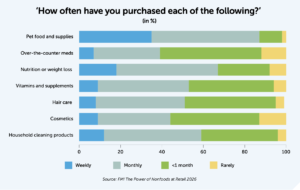
Some 87% of grocery shoppers who buy pet food and other pet products do so monthly, with 35% purchasing them weekly. This translates into a purchase frequency that rivals or exceeds that of nearly every other nonfood category in the research, particularly the weekly shop, which is twice that of any other category.
Understanding the grocery bypass
The big question is: if a shopper factors pet products into their routine grocery tab, what’s stopping them from spending those dollars in their grocery store?
The FMI report contains compelling clues. One of these is cost as the primary reason consumers bypass grocery stores for pet purchases. This is cited by 36% of pet shoppers, although mentioned by fewer respondents than for most other nonfood purchases.
The next main reason given is general affordability, at 23%. Other reasons include a lack of variety (20%), preferred brands (20%) and pack sizes (16%) – the latter two are significantly higher than for all other types of nonfood purchases.
Further complicating these price perception and assortment issues is the elasticity of pet shoppers. A fifth of them (21%) changed their primary purchase outlet for pet products in the past 12 months, slightly more than the average for nonfood purchases in general.
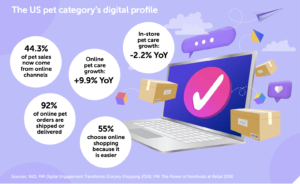
Looking at the e-commerce data from the Digital Engagement Transforms Grocery Shopping 2026 study together with the nonfoods findings, the picture sharpens considerably. Of total pet care department sales, 44.3% were made online. It’s a similar picture for health and beauty and baby care purchases.
Further underscoring this shift is the 9.9% YoY gain in online pet care sales, contrasted with a significant 2.2% decline in in-store pet sales.
More telling is how pet shoppers buy online: 92% of digital pet care purchases are fulfilled via shipping and delivery, often through subscription-based recurring shipments. Again, this is comparable to health and beauty (93%) and baby care (85%), and much higher than in the general food segment (62%). When asked why they buy pet products more frequently online, 55% of pet parents cite ease of purchase as their top motivator.
Sit. Stay. Subscribe
Delivery speed was identified as another major competitive battleground in the digital engagement study, which found that the average number of days from order to delivery has dropped from 6.4 days in 2018 to 3.1 days in 2025.
But speed alone does not solve the subscription problem. A pet shopper who runs out of dog food on a Thursday is not looking for next-day delivery from a grocery app they’ve never set up. They already have an order arriving on Friday from the retailer that captured their subscription months ago via autoship. Once that recurring purchase relationship is established, it’s extraordinarily difficult to disrupt.
Digital shopping assistants
Another significant finding in the digital engagement report concerns the projected future use of personal digital shopping assistants. Some 84% of shoppers identified at least one way they could foresee using these assistants.
This varies between store recommendations (12%) and getting recipes (26%) to finding specific product information (19%) – the latter being something both pet food manufacturers and retailers might need to take into account in the future.
Many of the other ways identified involve saving money and managing recurring needs. Automating repeat grocery orders was mentioned by 13% of respondents – a modest number today, but one indicating where AI-assisted and agentic shopping is heading.
The grocery retailer that builds a robust subscription infrastructure will be far better positioned when agentic shopping becomes the norm, and AI agents begin executing routine replenishment on behalf of consumers.
Taking positive steps
The encouraging news for grocery is that none of the hurdles to capturing a greater share of pet dollars are insurmountable. Maintaining the built-in relationship, physical footprint and foot-traffic frequency advantages can help the retail channel to reclaim the pet category. The question is whether the pressing nature of the data will translate into the urgency of the response.
Share this story:
One click prioritizes GlobalPETS in your search results and AI answers.