The drawbacks of home-prepared pet food

Findings from the Dog Aging Project support previous research that most homemade meals for dogs lack dietary balance.
An ongoing project in which owners self-report the ingredients they use when making food for their dogs at home is providing more detailed insights into the nutritional profile of such diets than have been available to date.
Existing research
The Dog Aging Project (DAP) is a US-based cohort study that collects information via online surveys. While examining DAP diet data, researchers have discovered a way to investigate the nutritional adequacy and diversity of home-cooked diets for dogs, using information provided by DAP owners.
Home-prepared diets for dogs are classified as any diet that is made at home by the owner. These diets can be made from any group of food ingredients and cover a diverse range: they can have raw or cooked meat ingredients, be vegetarian or vegan.
Previous research on home-prepared diets has found that these diets can often be incomplete, and some individual dogs have had adverse health consequences from long-term feeding of home-prepared diets.
When researchers from the University of California, Davis, in work published in the Journal of the American Veterinary Medical Association (JAVMA) in 2013, evaluated recipes found both online and in books, they discovered that 95% of recipes intended for maintenance diets for healthy dogs did not meet nutritional recommendations.
A 2012 study published in the same journal, also from the team at the University of California, Davis, found that no recipes designed for dogs with kidney disease were appropriate for the condition. A further study from Boston’s Tufts University, published in JAVMA in 2012 found that no recipes intended for dogs with cancer were appropriate.
However, the question remained: what percentage of owners were using the appropriate recipes and feeding a nutritionally complete diet, versus what percentage were using the inadequate recipes?
Indeed, the ratio of recipes available may skew towards the incomplete recipes, but perhaps dog owners are well informed and most select the appropriate ones.
DAP data: nutritional adequacy
As part of the DAP study, owners answer a diet survey every year. Owners who identified as feeding a home-prepared diet to their dog were given a free-text entry to tell the researchers as much or as little information about the home-prepared diet as they chose. Falling into this category were 1,765 diet responses.
Few owners gave exact recipes or amounts, but most gave detailed lists of ingredients. Researchers determined it was possible to answer the question: “Given these listed ingredients, can a complete diet be formulated from them?”
The individual ingredient lists were input into a commercial software designed for the purpose of helping owners design maintenance recipes for pet dogs using any set of food ingredients (Balance It).
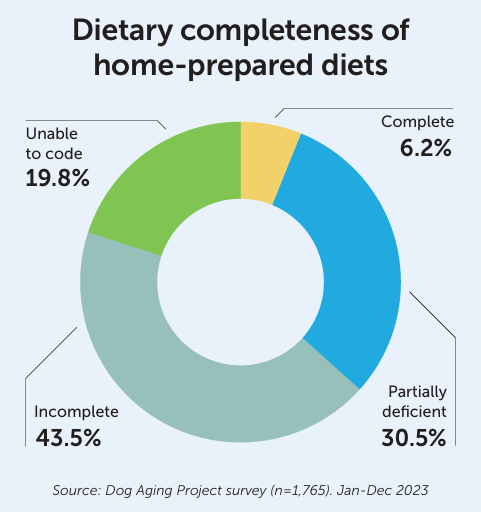
Each entry was evaluated on whether it was complete (no deficiencies), partially deficient (fewer than 10 deficiencies), incomplete (greater than 10 deficiencies), or cannot code (if not enough information was present to decide). Overall, only 6.2% of diets were determined to be complete.
DAP data: diversity
Beyond the completeness of the diet, the individual food ingredients, any listed preparation methods and common adjectives used to describe the diet were also evaluated.
The mean number of ingredients contained in this group of diets was 8.9 with a standard deviation of 5.5. Meat and vegetables were the most common ingredients, followed by offal products, fruit and non-meat-based proteins.
While the most common meat sources were chicken, beef and turkey, dogs in this dataset were also fed pork, lamb, venison, rabbit, duck, buffalo/bison and elk, and fewer than 10 dogs were fed alpaca, antelope, beaver, camel, emu, goose, guinea hen, kangaroo, moose, ostrich, pheasant and quail.
This was true for the other ingredient categories as well; while there were clear food ingredients that were most common in each category, the individual ingredient lists within each category were long.
Owners also reported feeding non-food items or food items that are known to potentially be harmful, such as diatomaceous earth, garlic, teas, clay and whole bones.
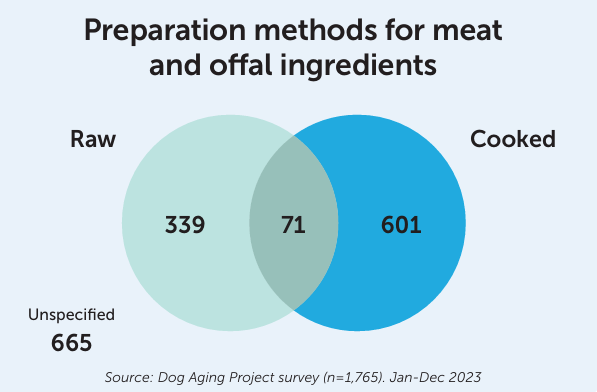
Common adjectives used to describe food ingredients included: fresh, organic, local, grass-fed/pasture-raised/wild-caught, human-grade, quality, and gently or lightly cooked. Among owners who specified a preparation method, most chose raw meat or cooked meat, but not both.
Impact and future areas of study
This study is the first to demonstrate that home-prepared diets – as described by owners – are most likely not meeting nutritional recommendations for dogs. While the research question was rather broad, if anything the results should over-estimate the actual completeness of the diets.
The website determined if a complete diet could be made using the ingredients listed. However, it was not possible to determine whether owners were feeding the exact amounts of those ingredients in the identified recipe.
Beyond the very low likelihood of being complete, these diets are difficult to treat as being all the same, given that the individual ingredients contained in them could be very varied and, on average, these diets contained around nine ingredients. Owners are not just feeding chicken and rice.
There is certainly more work to be done in this area of research. Testing large numbers of diets as prepared by owners would allow researchers to ask more detailed questions – such as, what are the most common deficiencies or nutrients above the recommended levels in this group of diets?
Conducting longitudinal studies could also determine if certain health conditions are more or less common in adult dogs fed a home-prepared diet over a long time. Answering these kinds of points will help researchers, veterinary health care teams and pet owners to provide the best nutrition and care to pet dogs as possible.
Share this story: