The pet tech making accessories smarter

Manufacturers are integrating AI, sensors and connectivity, moving beyond basic tracking to provide deeper insights into pets’ health and behavior.
The latest product launches and partnerships suggest that pet tech is increasingly being shaped around specific challenges in how owners monitor, understand and manage their pets’ care. Businesses are embedding ever more advanced technology into everyday pet products to provide detailed insights into pet safety and health, or to simplify daily routines.
Improved tracking coverage
Pet tracking is evolving beyond basic GPS location services, with companies improving connectivity, positioning and the amount of information available to owners. When smart pet technology brand Fi launched the Fi Ultra, it became the world’s first dog tracker powered by T-Mobile’s T-Satellite service with aerospace firm SpaceX’s Starlink.
The device is designed to stay connected when cellular coverage is unavailable, extending tracking capabilities to areas with limited network access. Currently, the service is only available in the US but will be rolled out in other markets as its reach expands.
“Fi Ultra powered by T-Satellite with Starlink opens up a customer segment no pet tracker on the market has been able to serve up to this point: the pet parent whose dog spends significant time outdoors and in areas with more limited coverage,” Jonathan Bensamoun, CEO and co-founder of Fi tells PETS International.

Integration into everyday life
Beyond connectivity, Fi also recently partnered with Verizon, the US’s largest wireless carrier, to integrate its Fi Mini tracker into Verizon’s Family app. The features of this digital assistant include real-time location sharing, content filters, screen time management and driving insights. The integration allows Verizon customers to add their pets to the same safety system, with safe zone alerts notifying owners when a pet leaves a designated area.
“These partnerships target two distinct growth channels. Verizon lowers the barrier to entry for mainstream connected pet care by embedding Fi into daily family safety routines. Fi Ultra provides coverage to those who live their lives beyond cell coverage, such as hikers, farmers and ranchers,” continues Bensamoun.
At IFA 2026, Europe’s largest consumer electronics and home appliances trade fair, held in Berlin, Chinese smart home and pet care brand Neakasa launched not one, but two innovations aimed at automating parts of the pet care routine. The Riko smart feeder stores freeze-dried food and automatically grinds and rehydrates it into wet food at feeding time, supporting more than 20 scheduled meals per day.
Smarter tracking and safety
Meanwhile, Neakasa’s M9 self-cleaning cat litter box takes a structural approach to automated litter box safety with its Tilt-Safe Rotation design, reducing potential areas where a cat could become trapped or pinched.
Another interesting launch at IFA came from SATELLAI, an AI-powered pet care company, with its next generation of SATELLAI Sense AI and new connected pet wearables. Moving beyond standard pet tracking, SATELLAI is developing technology to help pet parents better understand their pets’ behavior, routines, activity and wellbeing.
SATELLAI Sense AI is at the center of this evolution, interpreting pet data and translating behavioral patterns and changes into natural language insights. At the fair, the company introduced its first smart wearable for cats, the SATELLAI Cat Tag, and showcased the SATELLAI Tracker Ultra, a satellite-connected dog wearable designed for off-grid environments.
“Many existing trackers are primarily designed to collect and display location or activity data,” the company says. “SATELLAI Sense AI is designed to interpret those signals over time, understand each pet’s individual patterns and turn them into useful context through daily summaries, personalized insights and proactive notifications.”
Improved location accuracy
SATELLAI also expanded its collaboration with global connectivity provider Deutsche Telekom IoT and positioning technology enterprise Swift Navigation.
The collaboration with Swift Navigation aims to improve location accuracy and support GPS-based features such as virtual boundaries, route history and escape alerts. Meanwhile, Deutsche Telekom IoT’s connectivity helps maintain communication between connected pet devices and SATELLAI’s cloud-based services across international markets.
Another location and safety technology company, Life360, has launched the Pet Tag. This stainless-steel QR code collar tag allows anyone who finds a lost pet to contact its owner or share the pet’s location with the owner’s Life360 Circle account without needing an app. Pet parents can update the contact details linked to the tag through their pet’s Life360 profile.
Proactive care
Technology is increasingly being used not only to monitor pet health, but also to help owners interpret data and understand changes in their pets’ health and behavior. For instance, OpenVet, a Florida-based comparative medical intelligence company for veterinary care, recently launched OpenAnimal. This owner-facing platform combines pets’ medical histories with veterinary evidence and guidance.
In another example, in April Tractive launched its DOG 6 XL tracker alongside the CAT 6 Mini, its first-ever collar-integrated GPS and health tracker built specifically for cats. Aiming to bridge the gap between reactive tracking and proactive pet care, both devices combine GPS with continuous health and behavioral monitoring, giving owners a more complete picture of their pet’s wellbeing over time.
“By continuously monitoring metrics like activity, sleep, resting heart rate and respiratory rate, Tractive can help owners better understand what is normal for their individual pet and identify meaningful changes over time,” states the company.
Tractive says its products are designed around the specific needs of each animal type. The DOG 6 XL, which features improved durability, a lighter-weight design and longer battery performance, is tailored to larger breeds and highly active dogs. The firm, which was acquired by technology company Bending Spoons in May, also debuted an ultra-durable XL Adventure Edition in the summer. The CAT 6 Mini is oriented to cats’ distinct behaviors, movement patterns and health signals rather than adapting a dog-focused design.
For PETKIT, meanwhile, the focus is on addressing the fragmented nature of everyday pet care, where feeding, drinking and toileting are often monitored separately. The Chinese-based company has developed an integrated system that connects data from these routines to provide a more complete picture of a pet’s health through an AI-powered ecosystem, supporting preventive urinary care. Its cat feeders, fountains and litter boxes use AI cameras and multi-pet facial recognition to identify individual pets and track changes in their daily behavior without requiring a wearable device.
From health to behavior
The focus on interpreting pet health data is also extending beyond physical health. In mid-October, Chinese global pet tech brand Dogness officially launched its new-generation AI Pet Feeder based on technical cooperation agreements with Google Cloud. It is equipped with high-definition night vision and a 120-degree ultra-wide-angle camera, allowing users to seamlessly monitor their pets’ eating, activities and resting status at any time via the mobile app.
Moreover, leveraging the behavioral recognition capabilities of Google Gemini AI, the feeder can automatically monitor the pet’s status, identify abnormal behaviors and issue timely alerts.
According to Dogness, this proactive feature helps owners anticipate potential health risks, propelling the pet care experience from ‘functional connectivity’ to ‘emotional understanding’.
In a similar vein, Silicon Valley-based pet emotional intelligence company Traini partnered with global smartphone brand TECNO to integrate its pet emotion translation model as a native smartphone capability. This allows users to interpret their pets’ emotions, intentions and needs through their phones.
According to Traini, this partnership is part of its long-term goal to make intelligence available across the pet, consumer electronics, automotive, insurance and healthcare ecosystems. It says the next stage of pet tech will involve embedding pet intelligence into devices people already use, including smartphones, vehicles, smart-home devices and wearables.
Translating pet noises into words
Chinese startup PettiChat aims to take interpreting pet emotions to the next level. In April, it launched an AI-powered collar that translates dog barks and cat meows into full sentences on a smartphone in just 1.2 seconds. Powered by Alibaba Cloud’s Qwen AI model and trained on over one million vocal and behavior samples, the device is being positioned as “the world’s first real-time two-way pet translator”.
The company claims it detects pet emotions and intent with up to 94.6% accuracy. Although scientists remain skeptical, PettiChat secured more than 10,000 preorders at an early-bird price of $119 (€107) and the startup secured $1 million (€897,000) in angel funding in May.
Opportunities to expand reach
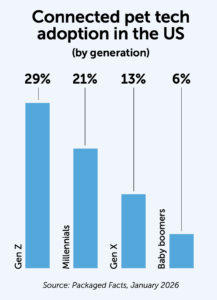
Overall, pet tech is becoming a more ambitious and sophisticated category even while take-up remains uneven. This leaves room for companies to expand beyond early adopters and make these technologies more relevant to a wider group of pet owners.
Share this story:
One click prioritizes GlobalPETS in your search results and AI answers.