The repositioning of private label pet food
Slower growth and a wider gap between economy and premium segments are changing how retailers are formulating and marketing their own brands.
Europe’s pet food market is still expanding, but its gains are becoming more selective. With volume largely flat, and consumers more circumspect about spending, private label is winning relevance where it can combine affordability with credible quality, nutrition and distinct positioning.
Mature and resilient market
The European pet food market is expected to reach €43.8 billion ($49.9B) in 2026, up from €41.1 billion ($46.9B) in 2025, representing growth of around 6.4% at current prices. Looking further ahead, the market is projected to grow at a 2% CAGR in constant 2026 prices between 2026 and 2031, reaching €48 billion ($55B) by 2031.
This points to a mature but resilient market. A market where future gains are more likely to come from value creation, channel strategy decisions and shifts in consumer choice than from higher pet care product consumption.
Growth is also becoming more balanced across the region. Eastern Europe grew faster than Western Europe in 2025, but this is expected to reverse in 2026, with growth forecast at 4.1% in Eastern Europe versus 7.3% in Western Europe. The shift suggests the market is moving away from the stronger inflation-led expansion seen in previous years.
Gaining ground in Europe
This relatively modest underlying growth also puts greater emphasis on where and how value is created within the market. Private label continues to gain ground across European food categories but follows a somewhat different trajectory in pet food.
Own-brand products account for around 27% of European staple foods value and 33% of cooking ingredients and meals value, and in both categories they grew faster than the market average in 2026, outpacing overall growth by 0.3 and 0.7 percentage points (pp) respectively.
Pet food follows a different logic. It is being increasingly treated as a health and wellness category rather than as a commodity category. This development makes brand trust and nutritional credentials more important than price alone.
Health and wellness lens
In this environment, private label is becoming a more important part of Europe’s pet food industry. Retailer-owned ranges are expanding across different price tiers and channels, reflecting both ongoing price sensitivity and a broader shift in consumer perception. For many pet owners, private label is increasingly seen as a credible choice rather than a compromise.
That shift is reshaping how such ranges are positioned. Instead of relying only on lower prices, they use improved formulations, clearer claims and stronger packaging. Because pet food is seen through a health and wellness lens, brand trust still carries real weight, so successful ranges lead with quality, nutrition and coherent positioning, treating price as a supporting advantage rather than the main reason to buy.
Sales growth vs market share
Private label accounted for €8 billion ($9.1B) of European pet food sales in 2025, most of which was dog and cat food – €7.7 billion ($8.82B). In 2024, total sales of private label pet food were €7.4 billion ($8.4B). Despite sales growth, market share has slipped slightly – from 19.7% in 2023 to 19.4% in 2025, meaning that private label has grown in value but not as fast as the total pet category.
Western Europe led in private label market share in 2025, with €5.9 billion ($6.8B) – up from €5.7 billion ($6.5B) in 2024. But Eastern Europe recorded stronger growth, rising from €1.5 billion ($1.7B) to €1.8 billion ($2.1B) in the same year.
Geographical breakdown
Looking at selected European countries gives an idea of how private label growth compares with branded pet food at an individual market level. In Western Europe, Sweden records the largest gap between private label and branded pet food growth, with private label outperforming brands by 12.5 pp. In Greece and Ireland, there are also significant gaps, at 6.6 and 5.2 pp respectively.
Eastern Europe shows even wider disparities in some markets. Bulgaria reports the largest gap in the region, with private label growth exceeding branded pet food by 14.1 pp. Poland follows with a 9.1 pp gap, while Slovakia records a more modest 1.8 pp difference in favor of private label.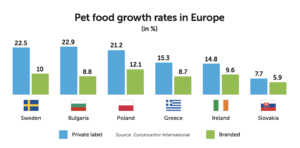
Polarized markets
The country differences help to explain why private label continues to grow in value across Europe, while its overall market share is only moving gradually. The pattern mirrors other food industries, where private label tends to advance fastest in more price-driven, commoditized categories.
This is indicative of a wider polarization. Growth is strongest in the economy and premium segments, while the mid-priced tier is under pressure. Private label sits on both sides. Economy ranges remain relevant for households managing spending, while premium private label is gaining ground as retailers improve formulations, packaging, claims and positioning.
In Western Europe, private label accounts for roughly three-quarters of economy cat and dog food value, compared with just 4-5% of the premium tier. In Eastern Europe, economy penetration varies widely, from around 15-25% in Ukraine to 50-80% in Poland, Hungary, Romania and Slovakia.
Premium remains largely brand-led, with private label accounting for less than 10% of value in most cases. Slovakia illustrates this shift: private label already represents around 24.8% of cat food value and continues to gain share by combining competitive pricing with more premium, health-led recipes. Together, these dynamics show how far private label has moved beyond its traditional role, increasingly resembling branded products in presentation and positioning.
Discounters provide affordability
Private label is evolving differently across retail formats, reflecting each channel’s competitive strengths. At discounters, affordability remains the starting point, but retailers also need to communicate quality through clear segmentation, recognizable packaging and relevant nutrition claims. Recent activity shows how this model is becoming more sophisticated.
Lidl operates two key private label brands: Orlando for dogs and Coshida for cats. In Spain, it introduced new recipes last year, combining natural ingredients and veterinary-developed recipes with Tetra Recart packaging. The launches added quality and product credibility, while maintaining the value proposition. In Ireland this year, during a Pet Week event, Lidl sold Coshida food with its Zoofari private label pet care range, including accessories, toys and other products.
In Germany, supermarket chain Kaufland expanded its private label pet food brand K-Carinura range with K-Carinura Naturals, featuring grain-free recipes, transparent ingredients and no additives. All these launches show how retailers are adopting many of the same credibility cues used by established brands (naturalness, functionality and solutions for specific pet needs) while maintaining a value-led positioning.
Spotlighting expertise
Pet specialists take a more premium approach. Perceived as experts in pet care, they can build ranges that compete directly with established brands. Fressnapf | Maxi Zoo, one of Europe’s leading pet supplies retailers, operates extensive omnichannel networks and positions exclusive brands such as MultiFit, Premiere and Select Gold across both affordable and super-premium segments, showing how specialists use private label to stretch across price points.
UK giant Pets at Home has adopted the same strategy. The pet specialist sells own brands such as Wainwright’s – which covers everyday, sensitive and grain-free nutrition – and AVA, a more specialist range segmented by life stage, breed size and specific nutritional needs.
In Italy, Arcaplanet offers pet consumers its private label range Virtus, which is positioned around high- quality animal protein, low-grain and no-grain recipes, and formulas that are tailored to factors such as size, life stage and neutering.
Broad online assortments
Online specialists are moving in the same direction. Zooplus, one of Europe’s leading online pet retailers, now offers more than 20 own brands across cat and dog food, using private label to differentiate its proposition from budget-friendly to premium.
Vertical integration adds a further dimension, as some pet specialists control their assortment, positioning and distribution – making their private label brands part of a broader retail ecosystem rather than simply a range of cheaper products on the shelf.
Where next?
Private label pet food in Europe is entering a more selective stage of growth. Its slight share decline shows that further expansion cannot rely on affordability alone. As the market polarizes, private label has opportunities at both ends: economy ranges can support consumers who are managing budgets, while premium private label will appeal to pet owners seeking health benefits and specialist reassurance.
The most successful ranges will be those that combine price benefits with credible quality, clear positioning and a reason to choose them over established brands – behaving like a brand in specialist retail, and pairing affordability with acceptable quality in discounters.
Share this story:
One click prioritizes GlobalPETS in your search results and AI answers.