The shifting landscape of alternative pet food

A comprehensive survey across six countries reveals the feeding behavior of today’s pet parents and what factors are driving their choices.
From fresh and dehydrated to raw and frozen, alternative diets for pets are attracting growing interest from consumers worldwide. Yet price, taste and habits continue to shape the speed at which users adopt these new types of food next to traditional dry and wet products.
The preferred option: fresh
A new survey from Yummypets, powered by Loop, and PETS International found that most respondents who bought alternative pet food between May and October 2025 fed their pets with fresh food (70%) – an increase of 18 percentage points compared to findings from a similar survey in 2023.
The 1,200 pet parents surveyed in 2025 were from France, the UK, the US, Canada, Brazil and Mexico, compared to 634 from France, Belgium, the UK, the US and Canada in 2023.
Dehydrated pet food (made by gently cooking real-food ingredients at low temperatures to remove moisture while retaining nutritional benefits and enzymes) is the second most popular option, at 58% (55% in 2023).
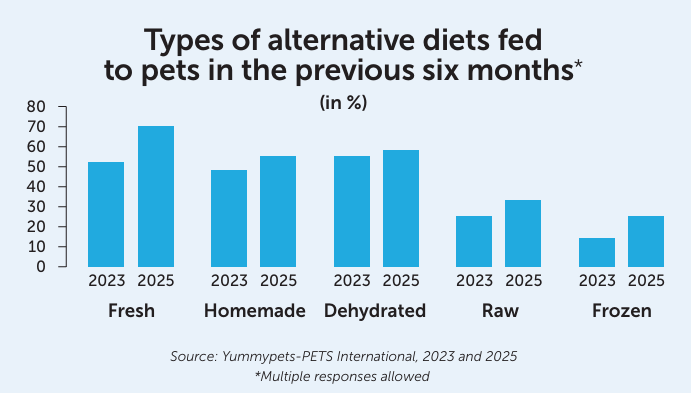
The use of raw pet food has increased from 25% in 2023 to 33% in 2025, the second highest rise in alternative food use after fresh. More than two out of 10 (25%) respondents fed their pets with frozen food, an increase of 11 percentage points.
Country overview
Dehydrated pet food is the most popular feeding alternative for pets in France, with 70% of the respondents saying this is currently their preferred option. In the Americas, fresh food leads the way, favored by 83% of pet parents in Brazil and 82% in Mexico. In the UK, the US and Canada, fresh food is also the preferred alternative diet.
Despite the overall increase in frozen pet food, penetration is still lower compared with other options. Only 18% of Brazilian consumers, 20% of French and Mexican owners and 21% of the Canadian respondents say they use this type of diet for their pets. In the UK (36%) and the US (34%), the level of acceptance is higher.
Raw food shows a similar pattern to frozen in France and Canada, where penetration remains low, at 22% and 25% respectively. It is more popular in Brazil, where more than four in 10 pet parents include it in their pet’s diet.
Assessing the benefits
Opinions of pet parents on the benefits of alternative diets vary per country. For example, more than half of the respondents (54%) agree that homemade pet food is healthier for their pets than commercial options, down from 60% in the 2023 survey. It’s a view that is most common in the US (65%), the UK (62%), France (60%) and Canada (57%). Fewer consumers in Mexico (44%) and Brazil (35%) share this opinion.
Regarding raw food, 45% of the respondents believe it provides all the nutrients a dog or cat needs, a level largely unchanged from 2023, when it was 46%. Agreement is the highest in the US (50%) and the lowest in Mexico (39%).
Alternative vs traditional
The Yummypets-PETS International survey confirms that wet and dry food are still the most widely accepted ways to feed cats and dogs. The participants were also asked which type of diet they believe is best at providing certain benefits.
When it comes to immunity, most respondents (70%) believe that processed dry and wet food are the best options. Around three in 10 respondents think that alternative diets are the best, with the US (36%), plus Canada and Brazil (33%) showing the highest support for this statement.
French pet parents are even more conservative, with just 20% supporting alternative diets as a good solution for immunity. Overall, support for alternative diets in this respect has decreased by eight percentage points since 2023, when 39% of respondents to the survey endorsed them.
On joint care, the trend is similar, with 31% of the respondents turning to alternative diets for this purpose. The strongest support is in Brazil (34%), Mexico (33%) and the US (32%). In 2023, 34% of pet parents considered alternative diets beneficial for joint health.
Alternative pet food is chosen by 24% of respondents for their pet’s digestion or for skin and coat health, by 25% for weight management and by 26% to support energy and vigor. Interest in alternative diets for these benefits has slipped since 2023, with skin and coat health plus digestion experiencing the same remarkable drop of nine percentage points.
Purchasing frequency
In Mexico, significantly more pet owners than in the other five countries buy alternative pet food weekly. This is almost one-third (32%), while the figures in the UK (17%) and Canada (10%) are particularly low when compared to the other countries.
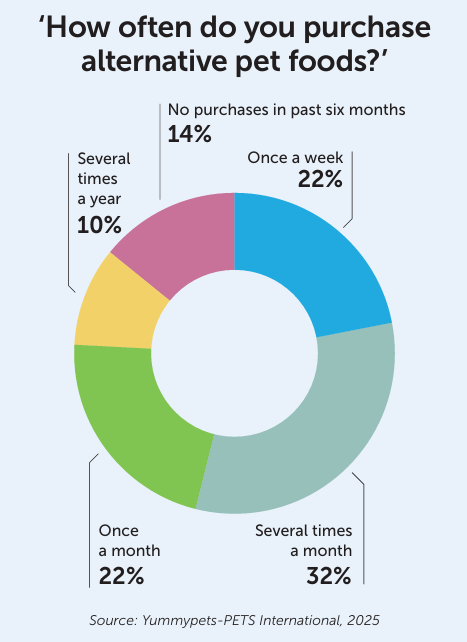
Over half of the respondents (54%) purchase alternative pet food once or more times a month, led by Brazil where this is 65%. A further 32% shop several times a month, while 22% purchase these products once a month. According to the survey, 14% of the respondents didn’t buy alternative pet foods at all in the past six months. This figure was even higher in Canada (21%) and the UK (20%).
Retail preferences
Specialist pet stores remain the preferred channel for purchasing alternative pet foods (62%). The highest market penetration is seen among Brazilians (75%) plus Canadians and Brits (66% each), closely followed by North Americans (65%), while just 39% of the French respondents buy alternative pet food from specialist retailers.
Other preferred channels to purchase this type of pet food are hypermarkets and supermarkets (47%) and online (30%). E-commerce penetration is the highest among North Americans, with more than half of them purchasing alternative pet food online. In contrast, just 20% of the French pet owners do so, with Mexican and Canadian respondents only buying these products slightly more online.
Nearly two in 10 respondents prefer to buy their alternative pet food at convenience stores, with the highest numbers reported for Mexico, the US and the UK. Discounters (8%) and garden centers (5%) follow at the lower end.
Price is the main barrier
The majority of the survey respondents (70%) spent between $25 (€22) and $100 (€87) per month on alternative pet food in 2025. Those spending between $100 (€87) and $150 (€130) represent 13% of the pet owners surveyed.
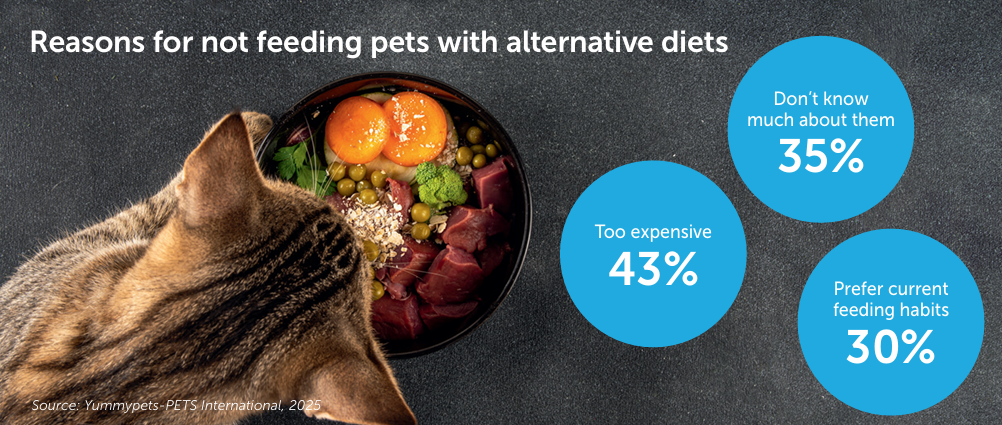
Price remains the main reason why many owners are still hesitant about including alternative food in their pets’ diets, with more than four in 10 citing that as the key barrier. This is as high as 64% among owners in the US.
Sticking to existing feeding habits is also a reason given for not adopting alternative diets, mentioned by three in 10 respondents to the 2025 survey. Taste is another concern – 21% of the pet owners believe their pets wouldn’t enjoy alternative food. Others point to a lack of knowledge of this kind of product (35%) and limited availability in stores (16%) as additional obstacles.
Half of the respondents say they’ve bought more alternative pet food than last year. This was particularly the case in Brazil (63%), Mexico (53%) and the US (52%). The figures among French and Canadian pet owners are below average – 37% and 39% respectively. Nearly two out of 10 owners report purchasing less of these foods than in the previous year, mainly because they’re too expensive.
The outlook for 2026 seems positive for the category, with 45% of pet parents expecting to purchase more alternative pet foods. An additional 38% say they are planning to spend the same amount.
But among those who don’t currently feed their pets alternative diets, few seem open to change. In fact, 76% say they do not intend to purchase any alternative pet food within the next 12 months.
Carving out a niche
The survey suggests that average expenditure on alternative pet food will decrease in 2026, with half of the respondents (53%) willing to spend between $25 (€22) and $100 (€87) on alternative pet food per month – 17 percentage points less than in 2025, but the same as in 2024. 18% of the pet owners plan to spend between $100 (€87) and $150 (€130) in 2026 – slightly more than in 2024 and 2025.
While traditional foods remain dominant, alternative diets are carving out their space in the market. With increasing awareness and continued interest from pet owners, these fresh, frozen, dehydrated and raw options are set to play a bigger role in shaping the future of pet nutrition globally.
Share this story: