Thinking outside the box
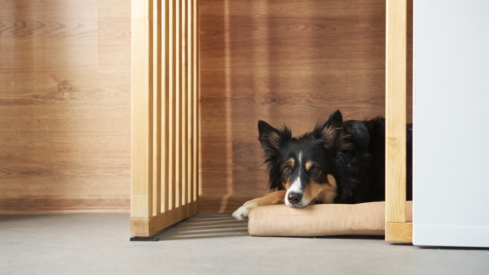
Furniture-style designs, multifunctionality and technology are reshaping the market, but manufacturers need to balance innovation with safety and practicality.
The indoor pet enclosure has been almost solely a functional product for decades, used for training, travel or sleep. But as pets have become increasingly integrated into the home, the category is evolving. For manufacturers and retailers, this raises the possibility of competing not only on materials or features, but also on personalization, configuration and the ease with which a crate blends into an owner’s living space.
Balancing purpose and style
Data intelligence company Business Research Insights estimates the global dog crates and kennels market at $2.6 billion (€2.3B) in 2026, rising to $3.67 billion (€3.22B) by 2035 – representing a projected compound annual growth rate (CAGR) of 3.9%.
This growth is partly being driven by manufacturers looking beyond traditional enclosures and exploring products that blur the lines between purpose, style and even technology. Customization, integrated storage and finishes designed to complement home design are key developments in the category, suggesting that manufacturers are responding to demand for crates that fit seamlessly into homes while also serving additional needs.
Private label opportunities
The shift is also creating new opportunities for retailers to expand their own ranges across pet housing and furniture, giving them greater control over product specifications, positioning and pricing.
For example, US online pet platform Chewy’s own brand, Frisco, includes dog crates and other pet housing products. This brings private label presence into a category that has traditionally been dominated by specialist manufacturers, potentially increasing competition for both in-store and online visibility.
From one function to multi-use
Today’s consumers are increasingly looking for crates that cater to their practical needs by being simultaneously sturdy and comfortable, while also being stylish enough to blend in with their home decor.
New York-based pet company Fable takes a design-led approach to dog products, aiming to combine functionality with aesthetics. It identifies furniture-style crates as a distinct segment alongside traditional plastic, wire and soft-sided ones.
Its founders worked with industrial design firm Doris Dev to develop a pet crate that addresses a common challenge for urban pet owners: fitting bulky pet equipment into the home. The resulting crate is designed to function both as a dog enclosure and an end table.
But Fable’s approach isn’t only cosmetic. Its Signature Crate design process identified the conventional swinging door of a crate as a problem, because it takes up space when it is open. This inspired the company to incorporate a sliding gate that can be stored within the unit when not in use.
Home-friendly designs
A similar shift is notable among newer furniture- focused pet brands. For example, Artisan Paws, based in the US state of Washington, positions its crafted wooden dog crates as furniture, highlighting the side-table function and apartment-friendly design.
Another company considering how the pet crate blends into the home environment is UK-based Lords & Labradors. Its range of covers, cushions and fabric bumpers allows pet owners to turn a crate into a more comfortable and a more visually integrated part of the home.
Customization choices
Meanwhile, the premiumization trend is creating opportunities for greater customization. UK business The Pet Carpenter specializes in bespoke, handmade “pet bedrooms”.
The company helps pet owners to make informed choices about design aspects including doors, end panels, bars, feeding drawers and soft furnishings. This enables them to curate their own look in line with their home’s style, while creating the perfect space for their pets.
Beautiful does not equal good
The examples above illustrate how the pet crate can make the transition from a functional, off-the-shelf product to a more visually pleasing and personalized piece of furniture. However, designing a pet crate with style in mind can bring with it practical constraints. How far can a pet crate move into the furniture category without compromising its primary purpose?
Colorado-based veterinarian Dr. Sarah Wooten says furniture-style crates may encourage owners to keep them in more central areas of the home, but that aesthetics shouldn’t come at the expense of function. “A beautiful crate is not automatically a good crate,” she explains, highlighting the importance of ventilation, safe materials, secure construction, sufficient space and easy access.
Out-of-home constraints
These factors are not only relevant in the home, but also when the product is intended for on-the-go use. Dr. Matthew Murdoch, another veterinarian – and Director of Asia’s leading veterinary surgeon-managed pet travel agency, Ferndale – highlights air travel as one example.
He explains that the International Air Transport Association (IATA) sets minimum requirements for pet crates used during air travel. For instance, the total open, ventilated area must account for at least 16% of the combined surface area of all four sides. The crates may not have holes in the base or wheels underneath. Requirements also apply to the spacing of bars and gaps in grilles, he tells PETS International.
For manufacturers, this means that they may need to balance design features intended to make crates more attractive or multifunctional against usage-specific requirements. According to Dr. Murdoch, if a crate is likely to be used for air travel, practical constraints need to be considered carefully. Otherwise, “a big market is excluded”.
Smart crates with built-in monitoring
Technology is emerging as another theme, with smart features such as GPS tracking, remote monitoring and climate control beginning to enter the pet crate category.
For the veterinary sector, Japanese high-tech corporation Asahi Kasei Microdevices (AKM) is exploring camera-free sensing for pet monitoring, such as during post-surgical recovery. At international tech event CES 2026, the company demonstrated a ‘smart’ cage monitoring system that can alert the vet in the case of irregularities in an animal’s vital signs.
The solution is based on the company’s millimeter- wave radar technology that detects emergency situations without the use of cameras or wearables.
The limitations of pet tech
The company has identified potential applications for its sensing technologies beyond veterinary practices, including helping owners themselves to monitor pet health. However, the company is not willing to comment further on the technology while it remains under development.
Dr. Wooten agrees that technology can be useful when it helps owners to understand an animal’s condition but points out that monitoring should not become a substitute for human care, social interaction or exercise.
Compliance challenges
Business Research Insights identifies safety and quality compliance related to materials, ventilation, design and stability as considerations for both traditional and more innovative crates. And as crates become more sophisticated, manufacturers will also face challenges around product development and technological compliance.
The crate category seems to be moving in several directions at once: toward multifunctionality as furniture, customization to blend with interior design, and also in the direction of technological enhancement. The key to success is to add value without losing sight of the basic principles of what makes a good pet crate: safety, durability, comfort and functionality.
Share this story:
One click prioritizes GlobalPETS in your search results and AI answers.