Understanding Canadian pet parents

As pet ownership continues to grow at a steady pace, households in the country are showing new patterns of spending, care and brand loyalty.
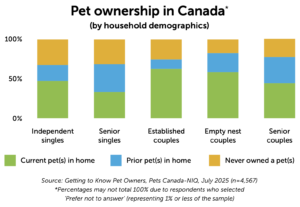
According to the survey Getting to Know Pet Owners, delivered by NielsenIQ for pet industry body Pets Canada, just over half of Canadian households (52%) currently have at least one pet. And more than half of those homes have multiple pets, with nearly a third caring for more than one species.
Breakdown by age
When looking more closely at age categories, we see that pet ownership among 25-34-year-olds remains strong, at 53%. This group also has the highest proportion of people who have never owned a pet. That points to continued growth potential, particularly as younger household shoppers navigate renting, urban living and delayed home ownership, while still expressing a strong interest in pets.
Midlife Canadians (aged 35-54) score slightly higher on current pet ownership. Adults aged 35-44 report above the total average, at 53%, and 45-54-year-olds are the highest over-indexed group, at 58%. These stages of life tend to offer greater housing stability, established routines, growing families and the financial ability to support pets – factors that continue to drive ownership rates.
Room for further expansion
Despite nearing retirement age, 55-64-year-olds also exceed the norm, at 56%. In contrast, Canadians aged 65-74 (46%) and those 75+ (28%) show ownership decline, falling under the national average. It is important to note these groups include experienced pet owners who may downsize – or adjust pet types and care needs – rather than leave pet ownership entirely, pointing to opportunities in senior-friendly products and services.
Taking a wider view, 73% of Canadians have owned a pet at some point in their lives. Over the past 15 years, both dog and cat ownership have risen consistently, with dog households growing slightly faster in recent years.
Looking ahead, there is certainly still room for growth. Nearly 15% of households that have never owned a pet say they are interested in doing so in the future, which provides a prime opportunity for market expansion.
Importance of veterinary advice
Canadian pet owners looking for advice turn to a mix of trusted sources. Across all pet owners, veterinarians are the most trusted source, with 60% of cat owners and 69% of dog owners relying on their guidance for daily care. As virtual veterinary services increase their presence, 11% of both dog and cat owners say they access them.
Friends and family are given as the next most common source, consulted by roughly one-third of dog and cat owners. This is followed by pet specialty store staff at 20%. Digital-first behavior increases for owners of birds, reptiles, fish and small mammals.
Sources of information
Reliance on sources varies significantly by pet species. For example, fish owners rely more on pet store staff, online discussion forums and instructional videos, whereas those with more niche pets such as reptiles, birds or small mammals tend to consult a wider range of online resources and group chats, rarely depending on a single source.
Shopping via social platforms and digital research is becoming increasingly important, so there is an exciting opportunity for businesses to create clear, trustworthy guides, quick reference tools and curated digital resources. These can help specialty pet owners navigate fragmented information and make more informed decisions about their pets.
Expenditure trends
In 2025, nearly one in four Canadian pet-owning households felt negatively about their finances, matching the 2024 data. Delving deeper, however, reveals that small mammal and reptile owners felt better off in 2025 than in the previous year, while bird owners felt worse.
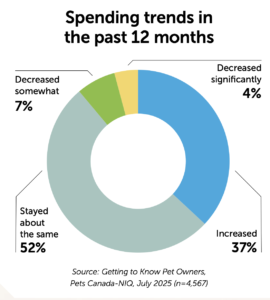
Among all pet owners, 37% say they have spent more on their pets in the past year. The largest spending increase appears to be among dog and bird owners, at 40%, while fish and small mammal owners saw the most notable decrease in spending, at 16%.
Looking to save money
All pet households were asked about the main ways they try to save on expenses. A substantial number seem to look for deals, with 38% stocking up on regular brands when they find them on sale. Others focus on value per unit, by buying larger sizes for better value (30%), as a way of avoiding reducing consumption.
One in four pet consumers use coupons (25%), which reflects increased price sensitivity and promotion engagement. Another 20% now only buy the essentials, so discretionary items are the most impacted among this group. Channel shifting to manage rising costs is also a strategy adopted by pet owners, with 16% switching to the lowest priced stores.
Value, sustainability and traceability
Pet owners are prioritizing value, leaning toward private label and value brands. This makes those segments well positioned for continued growth. Further NielsenIQ market research indicates Canadians are refining their spending by looking for brands that will fulfill a specific need, rather than staying brand loyal. As a result, 48% are buying more brands across more categories than ever before.
Sustainability is becoming an important factor for Canadian pet owners, with 52% saying it influences their pet food purchases. This is particularly notable among bird, fish, reptile and small mammal owners. While still a small part of the market, the presence of sustainable products is growing rapidly – reaching 19% in 2025, according to NielsenIQ. Pets Canada has been seeing this trend first-hand at its trade events.
Hot on the heels of sustainability is traceability. More than 50% of pet owners recognize the value of food traceability, i.e. they see merit in being able to trace a product or ingredient from its origin to their homes.
Reptile pet owners, followed by bird and dog owners, rate the significance of traceability as “very important” in their pet food choices. Canadian pet families are clearly interested in knowing what is in their pet food, where it comes from and how it is made.
Tariffs boost local brands
The impact of US tariffs has reinforced the importance of Canadian-made pet products for many households. Even before the tariffs, survey results showed that the country’s pet families value domestically produced goods, thanks to a competitive market and high-quality local suppliers. Today, 70% of pet owners say Canadian-made items are important to them, and 54% report that they are now buying more locally produced products.
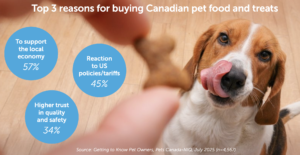
The reasons are clear. Supporting the local economy is very much at the forefront (57%), but trusting the quality and safety of ingredients is also very important to pet owners (34%). Other reasons include reacting to US trade policies, accessing fresher or locally produced items, benefiting from better pricing and availability, and knowing pets are getting well-sourced products.
Data provides opportunities
Pets have long held a special place in Canadian homes, and today that bond is stronger and more complex than ever. As the pet population continues to grow, so does the possibility for the pet industry to better understand who today’s pet owners are, what they value and how they care for their beloved companions.
The latest data offers a clear picture of these evolving relationships and what they mean for the future of the Canadian pet market. Pet families in the country are making intentional choices, seeking trusted advice, balancing spending pressures, prioritizing sustainability and traceability, and increasingly supporting new brands.
In terms of international interest in the Canadian market, Pets Canada has observed a growing demand for Canada-based shows from manufacturers outside of North America. For businesses across the pet industry, there is both a responsibility and an opportunity: to meet pet owners where they are and to continue to innovate in ways that support pets, people and communities.
Share this story: