US cat owners lean into wellness
The most recent APPA report provides detailed insights into trends in feline care – with the data showing that consumers are more mindful than ever of their companion’s wellbeing.
Cat owners are increasingly prioritizing high-quality, health-focused and environmentally friendly food choices for their pets, with human grade options on the rise. At the same time, the use of vitamins and other supplements continues to grow in popularity.
What’s in the bowl?
According to the American Pet Products Association’s (APPA) 2025 Dog & Cat Report, 38% of cat owners purchased premium cat food in 2024, up from 36% in 2023 and nearing the 2018 level of 40%. In contrast, basic food purchases fell to 38% in 2024, having peaked at 41% in 2023.
A cat food sub-segment that has shown significant growth in recent years is mixers and toppers. These were purchased by 19% of the respondents in 2024, up from 8% in 2018, as pet parents discover their benefits in helping to address issues with difficult eaters.
Looking at the label
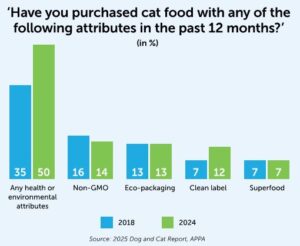
The shift toward cat wellness is also evident in the choice of functional foods. Half of the US cat owners (50%) reported buying food with at least one health or environmental attribute in the past 12 months, up from 47% in 2023. In 2018, just 35% of the respondents reported having done so.
When asked about the type of cat food they planned to purchase in the following 12 months, 14% of the respondents indicated an interest in buying clean-label foods, followed by human grade and eco-friendly packaging (both 13%).
US cat owners’ interest in pet food with attributes like these has been increasing since 2018. The biggest jump has been in human grade, up six percentage points over the six years.
Novel proteins and treat choices
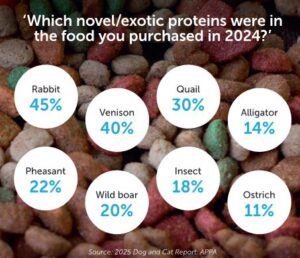
Rabbit (45%) and venison (40%) were the top novel protein ingredient choices in 2024. Since 2022, both have led this category, which also includes quail, pheasant, wild boar, alligator and ostrich.
Purchases containing these protein sources have all remained reasonably stable over two years. An exception is insects, which dropped from 25% to 18% between 2022 and 2023 and remained at that level in 2024.
Treat preferences are evolving with a health-conscious emphasis. Dental and breath-freshening items were chosen by 24% of the APPA respondents in 2024, up from 22% in 2022. Wet treats grew to 25% from 18% in two years, and other categories also gained traction, such as liquid and air-dried treats, at 9% in 2024, followed by freeze-dried (8%).
The products in the cat treat category that were purchased less by consumers in 2024 were natural treats (20%, down from 22% in 2022), while gourmet treats stayed steady (19% from 18% in the same two-year period).
Appetite for supplements
Vitamins and other supplements are increasingly popular among pet owners in the US in general, with a significant rise in the use for cats from 20% in 2018 to 34% in 2024. Multivitamins remain the most popular items, at 61%, almost matching 2022’s peak of 62%.
Prebiotics and probiotics held steady at 28% in 2024, maintaining their 2023 high after a steep rise from 21% in 2018, while digestion supplements reached a new peak of 26% in 2024. Other supplements, including those for immune support and joint health, as well as for skin, coat and nails, remain stable year over year.
Calming and grooming
The use of anxiety and calming supplements has declined steadily, falling by one percentage point per year to 17% in 2024. But purchases of other calming products have increased since the Covid pandemic, with toys, collars and sprays now also being used to keep a cat serene.
CBD is used by cat owners to help with different conditions. Although its use to treat anxiety is down since the peak of 30% in 2023 (25% in 2024) there was slightly increased use for treating pain in general (17% in 2024, up from 13% in 2018) and arthritis or joint pain (13% compared to 12% over the same period).
Professional grooming has experienced an uptick in recent years, with usage increasing by 10 percentage points over six years to 22% of the respondents in 2024. But many owners continue to groom their cats themselves, using an array of grooming tools.
Brush use is stable, used by three-quarters of pet parents (74%) in 2024, but less people are using combs (40% compared to 46% in 2018). Nail clipper and scissor ownership has increased substantially, from 41% in 2018 to 53% in 2024.
Protection from parasites
Another aspect of wellness is keeping cats free of fleas and ticks. Products are mostly purchased from a vet (35% in 2024), but this is down from 37% in 2020, while buying from pet superstores has increased to 22%, up from 10% in 2020.
Nearly all pet owners (96%) believe their pets bring them health benefits, with happiness/emotional support being the top ranked among the 13,910 respondents at 74%.
So it seems clear that these owners want the best for their pets too, and the increase in products promoting wellness for cats is an indication of that strong bond.
Share this story:
One click prioritizes GlobalPETS in your search results and AI answers.