World of wellness: in search of online pet supplements

Multivitamins might still lead the segment due to their convenience, but targeted, herbal and natural options for dogs and cats are increasingly sought after.
Pet owners are changing the way they buy supplements. They are timing purchases around sales events, focusing on specific or functional ingredients rather than brand names and generally becoming much more selective shoppers. For businesses in this space, understanding these changes is vital.
Promotional window effect
While overall category search declined by 1.8% in the US in 2025 compared with the previous year, a closer look reveals that pet owners are getting smarter about their purchases. Here’s what the US data shows: pet supplement searches peak consistently in July and October. Search volume jumped 35,000 from June to July 2024, and grew even larger last year with a 45,000 increase from June to July 2025.
These aren’t random months. July brings Amazon Prime Day, and October kicks off the fall promotional season. Many pet owners have simply figured out that, as supplements aren’t really impulse purchases, they’re happy to hold out for better deals.
This mirrors how people shop for other household essentials too. Supplements represent a commitment – both financially and to a pet’s healthcare routine – so consumers exercise patience. What this means for brands is pretty clear: your promotional calendar matters enormously. Getting visibility during these peak windows can make or break your year.
Specificity of searches
Dog owners are clearly driving the momentum in the pet supplements category. The most sought-after products skew heavily toward dog-specific needs, with probiotics and fish oils (almost 4 million clicks each) plus yeast infection treatment (almost 3 million clicks, up a whopping 731.5% in a year) dominating search activity.
While cat owners are also exploring probiotic options, as well as amino acids, their share of overall engagement remains far smaller. This is an indication of just how strongly dog supplement searches continue to outperform those for cats in the US.
As ingredients like these target joint health and mobility, this pet consumer interest tells us something that’s important for marketers to know: people are thinking ahead about their pet’s long-term wellness rather than just reacting to problems as and when they arise.
Appeal of multivitamins
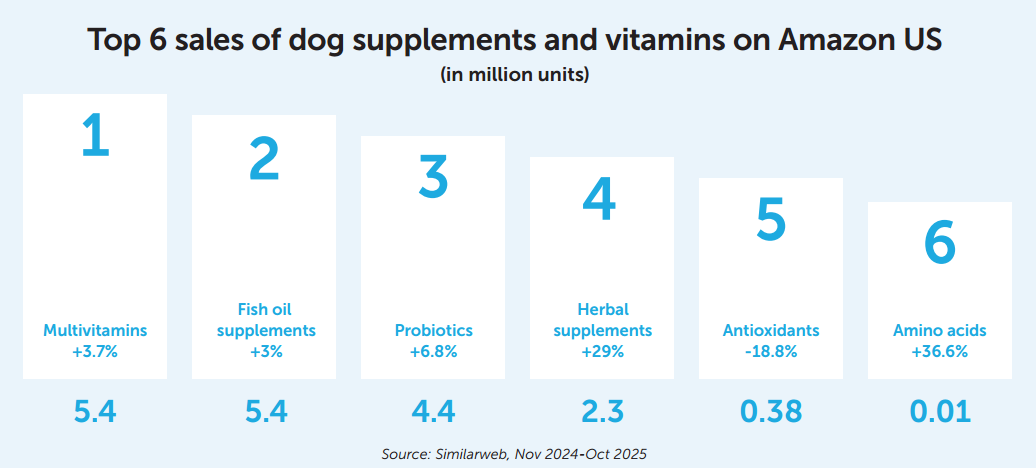
Total sales of supplements and vitamins for dogs at Amazon US in the period November 2024 to October 2025 were 18 million units, 5.7% up on the previous year. Multivitamins captured about 30% of category revenue share in the same period, growing slightly year on year. That’s a massive lead over other subcategories such as herbal supplements, antioxidants and amino acids – and the reasoning makes sense. Pet owners want simplicity.
Rather than juggling several different bottles for joint health, digestion, coat quality and immune support, they’d prefer one product that covers everything. It’s the same psychology that drives human multivitamin sales. People want comprehensive solutions without the hassle of complicated regimens. For busy households managing work, kids and pets, reducing decision fatigue is valuable.
Single ingredient options
Here’s the twist: while multivitamins dominate by volume, herbal supplements are growing much faster. We’re talking about 26% revenue growth on Amazon, if you compare the period November 2024 to October 2025 to the same timeframe in the previous year.
This absolutely smashes the category average. Interestingly, we’re seeing a huge revenue increase in the same period in the much smaller subcategory of amino acid supplements, up by 41.5%.
The surge in herbal supplements reflects a broader shift in the pet food industry toward natural, recognizable ingredients instead of more synthetic formulations. The top Amazon searches driving traffic to dog supplement listings very much prove this point.
Salmon oil, fish oil, probiotics – these are ingredient-specific searches from people who’ve already decided what benefit they want and are now hunting for the best product to deliver it. They’re not typing in brand names. They are searching for functional solutions. This represents a fundamental shift in shopping behavior that has major implications for marketing strategy.
Zesty Paws: successful SEO
A compelling case study is the US premium pet supplement business Zesty Paws. Despite revenue being down by about 5% year on year, the brand still controls approximately 10% of total dog supplement revenue on Amazon and drives impressive product page views. Its secret weapon? Mastering Amazon’s search ecosystem.
While traffic to its own website has grown 30% annually, the company’s real competitive edge shows up inside Amazon. Zesty Paws gets 47% of its clicks from Amazon’s search function, compared to 42% for the category overall. More significantly, 73% of those clicks come from non-branded searches, terms like ‘salmon oil for dogs’ where shoppers are researching ingredients rather than seeking specific brands.
Consumer search and product titles
Think about the opportunity that represents. When someone types ‘fish oil for dogs’ into Amazon’s search bar, they’re ready to buy but haven’t chosen a brand yet. By optimizing product titles, descriptions and backend keywords for these ingredient-based queries, Zesty Paws positions itself as the solution to functional needs, rather than depending solely on brand recognition.
This strategy is then amplified through paid search, sponsoring placements for the same non-branded ingredient terms. The combined approach – organic optimization plus paid visibility – keeps Zesty Paws high on the radar throughout the decision journey.
The takeaway for competitors? Success in supplements increasingly depends on being found when consumers search for solutions, not just when they remember a brand name.
Wider wellness context
Pet supplements don’t exist in a vacuum. They are part of a larger wellness movement reshaping the entire industry. This ‘petification’ trend shows up most clearly in the fresh food movement. Brands offering human grade, freshly prepared meals have seen dramatic growth.
Specialized companies like Smalls, Ollie and The Farmer’s Dog have built substantial businesses on the premise that pets deserve better than just traditional kibble. Even Chewy has jumped in with its Get Real private label fresh food line.
The connection to supplements is straightforward. Consumers willing to invest in premium, natural food are equally open to supplement regimens that support long-term health. The same values driving fresh food adoption, namely ingredient transparency, natural sourcing and functional benefits, apply to supplements too.
This creates interesting opportunities. Fresh food brands can credibly expand into supplements, while supplement brands can leverage the wellness narrative that fresh food has normalized. The consumer feeding their dog freeze-dried raw food is the same person searching for wild-caught salmon oil and grass-fed beef organ supplements.
Strategic priorities
Several clear actions emerge from this analysis. The first is to lead with ingredients rather than just brand messaging. Consumers are searching for specific functional ingredients, so clear communication about sourcing and efficacy matters.
Product pages should prominently feature ingredients, explaining why salmon oil improves coat health or how glucosamine supports joints.
Optimizing actual search behavior is key too. Brand building still matters, but discovery happens through ingredient and functional searches. Invest in keyword research around category terms and health benefit phrases. Target non-branded queries where shoppers haven’t made decisions yet.
Brands in the US should concentrate marketing around Amazon Prime moments. Those July and October search spikes align with when consumers are actively shopping and receptive to deals. Focus advertising spend, promotions and inventory around these windows to maximize visibility when purchase intent peaks.
Companies can consider embracing natural formulations. While multivitamins lead in volume on Amazon, herbal and natural supplements grew by 29% in the period from November 2024 to October 2025, compared to the same period in the previous year. Product development should prioritize recognizable, naturally derived ingredients. Consider reformulations emphasizing clean-label credentials.
A final tip: simplify choices for consumers. Multivitamin dominance proves people value simplicity. Differentiate through targeted bundles, senior dog formulas combining glucosamine, fish oil and probiotics, or puppy packs supporting early development. Reduce decision complexity while maintaining the perception of comprehensive care.
A strong rationale for growth
The industry teams at companies like Mars Pet and Hill’s Pet Nutrition view supplements as the next major growth frontier. The logic works. Fresh food addresses primary nutrition, while supplements allow personalized health interventions that feel premium and science backed.
Winners will be those that combine three elements – ingredient transparency that builds trust, search optimization that drives discovery, and formulations that deliver genuine benefits. In a category where consumers are willing to spend, but increasingly skeptical of hype, data-driven decisions about what to sell, how to position it and when to promote it will separate leaders from followers.
The pet supplement market may be stabilizing, but that stability reveals a more educated, ingredient-focused consumer base with clear preferences and predictable behaviors. For brands that can decode these patterns, the opportunity to capture meaningful share remains significant.
Share this story: