$43B: Global pet grooming market to more than double by 2035
Global grooming revenues are expected to rise by more than 9% annually, while rising labor, operating and compliance costs challenge businesses.
The pet grooming market is entering a period of rapid expansion, with its global value forecast to climb from $17.9 billion (€15.6B) in 2025 to $42.9 billion (€37.3B) over the next 10 years, according to the World Alliance of Grooming Associations (WAGA). That represents a compound annual growth rate (CAGR) of 9.1%.
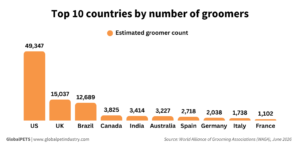
In terms of professional groomer count, the US leads the world with 49,347, followed by the UK (15,037), Brazil (12,689), Canada (3,825) and India (3,414), according to a report published in June by the association. Rounding out the top 10 are Australia, Spain, Germany, Italy and France.
Regional growth drivers
North America remains the largest revenue-generating region in the sector, accounting for 40% of global income. Here, a labor shortage is pushing up grooming prices, while mobile grooming services – which typically command 20-40% higher premiums than salons – are gaining momentum. According to WAGA, the mobile grooming market grew 37% over the past three years.
Meanwhile, Asia-Pacific is the fastest-growing region, led by China, India, Japan and South Korea, as rapid urbanization, rising disposable incomes and growing pet humanization drive market growth, the association says.
Globally, pet businesses are also increasingly adopting technology, with 58% of grooming appointments now being booked online or through apps, WAGA data shows.
Latest product launches
The pet grooming industry has also seen new product launches in recent months. In September, Miami-based fragrance specialist Doctor Aromas introduced pet perfumes in spray bottles. Meanwhile, Turkish pet care company Luvial launched new ear and eye wipe products under its Lumi-Noble brand.
In August, US-based pet health and grooming brand HICC PET launched its PRO Series, featuring eight wiping products for skin, eye, ear, oral, chin and anal gland care.
Cost pressures
However, rising costs beyond wages are affecting the sector. The International Grooming Society (IGS) identifies labor, rent and utilities such as electricity and water, which are needed for heating, drying and laundry, as key cost pressures. Businesses must also cover the ongoing expenses of items such as shampoos, conditioners, skincare products and disinfectant.
Equipment adds another layer of expense, from clippers, blades and dryers to grooming tables and baths, alongside maintenance costs. Meanwhile, insurance, software, payment processing, and administration increase the operating burden.
Raising standards
As the sector becomes more professionalized, stricter requirements and more comprehensive regulation are being introduced. Training and professional development costs go up as animal welfare procedures and documentation add to the workload. As a result, general inflation may not fully capture the increase in costs facing grooming businesses.
A recent example in October saw Singapore’s Animal & Veterinary Service (AVS) launch a revised Code of Animal Welfare for pet groomers, as part of broader efforts to safeguard animal health and welfare. For groomers, this means expanded competency requirements, including appropriate animal handling knowledge, breed- and species-specific grooming skills and relevant practical experience or training.
The Canadian city of Toronto, meanwhile, is bringing in pet establishment licenses from February 2027, creating a set of new requirements for pet-related businesses, including groomers.
Share this story:
One click prioritizes GlobalPETS in your search results and AI answers.