Analysis: E-commerce surge in MENA region opens new opportunities

Weekly online shopping is becoming increasingly common across the region, pushing pet players to rethink payments, fulfillment and customer engagement.
E-commerce adoption is accelerating across the Middle East and North Africa (MENA) region, with 45% of consumers now shopping online weekly or more often.
The MENA Digital Commerce 2026 report by fintech company Checkout.com found that half of consumers in Kuwait, Qatar and the UAE shop online at least once a week. In Saudi Arabia, 12% of consumers make multiple online purchases each day, double the share recorded in 2020.
Overall, middle-aged adults make digital purchases more frequently than any other age group. Around 51% of consumers aged 35 to 44 shop online weekly or more often. Despite being considered digital natives, only 33% of those aged 18 to 24 make an online purchase at least once a week.
Checkout.com also found that social commerce is gaining traction across the region. In 2026, 25% of UAE consumers shop on platforms such as Facebook, TikTok and Instagram, up from 22% a year earlier. Similarly, the share in Saudi Arabia increased by 1 percentage point (pp) to 26%.
The research is based on surveys of 26,000 respondents between 2020 and 2026. This year’s wave surveyed 4,002 adults across Egypt, Jordan, Kuwait, Qatar, Saudi Arabia and the United Arab Emirates (UAE).
Increasing trend
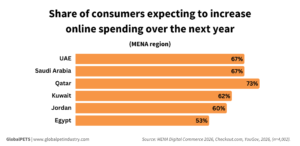
Over the next 12 months, 63% of consumers expect to shop online more frequently, driven by respondents with greater spending power.
More than 6 in 10 middle-aged consumers with stable incomes, young adults in their prime spending years and those in the highest income brackets all expect to increase their online purchasing frequency over the next year.
The intention to increase online purchases is highest in Qatar (73%), followed by Saudi Arabia and the UAE (67%), Kuwait (62%), Jordan (60%) and Egypt (53%).
The pet retail sector
The shift toward online shopping is also influencing how consumers purchase pet products, with omnichannel experiences becoming increasingly important for pet owners across the region.
According to Siddarth Mahindra, Board Member of Dubai-based pet retailer Pet Corner, online spending on pet products in the UAE has grown significantly in recent years, driven by convenience, trust, product availability and faster fulfillment.
“This shift is being driven by busy lifestyles, higher expectations for speed, stronger brand awareness and the need for reliable access to supplies and services,” Mahindra tells GlobalPETS.
Amin Dolat Shahi, Group Marketing and E-commerce Manager at Petzone, a Kuwait-based online pet retailer, adds that online channels are primarily used for planned, high-volume stock-up purchases. “Because of this, online orders typically generate a higher average basket size than offline impulse purchases.”
Other growth drivers
Amr Hazem, CEO of The Petshop UAE, explains that pet families have become significantly more informed.
“They actively research nutrition, preventive healthcare and wellbeing before making purchasing decisions, and that is naturally driving demand for premium products and trusted advice,” Hazem says.
Shahi adds that the Gulf region has some of the world’s highest smartphone and internet penetration rates.
The latest Saudi Internet Report 2025, published by Saudi Arabia’s Communications, Space and Technology Commission (CST), reports that internet penetration in the Kingdom reached 99.6% in 2025. Other Gulf countries also record some of the world’s highest levels of internet adoption. The United Arab Emirates, Qatar, Bahrain and Kuwait all have internet penetration rates above 98%, according to global digital connectivity data.
Purchase preferences
Food delivery is the most popular e-commerce category among MENA consumers, with 59% of respondents purchasing these services online. Clothing and fashion accessories rank second (54%), followed by travel services such as flights, hotels and rentals (40%), and beauty and grooming products (38%).
Within the pet care sector, Mahindra from Pet Corner notes that online sales growth is being driven by pet food, cat litter, treats, grooming products, supplements, veterinary care products and other convenience-based recurring essentials.
For pet food, customers are increasingly seeking breed-specific diets, life-stage formulas, hypoallergenic options, health care, weight management products, fresh meat formulas and premium nutrition.
Heavy products such as cat litter are also increasingly being purchased online, as e-commerce eliminates the inconvenience of carrying large bags.
Demand for fast payments
For online shoppers in the region, convenience also means a fast and secure payment process. The Checkout.com report showed that 35% of consumers said a fast payment process is one of their top 3 priorities.
It also found that a payment failure on the merchant’s end will send 62% of consumers away, while over a third (35%) will go directly to an online competitor after one payment failure.
For pet retailers, this is an opportunity. Shahi from Petzone says that integrating flexible, zero-interest payment structures directly into the checkout process is a crucial trend to support customers purchasing premium goods or buying in bulk.
“The rapid growth of integrated Buy Now, Pay Later (BNPL) options like Tabby, alongside local payment gateways, has significantly reduced checkout friction and boosted online conversion rates,” he explains.
Use of AI
Awareness of artificial intelligence (AI) is already well established across the region. Checkout.com found that 65% of consumers are familiar with agentic AI, while 50% say they are comfortable with AI shopping on their behalf. Only 19% express discomfort, while 31% remain neutral.
Comfort with agentic AI is highest in Qatar (56%), followed by Saudi Arabia (55%), the UAE (54%), Kuwait (49%), Egypt (44%) and Jordan (41%).
By demographic, high-income consumers are the most comfortable using AI agents for shopping in the future (67%). Among low-income consumers, this falls to 38%.
When asked which shopping tasks they would be willing to delegate to AI agents, half of respondents chose finding the best prices. This was followed by comparing products and reviews (41%) and creating shopping lists (30%).
Consumers are also willing to delegate practical tasks to AI agents, including buying groceries (27%), booking travel (25%), managing subscriptions (24%), reordering household items (23%), buying clothes (23%) and purchasing gifts (21%). Only 12% said they would not delegate any shopping-related tasks at all.
Opportunities for pet retailers
Pet retailers are also adopting AI to improve operations and customer engagement. Hazem says The Petshop uses the technology to improve operational efficiency, accelerate content creation, optimize digital marketing and SEO, and personalize customer communications.
Shahi of Petzone adds that AI can be used for behavioral diagnostics through the helpdesk platform Intercom, enabling hyper-personalized marketing. Beyond that, it is also improving operational efficiency through inventory optimization.
“By natively integrating our e-commerce platform with SAP ERP [enterprise resource planning], we leverage data forecasting to synchronize our physical stores and decentralized warehouses. This ensures that high-demand products, such as specialized food formulas, are always in stock and routed efficiently,” he concludes.
Share this story:
One click prioritizes GlobalPETS in your search results and AI answers.