Data: Are UK pet owners shifting toward quality over cost in purchasing decisions?

Half of UK consumers now prioritize quality over price, while convenience drives supermarket dominance in pet product purchases.
Veterinarians remain the most trusted source of advice for UK pet owners when dealing with flea infestations, cited by 55% of respondents in a 2026 survey by Johnson’s Veterinary Products.
This marks a broadly stable trend compared to 2022, when 57% of respondents also cited veterinarians as their preferred source of advice.
Reliance on online searches declined from 35% to 31% over the period, while the share of pet owners turning to local pet shops fell 6 percentage points to 28%.
The survey, conducted by Censuswide, polled 1,076 UK pet owners in February 2026.
Consumer awareness
When asked how often they use social media platforms or AI tools to seek information about pets and related products, 29% of respondents said they always or often rely on these channels. Usage was significantly higher among younger consumers, reaching 54% among those aged 25-34 and 47% among those aged 18-24.
By contrast, 57% of respondents aged 55 and over said they never use social media or AI for pet-related information, suggesting a preference for face-to-face guidance among older generations.
Product packaging remains an important source of information. Overall, 71% said they always or often read packaging before treating their pets. This figure rose to 76% among respondents aged 45 and over, compared with 59% among those under 45.
Influence factors
Environmental and ethical considerations also influence purchasing decisions. Ingredients ranked as the most important factor, cited by 38% of respondents, followed by natural formulations (35%) and cruelty-free credentials (30%). British manufacturing was important to 26%, while 23% cited packaging materials.
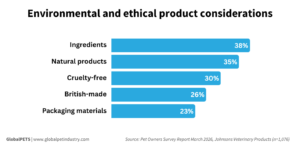
Priorities varied across age groups. Among respondents aged 55 and over, cruelty-free claims (38%) and British manufacturing (31%) were the leading considerations. In contrast, pet owners aged 25-34 placed greater emphasis on organic ingredients (34%) and packaging materials (30%).
Overall, 22% of respondents said environmental factors do not influence their purchasing decisions at all, while nearly 4 in 5 pet owners consider ethical or environmental factors to some extent when choosing products.
Retail channels
Supermarkets remain the leading retail channel for pet products, used by 32% of respondents. Veterinary practices were used for 19% of purchases, followed by online retailers (17%), national chains (12%) and independent pet shops (12%).
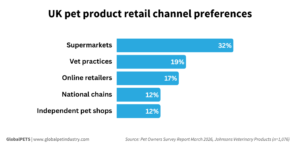
According to the survey, supermarkets benefit primarily from convenience, allowing shoppers to purchase pet products alongside their regular groceries.
Perceptions of independent pet retailers were generally positive: 23% of respondents described them as knowledgeable and trustworthy, although this was down from 28% in 2022. Meanwhile, 21% said independent retailers care more about customers and their pets than larger stores, which remained unchanged from 2022.
Younger consumers expressed the strongest support for independent retailers. Among those aged 25-34, 25% trusted their expertise, and 28% valued the personalized service they provided.
Purchasing drivers
Quality emerged as the leading purchase driver, cited by half of respondents, ahead of cost at 45%. This marks a shift from 2022, when cost ranked first at 50%, compared with 46% for quality.
According to Johnson’s Veterinary Products, the results suggest that consumers are making more deliberate purchasing decisions rather than simply opting for the lowest-priced products.
Trust ranked third at 39%, followed by convenience (24%), reviews (20%), face-to-face interaction (14%), loyalty to local shops (12%) and a desire to support high street commerce (9%).
Lower prices were the most cited reason for visiting a pet shop more frequently, selected by 39% of respondents. Other motivators included special offers (28%), convenient location (26%), wider product choice (23%), expert advice (21%) and community events (9%).
Cost-of-living pressures
Despite quality overtaking cost as the primary purchasing factor, affordability remains a concern, as 42% of respondents said they had switched pet products in the past 12 months to save money.
The trend was strongest among younger consumers. More than half (55%) of those aged 25-34 and 50% of 18-24-year-olds reported switching products, compared with 29% of respondents over 55.
According to the report, this generational divide reflects the greater financial pressure facing younger households.
Regional differences were also evident. Pet owners in Greater London (55%), Wales (46%) and the East of England (46%) were the most likely to switch products for affordability reasons.
“Retailers in areas where cost sensitivity is highest may benefit from more visible value messaging, special offers or loyalty incentives that acknowledge the economic reality without undermining the quality proposition,” the report concludes.
Share this story:
One click prioritizes GlobalPETS in your search results and AI answers.