Data insight: Pet gifting defies the holiday spending slowdown

While shoppers tighten budgets amid economic uncertainty, pets continue to rank among the top holiday priorities.
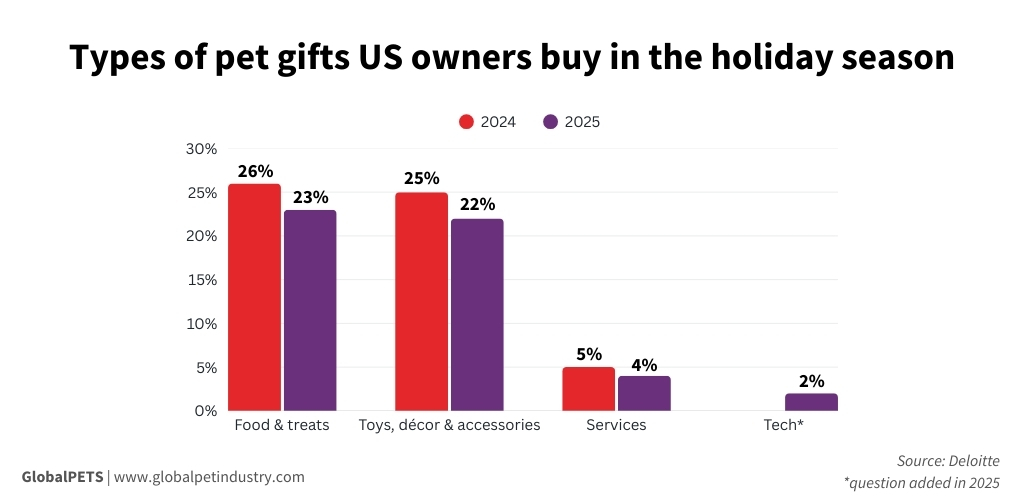
According to a Deloitte survey of 4,270 consumers in the US, almost one quarter (23%) of pet owners plan to purchase pet food and treats as gifts, while 22% plan to purchase toys, decor and accessories.
Only 4% will opt for services such as spa, grooming or training and another 2% are looking for GPS trackers, auto-feeders and smart collars.
Buyers intended to make pet purchases mainly in-store (59%), with 41% preferring an online shop. This survey was conducted between 27 August and 5 September.
UK: pets come first
Pets are popular in British holidays as well. Research by retailer Pets at Home found that 3.1 million households will spend more on gifts for pets than on any other family member. The survey was conducted in October and included a sample of 2,000 adults in the UK.
According to the retailer, this means that 1 in 3 pets, or a total of 6.4 million, will be the most spoiled family member this Christmas, with rabbits leading as 70% of their parents are willing to buy them presents, followed by dogs (59%) and cats (48%).
Almost half of pet parents plan their Christmas around their pets, and 14% say they’ll “sacrifice festive events with friends and family to stay home with them.”
Regarding grooming, 24% of parents will book services for their pets before booking services for themselves. And a similar number of respondents (25%) are “more likely to buy a new festive outfit for their pet than for themselves.”
Uncertainty
Deloitte highlights that consumers are feeling “uncertain” heading into the holiday season this year and plan to cut back on spending. “This is causing a pull-back in most gift categories, although the pet category is holding fairly steady,” Lupine Skelly, Retail Research Leader at Deloitte, tells GlobalPETS.
Consumers in general “are showing strong value-seeking behavior,” Skelly says, which leads to 75% say they will “focus on promotional events to maximize their holiday budgets.”
According to Thomas Elliot, Managing Director of Consumer Goods Investments at Capstone Partners, there is a “big concern over consumer spending” in the market now, especially in the US, and the holiday season is a good bellwether to measure it. “We will know more about exactly how conservative the US consumer is with their money,” based on after-season metrics, Elliot tells GlobalPETS.
Although spending on pet goods has been moderate over the past 2 years in America, Elliot says some of his clients in the sector reported a positive November. “I’m optimistic about the season, although this is a small sample size,” he adds.
Global holiday spending
In the US, the National Retail Federation forecast that overall retail sales in November and December would grow between 3.7% and 4.2% year-over-year (YoY), translating into total spending of $1.01 trillion (€860M) to $1.02 trillion (€870M).
By comparison, last year’s holiday sales rose 4.3% over 2023 to reach $976.1 billion (€832.9B). “We remain bullish about the holiday shopping season and expect that consumers will continue to seek savings in nonessential categories to be able to spend on gifts for loved ones,” says Matthew Shay, president of NRF.
In the UK, the management consulting firm Bain forecasts a 2.5% YoY growth in retail sales during the same period, but noted that most of the gain is due to inflation, while volumes are expected to decline. Currently, inflation rates stand at 3.8% and are even higher in essentials like food.
In France, a marginal 0.5% YoY growth in retail sales is expected amid political instability, rising unemployment and slowing income growth, which dampen consumer confidence and spending.
Meanwhile, in Germany, Bain anticipates 2.5% YoY nominal growth in retail sales, with flat volume, driven by resilient wages. This forecast is lower than last year’s 3.9%, as political pressures, cost-of-living concerns and unemployment rates rise.
In short, while cost pressures are weighing on global spending, data show pet spending signaling a bit stronger, though inflation and uncertainties persist.
Holiday travel
Over half of American pet owners (54%) are also planning to bring their pets along on their travels, according to a survey of 1,000 pet parents by US pet care platform Kinship.
A majority of respondents (51%) will travel by car, and only 3% will take their pets on planes this holiday season.
Among those planning to travel with their pets, Millennials are the most likely to do so (56%), followed by Gen Z (51%) and Gen X (49%).
Americans are expecting to spend an average of $242 (€206.50) to travel with their pets over the holidays. Among the generations, Gen X are the biggest spenders, planning costs of $281 (€239.78), while Millennials budget $277 (€236.37) and Gen Z, $248 (€211.63).
Share this story:
