Flea and tick prevention gaps persist despite increased awareness

A survey shows that more than half of pet owners miss doses, while veterinarians warn that seasonal treatment leaves pets vulnerable to disease.
Fleas and ticks remain a major concern for many pet owners, yet many are not complying with recommended treatments.
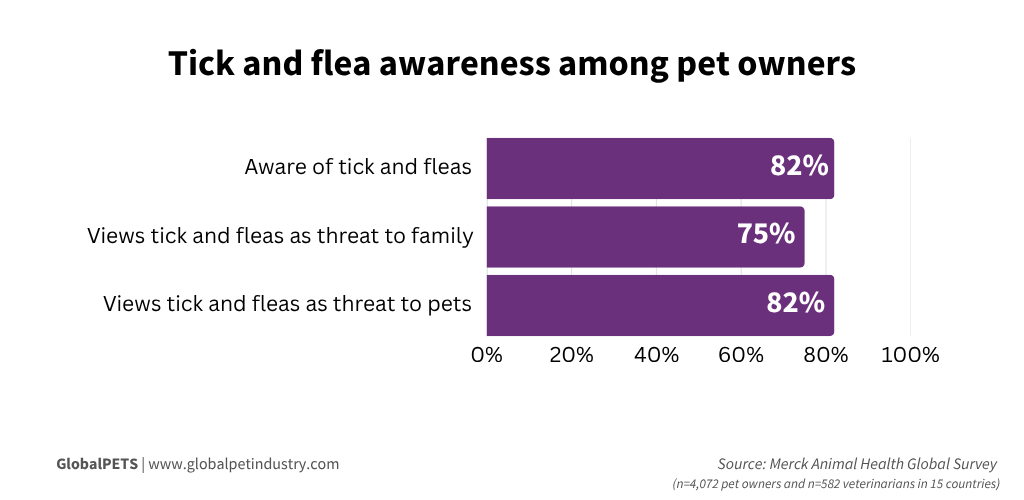
According to Pet Owner & Vet Perspectives on Parasite Treatment and Prevention: A Global Survey by Merck Animal Health, 82% of owners see fleas and ticks as a threat to their pets and 75% as a threat to their families, but vets report that more than half of concerned owners still do not administer treatment year-round.
More than 8 in 10 (82%) of pet owners are aware of flea and tick threats to their pet’s health, but only 40% strongly agree that it is a threat to their personal health.
Merck surveyed 4,072 pet owners and 582 veterinarians in 15 countries, including Australia, New Zealand, Brazil, Canada, China, France, Germany, Italy, Japan, Mexico, Peru, Poland, Spain, the UK and the US. The research took place in January 2025.
Reported cases
Globally, over half (51%) of dog owners reported having a flea or tick issue at least once or twice, and 66% of outdoor cat owners reported the same.
Meanwhile, 43% of exclusively indoor cat owners reported experiencing a flea and tick problem.
Challenges
According to the data, 80% of surveyed pet owners feel confident in administering flea and tick medication.
At the same time, 74% of veterinarians worry that pet owners are not consistently administering flea and tick prevention medication (administering late or missing doses).
Notably, 56% of pet owners admit that administering flea and tick solutions can be difficult, and 46% of dog owners and 51% of cat owners share that they have forgotten to administer flea and tick treatment in the past year.
In the US, veterinarians report high levels of non-compliance, with two-thirds saying most pet owners do not follow year-round treatment and are more likely than their global peers to admit missing doses.
Managing flea and tick
Nearly half, or 44% of pet owners, believe that flea and tick season is during the summer months, but veterinarians are four times more likely to define flea/tick season as year-round.
In the US, half of pet owners see fleas and tick-borne illness as potential risks to their pets, themselves or their families. However, compliance in administering flea and tick preventatives remains difficult, and long-duration medications may be an option to help ensure year-round compliance.
Globally, two-thirds of vets (65%) would be likely to recommend an annual medication option, and 3 in 4 (75%) pet owners are likely to try a once-yearly medication.
Pet owners and veterinarians also agree that prescription options are preferred, with veterinarians viewing them as more effective than over-the-counter (71% vs. 4%) and owners placing greater trust in them (79% vs. 47%).
Share this story: