Interview: Proteine Resources aims to raise the bar for insect protein in pet food
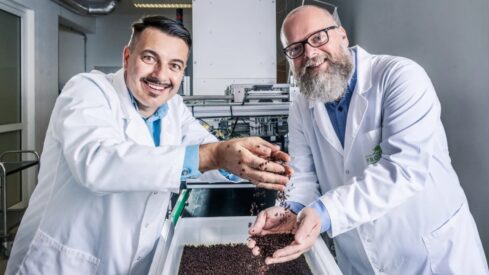
From AI-driven automation to circular feedstock, the Polish startup is scaling insect protein production following a €9.5 million capital injection.
As the pet food industry continues to demand sustainable, high-quality and affordable protein alternatives, a Polish startup aims to move beyond being just another insect protein player, but to redefine ‘premium.’
Proteine Resources secured in July €9.5 million ($8.2M) from the European Innovation Council (EIC) Accelerator funding program under Horizon Europe, the EU’s key funding program for research and innovation.
Having been involved in various industries, including software development, company Co-founder and co-CEO Bartłomiej Roszkowski says in an interview with GlobalPETS that his stepping into the pet industry is different. “What we’re doing now is the most impactful business I’ve built.”
10x leap
Proteine Resources, headquartered in Masłomiąca (270 km south of Warsaw), has been quietly developing its technology and know-how since 2018.
However, it’s now scaling out of stealth mode in a significant way, launching a tenfold expansion of its production facility. The first commercial-ready protein batches are expected to enter the market by the end of next year.
The company is currently working closely with 10 customers on final formulations, and demand is already exceeding current capacity. With all necessary veterinary and Hazard Analysis and Critical Control Point (HACCP) approvals in place across the EU, it is ready to meet that demand.
While some alternative protein ventures may have decided to scale too early by building “gigafactories” before securing feedstock or consumer acceptance, Proteine Resources is taking a different path: modular, scalable, feedstock-optimized production.
And they’re betting that the next evolution of pet food will prioritize functionality over sustainability alone.
“Pet parents are humanizing their animals. They want functional products, not just fillers,” Roszkowski says. “It’s not enough to be sustainable. You have to work. You have to taste right. You have to deliver value.”
Production
The company’s facility is expected to be the first fully autonomous insect protein production plant of its kind globally, while the choice of insect, buffalo worm, also steers clear of ‘route-one’ insect protein production.
“Not all insects are created equal,” Roszkowski says. “Some can’t be automated; they fly or jump. Buffalo worms don’t. They stay in their boxes through the entire life cycle, which is perfect for automation.”
And it is perfect for scalability, as the worms grow quickly and offer up to 70% protein in dry mass, far outperforming more commonly used insects like the black soldier fly (BSF), which has a lower protein and higher fat content.
The automation benefits of the buffalo worm are not the only reason the company has not opted for BSF.
“Black soldier fly is low to mid quality,” states the CEO. “Ours is a premium product. Leaner, richer in essential amino acids, some even exceeding those found in beef.”
Truly circular
Proteine Resources has created a truly circular economy model, going beyond the increasingly common practice of feeding waste products from another industry to the insects and passing on the unwanted waste from protein production to a third industry.
The Polish startup is utilizing waste from the mushroom industry, specifically mycelium and stems, which are produced in massive quantities (6.5 million tons annually in the EU) and serve as feedstock for buffalo worms that are rich in nutrients, pesticide-free and produced year-round.
Its by-product becomes a fully organic fertilizer that is being trialed as a peat alternative for the same mushroom farms, replacing environmentally damaging turf.
With the UK, Norway and Switzerland already banning peat extraction and Russia, formerly the largest exporter, now unavailable due to the Ukraine conflict, the timing couldn’t be better.
“It’s not just zero-waste,” Roszkowski explains. “It’s value-creation. We’re taking a problem for one industry and solving two of their biggest issues, waste disposal and substrate shortages, in one.”
Palatability and price
While the ability to produce at scale and sustainability are hugely important, there is no business unless pets like the end product.
Roszkowski adds that while cats have reportedly rejected black soldier fly protein, the company’s buffalo worm protein contains amino acids that not only meet dietary needs but also act as palatants, particularly for cats.
“Our product sits somewhere between beef and plants,” he explains. “It delivers protein with a lower carbon footprint and cost than beef, and includes chitin, a natural fiber essential for cat digestion.”
Compared to beef, the product is 20-30% cheaper, while offering comparable nutritional value, Roszkowski says.
And while it’s not a one-to-one sensory replacement, its functional benefits and environmental edge make it an obvious choice for manufacturers looking to improve margins without compromising quality.
AI powered
Technology underpins the company’s entire production model, using a proprietary AI-controlled environment management system that automates every aspect of the rearing process, including temperature, humidity, and early stress detection.
What traditionally required highly skilled human labor for tasks, such as visual inspection of insect colonies, is now fully automated through multispectral analysis, a system capable of monitoring entire stacks of boxes in real-time.
“This means we don’t just do sample-based quality control,” Roszkowski notes. “We analyze everything, constantly,” adding that this is not just more efficient but more consistent, more scalable and far more cost-effective.
What’s next?
Fresh from the funding from the EIC Accelerator, the company has no immediate plans for a major funding round until 2026-2027, when a Series B or perhaps even an IPO may be on the table.
“We need to deliver results with this funding,” concludes Roszkowski. “We’re raising a small top-up round, but the next major step will be after we’ve proven this model at scale.”
In the longer term, licensing its technology is also part of the strategy. Rather than competing with other players, Protein Resources aims to enable collaboration by providing others with access to its automated, AI-managed facility model.