Less is more: What European owners want from smart pet devices
Younger pet owners embrace extra features, while older ones value trust, clarity and cost, according to a new survey.
As pet tech continues to gain traction, companies are ramping up innovations, adding new features to devices for health monitoring or location tracking. However, a survey by tech company Weenect shows that some of these innovations may be unnecessary for pet owners.
Weenect’s study on the perception of pet tech, which involved 1,929 dog and cat owners in France, Germany, Spain, Italy, the United Kingdom and the Netherlands, reveals that less is more for pet owners when it comes to smart devices.
Preference
Nearly 8 in 10 respondents (79.3%) prefer a simple, reliable GPS tracker over a multifunctional model. This preference is similar among dog owners (78.5%) and cat owners (80.1%).
In addition, 75.3% of respondents prefer a single reliable function over an “all-in-one” product due to concerns about complexity and multiple failures.
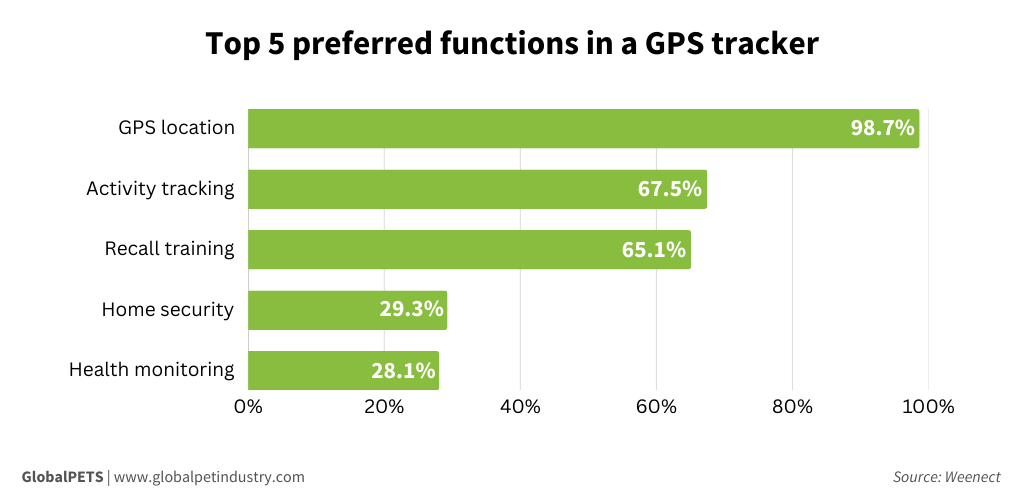
Feature-wise, nearly all (98.7%) value GPS location, followed by activity tracking (67.5%) and recall training (65.1%).
However, preferences vary depending on the type of pet. For instance, the recall training and activity tracking features are more popular among dog owners, with +8.8 percentage points (pts) and +4.9 pts, respectively. Meanwhile, cat owners place more value on home control (+10.1 pts) and connected litter boxes (+5.9 pts).
“As technology becomes more sophisticated, pet owners are becoming more selective – not more demanding in terms of feature quantity, but in terms of clarity, reliability and transparency,” Adrien Harmel, Co-founder and CMO of Weenect, tells GlobalPETS.
“They want technology that solves a specific problem exceptionally well, that is easy to understand and that works seamlessly in the background,” he adds.
Tech mistrust
Nearly 6 in 10 respondents (59%) say transparency is important to them; specifically, they are interested in knowing exactly what data is being collected.
In general, trust in a tech tool concerning data privacy remains fragile, the report says, with only 48.8% partially trusting, 25.3% totally trusting and another 25.2% not trusting at all.
On average, 59.5% fear a false diagnosis, and 39% are concerned about data protection. “Transparency and education about usage are key to removing these barriers,” the company says.
Over half (54.1%) also believe technology can go too far, with 23.6% thinking it already does, and only 22.3% say it has advantages, which is more prevalent among younger respondents than seniors.
Health features
When it comes to health features, such as activity and vital signs monitoring, less than half (42.5%) consider these functions useful, but only if they meet a concrete need.
Interestingly, pet owners aged 24–34 are more likely than those over 55 to rely on veterinarians.
On the other hand, more than a quarter (25.7%) believe it goes too far, while 20.8% see it only as marketing.
Almost 60% also refuse to pay more for additional functions, and only 14.8% would do so if the added value is genuine, a trend seen more among young urban residents.
Budget constraints are more prevalent among pet owners aged 55 and above and those living in rural and peri-urban areas.
Demographic differences
Notably, 58% of the survey respondents are aged 45 and above. This means their views on tech are overrepresented compared to younger generations.
The study reveals clear demographic patterns in how different groups approach pet technology. Age emerges as one of the strongest factors: younger pet owners are far more open to tech adoption.
More than 70% of those aged 18–24 want full transparency around data collection, and the willingness to consider additional features is noticeably higher among pet owners under 35. Older respondents are not just more cautious about tech adoption; they are also more price-sensitive and distrustful of connected health products.
For Adrien Harmel, pet tech tools of the future may become more “explanatory” rather than part of everyday pet care. AI will be a big part of this innovation, as there is already a growing number of experimental ideas.
Share this story: