One in seven Swedes to stop cross-border shopping over EU customs duty

Survey data show younger consumers and those in larger cities are less likely to change their habits after the new EU charge on low-value packages.
New research in Sweden suggests that the EU’s new €3 duty on low-value imports could prompt some consumers to reconsider purchases from online stores outside the bloc.
Rethinking non-EU shopping
More than 1 out of 10 (14%) respondents state they would stop shopping from countries outside the EU completely after the new €3 duty, according to a survey commissioned by the Swedish Customs Service (Tullverket) seen by GlobalPETS.
This share rose to 23% among women aged 65 to 84. Furthermore, 19% of respondents in this age bracket expressed support for this option.
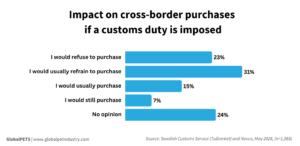
The survey polled 1,068 Swedish adults between 14 and 21 May, a few months before the removal of the de minimis customs duty exemption for e-commerce imports valued at up to €150 ($171). The exemption was replaced by a flat-rate duty on low-value imports entering the EU.
Urban shoppers less likely to change habits
Meanwhile, 24% say they would continue shopping from non-EU countries, although less frequently. Among men aged 35 to 49, this rose to more than 3 in 10 (33%).
The survey shows that residents in Stockholm are particularly likely to cut back on purchase frequency (30%).
Another 41% say the customs duty would not affect their shopping decisions at all. The share reached 49% among consumers aged 18 to 34 as well as those residing in larger urban areas.
Non-EU platforms reach a third of Swedish shoppers
According to the data from Tullverket, 1 in 3 (33%) Swedish consumers shop online from non-EU e-commerce platforms, with 12% doing so a few times per quarter and 19% a few times per year. The survey also reveals that 2% of Swedish consumers shop monthly.
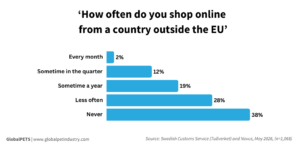
Those who buy frequently each quarter are mostly men aged 50 to 64 (18%) and households with children (18%).
The proportion who never bought from non-EU stores was higher among women (45%) and consumers aged 65 to 84 (46%).
Share this story:
One click prioritizes GlobalPETS in your search results and AI answers.
