Survey: Pet boarding drives revenue for global pet care operators
Established businesses report stronger owner income, while customer retention and add-on services support performance.
Pet boarding is the largest revenue generator for pet care service operators globally, according to the Pet Boarding Industry Benchmarking Survey by The Dog Gurus, the International Boarding & Pet Services Association (IBPSA) and PocketSuite.
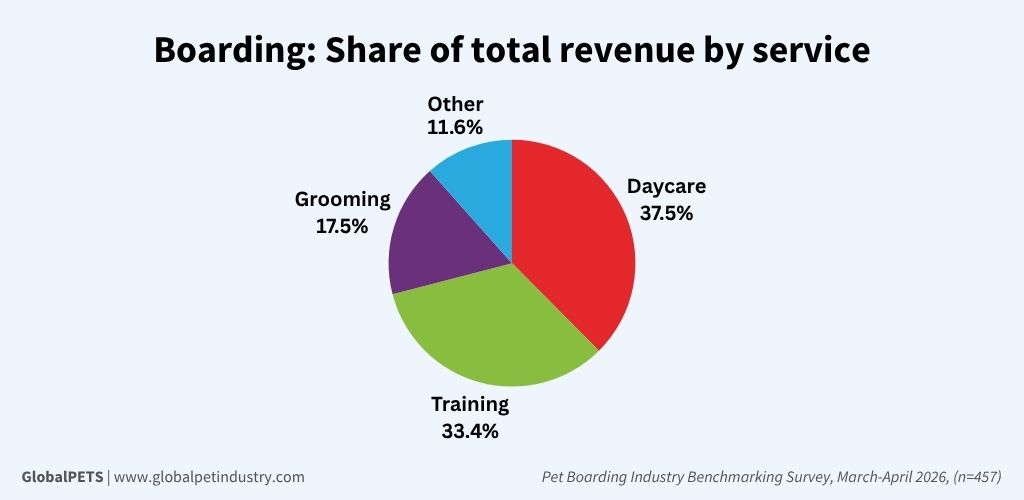
The survey, which polled 457 pet care operators across 9 countries between 2 March and 7 April, found that 42.1% of total revenue came from boarding, followed by daycare (21.7%), training (19.3%) and grooming (10.1%).
Participants were based mainly in the US (93%), with additional respondents from Canada (4%), Australia (2%), the UK (1%), and Algeria, China, Mexico, Sweden and New Zealand (less than 1% each).
Business profile
Among the businesses surveyed, 41% had been established for more than 15 years, while 32% had been operating for 6 to 15 years. The remaining 27% had been established for 1 to 5 years. Overall, 81% operated from a single location, while 8% had at least 2 locations. Meanwhile, 57% owned the property where their facility was located, while 35% rented or leased their facilities.
Capacity and bookings
Boarding had the highest capacity utilization, with 6 in 10 respondents reporting that the service was filled to at least 50% of capacity on average across the year. Daycare followed with 5 in 10, while grooming and training recorded lower utilization rates of 36% and 33%, respectively.
Most businesses reached maximum capacity during high-demand months, with many appointments booked in advance. This suggests pet owners are incorporating these activities into their animals’ routines.
At peak periods, 27% of respondents said they were typically fully booked 2 to 3 weeks in advance. Meanwhile, 18% said they were fully booked in less than 2 weeks or 1 month ahead of time.
Another 13% reported being booked 2 months ahead, while 11% were booked 3 or more months in advance. Only 13% said they were not typically fully booked.
Business performance
Financial returns for these establishments are improving, although a small portion still struggles to become profitable.
For instance, 60% of respondents reported year-over-year results ranging from no change to growth of more than 21%, while 17% reported declines ranging from 3% to more than 21%.
More than half of those surveyed said at least 75% of their monthly revenue came from repeat customers, highlighting the importance of customer retention in the pet care services sector.
Notably, 42% said they were happy with the income they received from their business, while 33% were satisfied. However, 25% were not happy.
Overall, 86% reported receiving personal income from their business over the past year. Among those with a single location, 85% received personal income, compared with 91% among those operating 2 or more locations.
Income stability
Business tenure appeared to influence owner income. Those operating for more than 10 years recorded the highest percentage of owners receiving personal income, at 91%, followed by those operating for 3 to 10 years at 87%.
Meanwhile, only 54% of businesses operating for less than 3 years reported that their owners received personal income, suggesting that newer companies may face greater challenges in generating sufficient returns.
Customer engagement
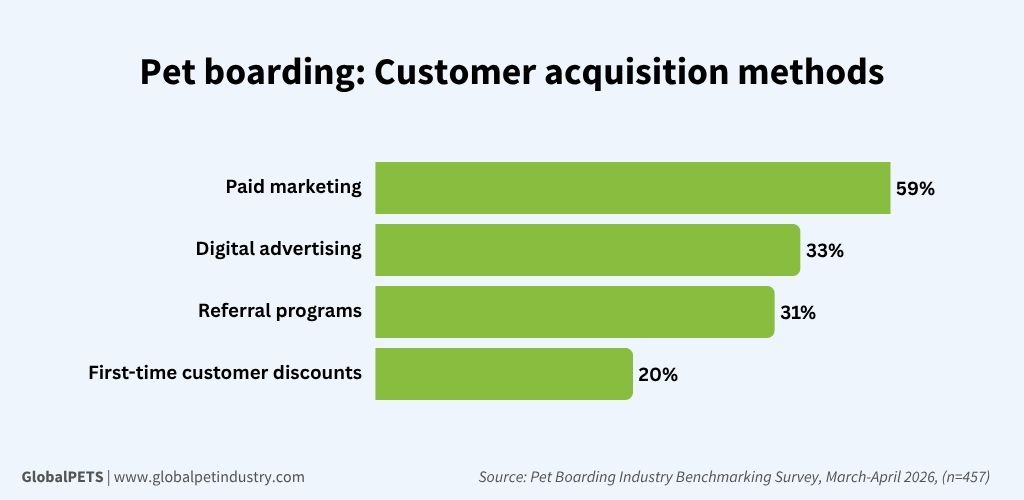
To acquire new customers, 59% said they paid for marketing, while 33% paid for digital advertising. Referral programs were used by 31%, while 20% offered introductory or first-time customer discounts.
Add-on services were also common, with 71% reporting that at least 1 in 10 customers purchased services beyond the base booking. Specifically, 29% said 1 in 10 customers purchased add-ons, 28% said 2 to 3 in 10 did so, 21% reported 4 to 5 in 10, and 22% said 6 or more in 10 made additional purchases.
Labor costs
Regarding labor costs, including spending on contractors and consultants, 20% said they spent less than $75,000 (€66K) during the last fiscal year. Another 35% spent between $75,000 (€66K) and $369,999 (€326K), while 35% spent between $370,000 (€326K) and $2.99 million (€2.63M).
Share this story:
One click prioritizes GlobalPETS in your search results and AI answers.