US: Unexpected costs cause pet owners financial stress

A new survey reveals that veterinary bills remain the top concern, with charges reaching up to $250.
Data from the 2025 Lifetime of Care study by Synchrony, a US-based consumer financial services company, shows that nearly half of pet owners in the US say unexpected expenses cause financial concern, up from 1 in 3 in 2022.
Approximately 1 in 4 pet owners (26%) say they are stressed about a veterinary expense of $250 (€217) or less and are mostly worried about unexpected emergencies, specialty care and routine care.
Veterinary bills and visits are the most unexpected expenses, according to the survey of 4,861 pet owners. The second most common concern for cat and mixed-pet owners is emergency expenses; for dog owners, it’s surgery; and for small companion animal owners, food.
Managing expenses
The share of pet owners with unexpected expenses above $250 (€217) has slightly decreased, with 71% of dog owners and 72% of cat owners reporting such expenses, down from 75% in 2022.
Jonathan Wainberg, Senior Vice President and General Manager for Pet at Synchrony, tells GlobalPETS that this may suggest either better preparedness or smaller incident costs, but not necessarily a reduction in the overall financial burden.
The research also showed that 2 in 3 dog, cat and small companion animal owners and 3 in 4 mixed-pet owners say they have ways to manage those expenses.
To manage such costs, 1 in 3 pet owners would borrow money from a friend or family member, and 3 in 5 would be interested in a credit card with pet expense coverage.
“When it comes to income levels, financial concern is not limited to lower-income households. The study showed that even higher-income pet owners are feeling cost pressures and absorbing cost increases,” says Wainberg.
Costs are up from 2022
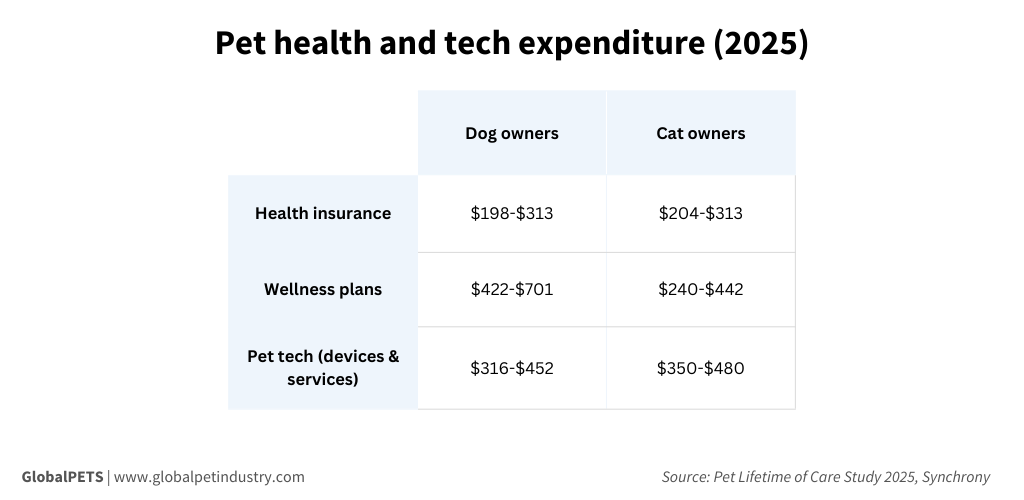
Synchrony reveals that the current annual health insurance expenditure among dog owners ranges between $198 (€172) and $313 (€272), while wellness plans cost between $422 (€366) and $701 (€609), up from 2022 levels.
Pet tech has also seen increased adoption, which, in turn, has driven up pet expenses. Pet owners now spend between $316 (€274) and $452 (€392) per year on products and services, including GPS collars, smart feeders and tele-vet platforms.
Likewise, cat owners spend $204 (€177) to $313 (€272) annually on health insurance and $240 (€208) to $442 (€384) on wellness plans. Tech-related spending has also nearly doubled since 2022, from $350 (€304) to $480 (€417) per year. These purchases include automated litter boxes, smart feeders and telehealth services.
On the other hand, pet owners are reducing their spending in essential categories such as food (premium food, treats, supplements), nutrition and supplies (toys, beds, leashes, litter, etc.).
Pet care cost expectations
According to Synchrony’s survey, dog owners expect to pay $8,158 (€7,084) over 12.5 years, but data show the cost of caring for a dog over 15 years can reach $60,602 (€52,631), underscoring that pet owners underestimate the cost of pet ownership.
This is similar to cat owners, who expect to pay $5,735 (€4,980) over 14.7 years, whereas the actual cost could reach $47,106 (€40,910) over 15 years.
For small pet owners, the gap between expected and actual costs is even wider: they expect to pay $2,977 (€2,586) over 7.3 years, yet could spend up to $14,938 (€12,975) over a 6-year lifespan.
“This gap might stem from a lack of awareness of true lifetime expenses and limited preparation through conversations with veterinarians and financial planning,” Wainberg says.
However, Synchrony also found that pet owners are willing to spend more on their pets. Since 2022, the lifetime cost to care for a dog has increased by 11.65%, while lifetime cat care costs have risen by 19.4%.
The human-pet bond
Despite these higher expenses, the share of pet owners who view their pets as a family member, best friend or child grew from 75% in 2022 to 77% in 2025.
“Pet ownership today has evolved into a premium, lifelong commitment – one that’s emotionally valued, tech-supported, and financially significant. The pet care economy is entering a critical inflection point: while discretionary spending is rising, emergency costs are fueling financial anxiety and strain among pet owners,” says Wainberg.
Share this story: