A report of GlobalPETS Forum 2026
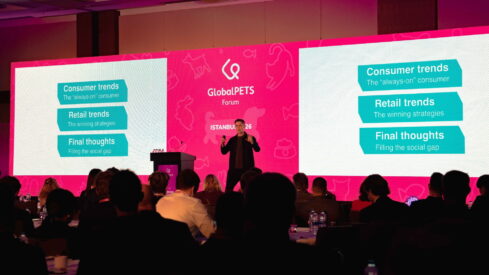
The industry gathering in Istanbul highlighted how innovation, data and shifting pet owner behaviors are shaping the future of the pet sector.
At this year’s GlobalPETS Forum, business leaders and experts discussed how technology, innovation and a focus on the client can empower pet companies to take advantage of the present moment.
Understanding category dynamics
From a macroeconomic perspective, inflation is falling but growth is stagnant. In the pet segment, market saturation is putting pressure on consumer demand, and a particular challenge lies in reconciling the seemingly divergent trends towards luxury and affordability.
While the global gross domestic product (GDP) is expected to slow to around 3% this year, other indicators cast a more positive light on the economy. “From 2026 onwards, we expect that the global baseline is going to be driven by lowering of interest rates as well as easing of inflation,” explained Sahiba Puri, Global Insight Manager of Pet Care at Euromonitor International, opening the event.
One of the results of this scenario for the pet care market is the increasing price polarization between those who are splurging on their pets and those who are on a budget, Puri said. But instead of being cause for alarm, this forecast represents an opportunity for pet businesses to invest strategically.
Andrea Deitert, Global Insights Lead Food at NielsenIQ, gave a hint of where these businesses should focus their attention. “We see some really nice growth rates in emerging markets, Eastern Europe and Asia Pacific on value and volume,” she said.
However, even though North America and Western Europe show flat or declining value and volume growth rates, 81% of all dollars in the pet sector are still concentrated in these regions, making them relevant for all kinds of players.
Agentic Al: bolder use of data
Gilbert Gooijers, Chief Operating Officer of software company CM.com, and Marlou Mulders, Managing Director at Prins Petfoods, surprised the audience by introducing a new – and quite unusual – colleague: an Al agent. They went on to show how artificial intelligence can be adopted in bolder ways to use data and expertise to serve clients.
The duo opened their joint presentation by explaining that large language models (LLMs) are highly effective at predicting users’ next actions. Agentic Al uses this capability by combining LLMs with tools that enable it to act on those predictions.
Based on that, Prins Petfoods uses the input data gathered from clients via phone, mail, WhatsApp and chat to train an agentic Al model that thinks and acts like an employee. This agent is assisting customers 24/7 and learning from their history to recommend treatments and products.
“We can also give this ability to retail stores. Systems can be present for the staff to consult about the questions that consumers ask, or we can place QR codes that consumers can scan, go to WhatsApp and talk with the agents,” Gooijers explained.
What’s needed to make Al work
Despite holding promise, Gooijers cautioned that a single channel or agent does not fit all the company’s purposes. Therefore, businesses planning to implement this technology need to establish different priorities and create distinct agents to address each of them.
Another point to be taken into consideration is that the solution must be designed for all generations – from digital natives to those who are not familiarized with technology. In other words, the complexity lies in constructing an efficient system that gives consumers access to an intuitive service. “It takes data you can trust; the agent is as good as your data is. Start with small experiments and keep progressing,” Gooijers advised.
At Prins Petfoods, there has been a notably positive impact on efficiency, according to Mulders, with smaller teams and faster execution of tasks. “Engagement with the customers is better because they don’t quit as easily as with other tools. Because our products are being sold via our partners, we don’t know exactly what the turnover is, but we hear from the market that it’s worth it,” she said.
Similar initiatives are also underway on the retail side of the pet industry, such as at KIKA, a pet specialty chain with over 120 locations in the Baltic region. Paulius Ausmanas, Head of Export, said that the company is investing in Al solutions, with two ambassadors advancing its integration in marketing and internal processes.
The power of TikTok Shop
Another technological development that sparked interest among Forum attendees was social commerce – or how TikTok Shop can be the new frontier for brand and retail purchases.
Remy Beaumont, founder and CEO of social commerce agency Z Media, explained that TikTok is now responsible for 68% of all global social commerce. This turns the platform into a “full retail channel”, as product discovery and final purchase happen at the same time.
It is also driving a shift in how brands communicate with clients. “What TikTok is really doing is taking word of mouth and applying it at scale. So, creators are now the new sales force. Not celebrities, not influencers, but everyday people who understand relevance and the culture of the platform,” Beaumont explained.
When it comes to pet care social commerce, he said that people’s interests revolve around three main trends: routine and habit content that makes goods feel essential; problem and solution demos; and identity and community. “Pet owners very often self-identify by breed, values or lifestyle, and they buy products that reinforce that belonging,” he said.
Retail: from transactional to emotional
Jack Stratten, Director of the global retail trendsetting agency Insider Trends, described 2026 as being the year of the “always-on consumer”. This implies that businesses need to present new products every day and constantly change the offerings in their feeds to stay relevant, he said.
But this dynamic has also led to market saturation, pushing shoppers to spread their spending across more retailers. On average, they join 19 loyalty programs but engage with less than half of them.
For retailers, this concern has to be at the heart of their strategies. “If you’re going to do a loyalty program, it has to start to build a deeper connection with the customer on an emotional level. A simple transactional process won’t work unless you are the cheapest business in the world,” he stated.
To capture these shoppers, Stratten advised investing in affordable luxury supplies and in-store experiences and activations. Across the world, he said, stores are important places for product discovery in opposition to the flood of online offerings. They are also evolving into spaces where people want to create and share content, and spend quality time. “We have an opportunity as retailers to fill the social gap,” he concluded.
Pursuing innovation without losing focus
When Jean Richard de Latour left behind years of general retail to land his first role in the pet industry 18 months ago, he had one mission: to transform Tom&Co by opening new stores and placing less focus on franchises. Tom&Co, the biggest pet specialty chain in Belgium, is also present in Luxembourg, France and – since recently online – the Netherlands.
“We restarted the remodeling process of our shops. We need to be more welcoming, reward the customer journey and be on top of our assortment. We are also investing in IT, data and all our back office systems,” Tom&Co’s CEO explained.
The pursuit of innovation without losing focus on the customer is also key for KIKA. According to Ausmanas, its focus is on offering complete assistance to clients and training staff to become experts. “We are not just retailers, we are also groomers, have a grooming academy and spa centers to offer added-value services,” he said.
Both retail groups recently launched subscription and loyalty programs and are seeing an increase in e-commerce participation. In addition, they are investing in a new, compact urban store model, with fewer products and employees, but still offering services that create a “sense of community”, according to de Latour.
Sustainability, regulation and trust
Besides growth and innovation, sustainability has become another key factor for building trust in the pet industry. “58% of consumers want more sustainable products, but they’re skeptical. Many companies are making unfounded claims about sustainable products and consumers have recognized it,” said Jim Lamancusa, Executive Director of the Pet Sustainability Coalition (PSC).
To win over pet parents and achieve realistic goals, companies in the sector must adapt to important regulations that will come into effect in the EU. One of them is the Directive on Empowering Consumers for the Green Transition, also known as ‘anti-greenwashing’ legislation, Lamancusa explained. According to him, every EU country must have a national law on the subject by March 2026, which must be fully enforced by September.
“Under these rules, companies have to avoid false and misleading environmental and circularity claims; provide transparent, accurate evidence for all their sustainability claims; and give consumers better information at the point of sale, like on packaging and in store,” he said.
This change also brings opportunities, as forward- thinking businesses tend to benefit during transitions. “When you’re designing products, design for the strictest foreseeable regulations. If you’re doing it ahead of time, you gain loyalty. Consumers who buy sustainable products are some of the most loyal customers you will ever have,” Lamancusa concluded.
Regional focus: Middle East and Turkey
The event also delved into regional opportunities and challenges. Farah Al-Khojai, founder and Managing Director of Arab Land Trading – a pet products wholesaler, distributor and retailer – pointed out that the UAE and Saudi Arabia have the biggest pet markets in the Gulf Cooperation Council (GCC) region, which also includes Bahrain, Kuwait, Oman and Qatar.
Expats have changed pet ownership and consumption in both countries, she said, as they have deeper bonds with companion animals. “The change is not just sociological, it’s commercial. People are looking for entry-level premium brands, smaller pack sizes and functional food at mid-tier price points. It’s conscious wellness over indulging luxury,” Al-Khojai explained.
Thuyen Vu, Chief Marketing Officer at TGM Research, rounded off the presentations with a detailed overview of the market in the host country of this year’s GlobalPETS Forum. Based on research conducted by the company in December 2025, she showed that – while declining in number – Turkish pet parents are diverse and spending more on pet care.
“Many pet owners purchase food and supplies every month, meaning it becomes part of the monthly household routines, just like groceries or utilities. And this consistency opens doors for subscription services, loyalty programs and personalized delivery services,” Vu said. Furthermore, consumers are open to experimenting in the sector, especially with innovative solutions.
Tools, technology and real connections
Turkey’s share of the global pet care industry is 0.6%, said Başar Yildirim, Chief Economist at the local offices of PwC. The country’s economic outlook is challenging, but hopeful. “We are expecting a stable trend in our current account deficit. It’s not really easy but we are applying fiscal discipline. So, I hope it will be positive in the upcoming period,” Yildirim concluded.
This year’s GlobalPETS Forum showed that tools and technology can – and should – be used to optimize processes and meet new market demands. Above all, however, understanding pet parents and fostering real connections with them remains fundamental in an industry whose growth is rooted in the bonds between owners and their pets.
The next GlobalPETS Forum will take place in Lisbon in January 2027.
Share this story: