APAC: one region, multiple playbooks
Pet owners in Thailand, South Korea and Japan are adopting technology and services at very different rates, suggesting localized attitudes toward convenience, privacy and care routines.
New research reveals the danger of assuming that all Asia-Pacific (APAC) countries are the same. Despite their geographic proximity, these three national markets are at varying levels of maturity when it comes to views on pet care and gadgets.
Distinct market differences
A survey conducted by TGM Research across six countries, including Thailand (769 respondents), South Korea (394) and Japan (239), shows how misleading the umbrella term APAC can be, especially when it comes to consumer realities.
In Thailand, for example, 74% of respondents own a pet, compared with 39% in South Korea and 23% in Japan. And regarding pet-related technology, services and spending, these markets are not merely following the same path at different speeds; they are each moving in their own direction.
In Bangkok, for example, a young dog owner might check her phone before sitting down while dining out. A smart feeder has already dispensed her pet’s meal, and a GPS collar confirms that her golden retriever is safe at home.
In Seoul, meanwhile, a cat owner might access his living-room camera to quickly check on his pet while away from home. He feels reassured, though he still wonders where all that footage is being stored. And in Tokyo, a woman cleans her cat’s litter tray by hand – not because she has missed the rise of pet technology, but simply because the routine works for her.
Thailand: technology meets tradition
Thailand provides a good sense of the momentum. Pet ownership is broad, energetic and often young. Many owners are still shaping what pet care means, and technology is being welcomed with open arms.
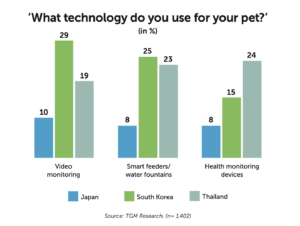
Thai pet parents lead the three markets in the use of health-monitoring devices (24% of respondents compared with 15% in South Korea and 8% in Japan). They are also ahead on GPS trackers, at 20% – four times Japan’s level. Apps that detect health issues from a photo appeal to 41% of respondents, feeders that track eating habits to 40% and activity-monitoring collars to 37%. Only 11% show no interest in any new pet care technologies.
Perhaps surprisingly, the respondents’ enthusiasm for technology does not mean leaving tradition behind. The survey reveals Thai owners to be the most likely to refrain from using more tech because they prefer traditional care, and they are also the most likely to use or consider natural and herbal remedies. A Thai pet parent can trust a smart collar and still believe in non-tech recommendations received from their family or community.
Old habits are not being replaced with new tools in Thailand. Instead, things are being layered: instinct and data, tradition and tracking, affection and apps.
Korea: connected but not convinced
South Korea tells a different story. If Thai consumers are excited about discovering pet tech, in Korea they have lived with it long enough to become more selective.
Korean pet owners are the most connected in the study. Only 23% use no pet technology at all, compared with 35% in Thailand and 68% in Japan. Video monitoring, used by 29%, and smart feeders, used by 25%, have become part of many households.
Not anti-tech, just experienced
But things change when the conversation turns to the customer experience. Korean pet owners don’t only want to know whether a device is smart. They also ask whether it is trustworthy, useful and worth the money. Additionally, they are notably wary about data privacy, with 20% naming it as a barrier to using more pet technology – nearly three times the level seen in Japan.
That does not make them anti-tech. It makes them experienced users. Where does the camera footage go? Who owns the health data? Is this helping my pet or just adding another subscription?
In Korea, the question is no longer whether owners will spend on their pets. They already do. The harder question is whether a brand can justify its place in a crowded, sophisticated market. To stay in the home, a device needs to prove its value.
Japan: quiet routines, clear boundaries
At first glance, consumers’ low use of pet gadgets in Japan could look like hesitation. Two-thirds of Japanese owners use no pet tech at all.
But the data suggests something quieter and more deliberate. When Japanese owners are asked what stops them from using more pet technology, only 24% doubt the benefits. The most given answer – at 27% – is disarming: “I already use everything I need”.
This is not a market waiting to be converted. Japanese pet parents have considered numerous offerings and have decided, for now, that life is fine without them. Pet care in Japan is often kept close to home, and built around routine, small acts and personal responsibility.
A product that promises to transform pet care may feel excessive to them. A product that removes one small daily irritation has a much better chance of success. That may explain why the automatic litter box is among the more appealing technologies in Japan. It is practical, discreet and relevant in this cat-led market.
It does not ask people to rethink the bond with their pet. It simply makes one part of the routine easier.
Varying opinions on robotic pets
In Thailand, 21% of respondents have already tried or owned one robotic pet, and another 45% are curious. At the other end of the scale, despite Japan being the birthplace of Aibo and Tamagotchi, 64% of Japanese respondents do not entertain the idea. South Korean consumers are somewhere in between.
Perhaps these results are not so surprising. Thai consumers are often newer to pet ownership and more open to different forms of companionship. Japanese consumers seem to have firmer boundaries around what a pet is and, for many, a machine does not fall within that definition.
However, one yet-to-be-invented piece of tech holds similarly strong appeal for consumers across all three countries: an app that can translate what their pet is trying to say, chosen by roughly three in 10 owners. Clearly, no matter the differences between these markets, many pet parents share the same simple human desire: to understand their animal companions a little better.
Divergent views on services and food
Likewise, there are differences between the three markets in terms of pet services and premium care. South Korea is the strongest market for professional grooming and supplements: 36% of respondents take their pet to a groomer every three to six months, and 45% either use pet supplements or are actively interested in them. These figures put South Korea well ahead of the other two countries.
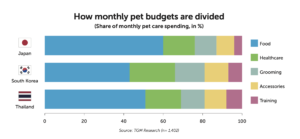
In Japan, owners’ attitudes to pet services echo their limited adoption of pet tech. Half never use grooming, two-thirds never book training, and 80% have used no care or training service – no sitter, no boarding, no trainer – in the past year. On average, Japanese pet parents spend just 11% on grooming services. This is similar to the figure for Thailand, where grooming services account for 12% of the average monthly pet budget.
When it comes to feeding, Japanese owners spend 59% of their monthly pet budget on food, suggesting care that is simple, essential and largely kept in-house. In South Korea, pet spending is more evenly balanced, with food at 43% and healthcare accounting for 23%. Thai pet parents spread their spending even more widely, with a larger share (8%) going on training than in the other two countries. This can be seen as a sign of consumer willingness to invest in living well with pets.
Separate strategies for APAC countries
The lesson for the industry is clear: do not apply a single pet strategy for the whole of APAC. In Thailand, the advice is to lead with innovation, health tools and services, but not to dismiss tradition. The winning offer may be the one that lets old and new sit comfortably together.
In South Korea, meanwhile, it is important to earn trust before asking for loyalty. Quality, transparency, privacy and proof of value matter in a market that has already seen plenty of options. And in Japan, pet industry players should respect the routine. Products need to fit quietly into a self-reliant, cat-led, multi-pet ownership model of care. The best ones will feel less like disruption and more like relief.
Pet humanization is spreading across Asia-Pacific, but not as one steady wave. As shown by the study, these three tides are shaped by different histories, habits and expectations. The brands that win will be those that stop searching for a one-size-fits-all APAC approach – and start writing a specific strategy for each market.
Share this story:
One click prioritizes GlobalPETS in your search results and AI answers.