Brushing up on grooming data

An exclusive survey of pet parents across seven countries on this aspect of care shows that while frequency is increasing, most still prefer the DIY approach.
Grooming is becoming a more regular part of owners’ routines, although habits vary significantly by country and type of companion animal. Professional services are more popular among dog parents, while spending expectations suggest that the majority of consumers will not reduce their budgets in 2027.
A significant proportion
Around two-thirds (67%) of owners groom their animals, either at home or through professional services, according to a survey by Yummypets, powered by Loop, and PETS International of 2,457 pet parents in Australia, Brazil, Canada, France, Mexico, the UK and the US.
Grooming is more prevalent among the respondents in English-speaking countries, particularly in Australia (75%), the UK (73%) and Canada (73%). The US and Brazil are in line with the average, at 68% and 63% respectively, while Mexico (58%) and France (59%) report the lowest shares. But the most significant difference is between the type of pet: 83% of dog parents groom, compared to just half of cat parents (50%).
Rising frequency
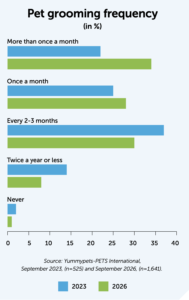
Grooming is a regular activity across all markets, with six in 10 owners tidying up their pets at least once a month. This marks a 16 percentage point increase since a Yummypets and PETS International survey of 2023, which covered 525 pet owners in Belgium, Canada, France, the UK and the US.
Grooming frequency is more or less in line with the general rates per country. Pet owners in the UK and the US clearly lead at twice a month or more: 49% and 41% respectively.
Three in 10 respondents groom their dogs or cats every two to three months. This type of frequency is seen more among Mexican (40%) and French owners (34%). Only 8% of pet parents opt for very sporadic grooming – once or twice a year – although more so in Mexico (12%) and France (16%).
The twist comes with the comparison between cats and dogs. Although fewer cat parents use grooming services or groom themselves, those who do appear to do it more frequently than dog owners: 72% of cat-owning respondents groom every month versus 56% of dog owners.
Professionals vs owners
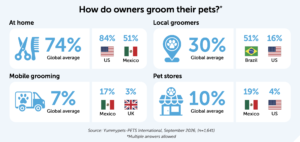
Overall, most pet owners groom their pets at home, with 74% handling the task themselves. However, the results vary considerably across markets. Home grooming is more common in Europe, Australia and North America, with over 84% of pet parents choosing this option in the US and 83% in France.
In Latin American countries, home grooming is slightly less popular – at 50-65%. Brazilian and Mexican owners prefer to take their pets to local groomers. The preference for this option is 51% in Brazil and 43% in Mexico, while the global average is only 30%.
Mexico also records the highest shares for mobile groomers (17%) and pet stores (19%), against averages of 7% and 10% respectively. These results point to different market dynamics, with a larger presence of independent, local professional groomers in Latin America.
Professional grooming as a whole is a dog-dominated field. Cat owners are more likely to groom their pets themselves (85%) than dog owners (67%). And, while 40% of dog parents use local groomers, only 12% of cat parents do the same. Pet stores also attract a higher proportion of dog (13%) than cat owners (6%), a pattern that is repeated, albeit with a smaller gap, for mobile services (7% vs 5%).
The global perspective
The World Alliance of Grooming Associations (WAGA) reports that the US has the highest number of professional groomers (49,347), followed by the UK (15,037), Brazil (12,689) and Canada (3,825). North America accounts for 40% of global revenue in the sector, according to WAGA, with labor shortages driving up prices and mobile services commanding higher premiums than salon-based alternatives.
The Yummypets and PETS International survey found that only 4% of US owners and 6% of Canadian owners use mobile services, suggesting the potential for further adoption in the region. The data also points to a link between frequency and location, with markets where owners groom their pets more often also reporting higher rates of at-home grooming.
What drives service choice?
Groomer friendliness and expertise (21%), price and affordability (20%), and cleanliness and hygiene of the facility (17%) are the top three reasons considered by owners when choosing a service – something that hasn’t changed since the survey of three years ago.
But respondents also value reputation and reviews, plus the services offered (e.g. bathing, haircuts and nail trimming) – both at 16% – as well as location and convenience (14%). The availability of appointments seems less important, with only 5% of the pet owners taking this into account.
As the respondents in Mexico and Brazil are more likely to use professional services, they also give higher than average responses for almost all the reasons presented to them. But while expertise is the most important feature for Mexican owners, reputation and hygiene are factors considered more often by Brazilian pet parents.
Qualifications build consumer trust
Certifications are also important to consumers choosing professional services. More than half (58%) consider groomer qualifications important or very important. This suggests that recognized credentials can help providers build trust and differentiate their services. Across Europe, professional grooming training and certification schemes offer opportunities to strengthen skills and demonstrate expertise, although pathways and recognition vary from country to country.
In Germany, the Potsdam Chamber of Industry and Commerce and the German Pet Trade and Industry Association, ZZF, have jointly developed a one-year professional dog grooming qualification. Launched in 2025, the program combines practical skills with training in canine health, animal welfare and business management. The second intake began in October 2026.
Budgets vary by market
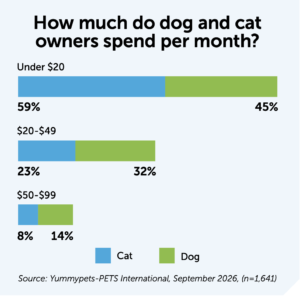
Whether at home or in salons, monthly grooming expenses remain below $50 (€45) for eight in 10 pet owners. Expenditure is generally concentrated in the lower price brackets, with more than half of the respondents (52%) spending less than $20 (€18) per month.
The UK stands out in the responses on spending, with 63% of owners in the lower category. On the other side of the world, Mexico has more owners dedicating a larger part of their budget to grooming: 46% of the Mexican respondents spend between $20 (€18) and $49 (€44) per month. Brazil also has a high share of owners in this category, at 38%.
Some 68% of cat owners spend less than $20 (€18) per month, compared to 43% of dog owners. Among the higher-spending dog parents, 33% report $20 (€18) to $49 (€44), while 19% spend over $50 (€45). These country and cat-dog spending differences are, understandably, consistent with the type of grooming used. Owners who opt for external services are also those who say they spend more.
Impact of inflation
Survey respondents are equally divided on whether inflation has affected their consumption of professional services. There are, however, slightly more owners saying that inflation hasn’t reduced their use of groomers (51%) than those who say it has (49%).
Rising prices are perceived differently across the regions. More than half of the consumers in France and the UK say they haven’t changed their habits due to price increases. These rises have, however, led to owners using grooming services less often in Mexico (45%), the US (44%), Australia (42%), Brazil (42%) and Canada (42%).
In 2023, when Yummypets asked owners whether inflation made them reduce how often they used grooming services, the category was less affected: 59% of respondents said no and 41% said yes. French respondents at that time were also the least affected by inflation, with only 29% of owners reducing frequency, while half of the respondents in Canada and the US reported reduced use of services.
In August 2026, prices for pet services – including veterinary care – had risen by 8.4% in Brazil in the past year. This price rise was 4.8% in both the US and the UK, and 2% in France, highlighting differences in pet care inflation across the markets.
Although most countries don’t publish inflation indices specifically for grooming, broader service categories can provide an indication of price trends. In the UK, the Office for National Statistics (ONS) added pet grooming to its official inflation calculation in March 2026, so that price changes in the category now contribute to the overall index.
Consumer expectations
Respondents to the latest survey are more concerned with price rises in other categories than they are about grooming service increases. Only 16% of all pet owners – many of whom groom themselves rather than paying for a professional service – expect to spend more next year.
This is far behind their expectations of spending more on food (73%) or health (54%), and below supplies (33%) and even toys (20%). A larger budget for grooming is expected to be necessary in Mexico (21%) and Brazil (19%), already the leaders in cat and dog owner spending on professional services.
However, not anticipating paying more for grooming does not necessarily mean reducing expenditure, as only 21% overall expect to spend less on this category next year. Interestingly, this expectation was reported more by Mexicans (30%), with Brazilians (22%) and Americans (22%) also slightly above the global average.
Outlook for 2027 and beyond
Owners in France (76%) and the UK (69%) expect to maintain the same level of grooming expenditure in 2027, followed by Canadians (67%). Findings show that it is pet owners in countries where the effects of inflation have been felt least who expect to continue with their current habits.
The data indicates little movement overall in the grooming service market. There are no significant figures suggesting cutbacks, but there’s also no intention to increase spending, whether with premium services or higher visit frequency. Despite this short-term potential setback, projections for the category are positive. WAGA expects the market to grow from $17.9 billion (€16.1B) in 2025 to $42.9 billion (€38.5B) over the next 10 years.
Share this story:
One click prioritizes GlobalPETS in your search results and AI answers.