Data snapshot: changes in pet ownership across Europe

We take a comprehensive look at the trends emerging in Italy, France, Germany and the Netherlands in the years since the COVID pandemic.
While France and Italy continue to show population growth in cats and small mammals, Germany and the Netherlands are seeing signs of an overall downturn. Industry data provides a detailed snapshot of how pet populations are shifting across these European countries.
General trends
Data from the Italian pet industry association Assalco shows a stabilization in the country’s pet population, which remained steady at 65 million in 2024 – while the human population has decreased by 1.9 million to 59 million in the past decade.
In France, the pet population reached 75.1 million in 2024, unchanged from 2023. Compared with 2022, however, this represents an increase of 1.1 million. According to FACCO, the French federation of pet food manufacturers, the number of pets in France has more than doubled since 1976.
German households owned 33.9 million pets in 2024, down from 34.3 million in 2023. The share of households with pets also declined slightly, from 45% in 2023 to 44% in 2024, according to ZZF, the German pet trade and industry association, and the Industrial Association of Pet Care Producers (IVH).
In the Netherlands, the pet population is estimated at 18.5 million, representing 44% of households. In 2023, the number was higher, at 22.4 million. Data from the Dutch pet trade association Dibevo and the Dutch pet food manufacturers association NVG, indicates that Dutch households now own fewer dogs and cats compared with 2021.
Cats: rising numbers in Italy
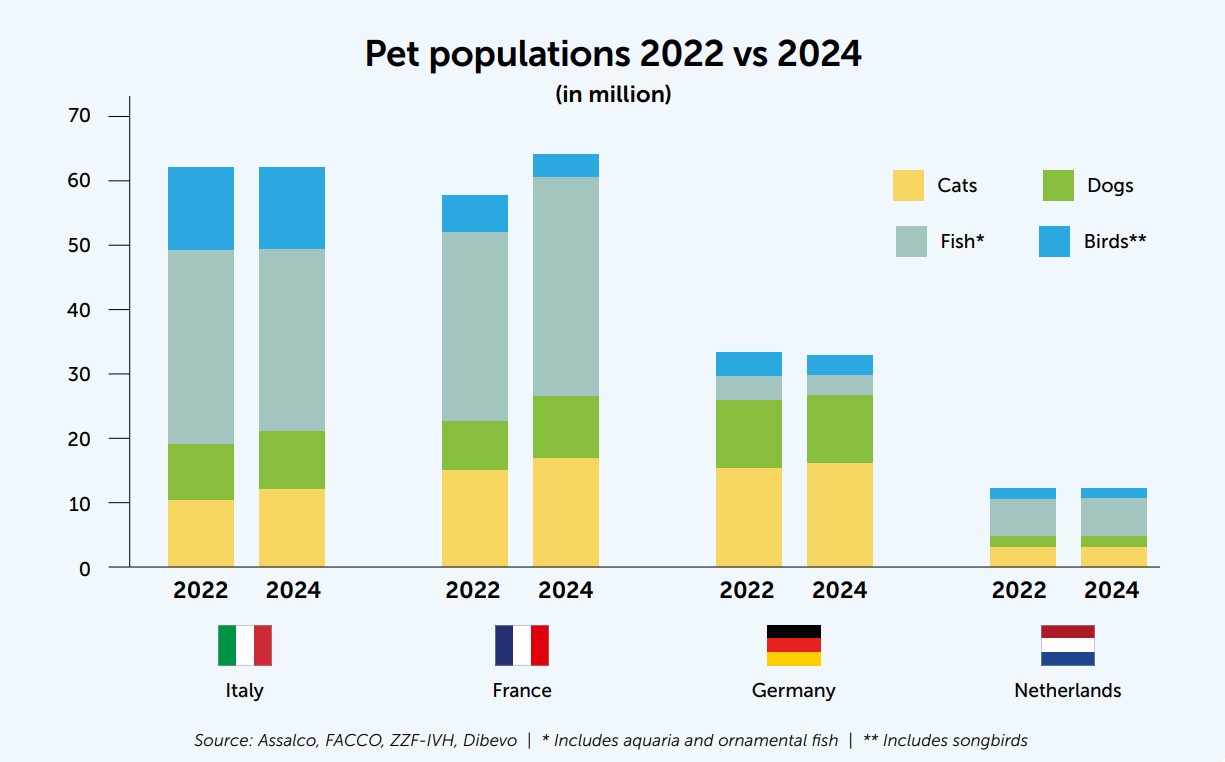
One of the sharpest increases in pet populations has occurred in Italy, driven by a surge in cats. The feline population there rose by 1.7 million in a single year, climbing from 10.2 million in 2022 and 2023 to 11.9 million in 2024 – an increase of 16.7%.
Overall, the cat population in Italy has grown by nearly 2 million since 2021 (18%), making cats the country’s fastest-growing pet category.
In Germany, growth was more modest. The number of cats increased by 200,000 between 2023 and 2024, from 15.7 million to 15.9 million.
ZZF and IVH research shows that last year a quarter of German households owned a cat. Almost 4 in 10 (38%) of German cat owners had 2 or more felines in 2024, a drop from 42% in 2023.
France also recorded an uptick in its cat population. The number of cats rose by 100,000 year on year, reaching 16.7 million in 2024.
By contrast, the number of cats in the Netherlands remained stable, with a population of 3 million from 2022 to 2024, and 23% of households owning one or more cats. Compared to 2021, when there were 3.2 million cats, this represents a 6.3% decline over 3 years.
Dogs: numbers down in the Netherlands
In Italy, the dog population increased from 8.8 million in 2023 to 9 million in 2024, a rise of 2.3%. Assalco data shows that the number of dogs has grown by 270,000 over the past 4 years, after a period of stabilization during the tail end of the pandemic in 2021 and 2022. Between 2021 and 2024, dog ownership rose by just over 3%.
In France, the dog population reached 9.7 million in 2024 – 200,000 more than in the previous year.
Germany reported no change year on year, with 10.5 million dogs in 2024, making them the country’s second most popular pet. Around 21% of German households own a dog.
In the Netherlands, the dog population stood at 1.7 million in 2024, down slightly from 1.8 million in 2023. Compared with 2021, this represents a decline of 5.6% over 3 years, with the biggest decline since 2023.
Fish: a popular choice in France
Following the trend of previous years, fish remained the most popular pets in France in 2024, with a population of 33.7 million. This marks a sharp increase from 29.8 million in 2023 and 29.1 million in 2022.
In Italy, fish are also the most common pets, but the stable trend seen since 2021 shifted in 2024. The population fell from 29.9 million in 2023 to 28.1 million in 2024.
In Germany, the number of ornamental fish and terrarium pets has declined. Their population was estimated at 1.1 million in 2024, down by 200,000 from 2023.
The aquarium fish population also decreased, from 2.2 million in 2023 to 2 million in 2024.
In the Netherlands, 4% of the households kept around 6 million aquarium fish in 2024. This was 700,000 fewer than in the previous year.
Birds: less interest in Germany and Italy
In Italy, the pet bird population declined slightly from 12.9 million in 2023 to 12.7 million in 2024. Over the period 2021-2024, this represents a decrease of 1.4%.
Germany also recorded a drop in pet bird numbers, from 3.5 million in 2023 to 3.2 million in 2024, with birds found in around 3% of German households.
In France, the bird population remained stable at 3.6 million in 2024.
The Netherlands, by contrast, saw a modest increase. Around 1.5 million songbirds were kept as pets in 2024, 100,000 more than the year before. However, industry data indicates that the population has declined by 6.3% since 2021.
Small mammals in France and Germany
The number of small mammals rose sharply from 3.7 million in 2023 to 4.7 million in 2024 in France.
In Germany, small pets such as rabbits, guinea pigs, hamsters and mice totaled 4.3 million in 2024, representing 5% of households.
This was slightly down from 4.6 million in 2023. Industry data also shows that 1.4% of Germans kept farm animals such as chickens or quails at home in 2024.
Share this story:
One click prioritizes GlobalPETS in your search results and AI answers.