EU deals set to expand pet trade horizons
Lower duties could unlock new markets for European brands while also enabling emerging producers to trade more productively with the bloc.
In January, the EU signed two promising trade deals: a Partnership Agreement with four Southern Common Market (Mercosur) countries – Brazil, Argentina, Paraguay and Uruguay – and a Free Trade Agreement with India. While both could ultimately increase trade volumes, industry players expect the effects to unfold gradually.
Changing international climate
The new deals either remove or decrease tariffs on exports of goods, including pet products and food, paving the way for strengthening the pet industry worldwide. The moves come at a time when international trade is reorganizing, after the US increased tariffs on several countries in 2025.
High levies to be abolished
Within Mercosur, Brazil is the biggest EU trading partner, but its basic import tax is 12.6% for pet food plus additional levies of 18.2%. The EU-Mercosur deal plans to end customs duties on cat and dog food imports in two different ways.
For some products, such as food that doesn’t contain starch or milk, there will be an immediate elimination of tariffs when the agreement comes into effect. For others, reductions will follow a schedule of 11 equal annual stages, leading to items becoming completely duty-free by year 10. This classification takes into account the different formulations and the presence of glucose and maltodextrin (powdered filler or preservative) beyond starch and milk.
In March, after all four Mercosur countries ratified the trade deal, the European Commission (EC) set in motion the process to provisionally implement the agreement, likely from the start of May. This interim arrangement would then remain in effect until final ratification, after which it would be replaced by a comprehensive trade deal and investment accord.
Meanwhile, the agreement with India – which the EC describes as the largest trade deal ever concluded by either side – also covers the agri-food sector and will reduce the current tariff s on pet food imports from levels of up to 50% to zero.
Opportunities for premium exports
Industry players expect the deals to create excellent opportunities for pet supplies in general, but especially for the premium and specialized pet food segments in emerging countries. “The tariff reductions outlined in these agreements are expected to significantly boost European pet food exports to new markets while strengthening our existing presence,” Tommaso Gagliardi, Group Sales Director at French-based business Nasta Pet Food, tells PETS International.
“This is particularly true for premium and high-quality products, such as therapeutic diets like our leading brand Forza10, which are currently confined to a niche segment due to high import duties,” Gagliardi adds.
It is common practice for international companies to avoid costs and barriers in the export process by establishing a presence locally, such as Farmina Pet Foods, which opened its first Latin American distribution center in Brazil in 2025, and Nestlé Purina, which invested CHF370 million ($472M/€409M) in a wet pet food factory in the country in March 2026.
Following the letter of the agreement
Without this local production, some companies are uncertain about operating in emerging countries. During the 2026 GlobalPETS Forum, German-based Bunny Nature, which produces food for small mammals, and the Spanish manufacturer of dairy products for pets YowUp! told PETS International that they were following the agreement precisely to overcome barriers and enter the countries sustainably without margin loss or uncompetitive prices for new products.
Entering the EU market
Producers from emerging countries also hope to gain a share of the European market, which is considered demanding in terms of quality. One of them is the Brazilian pet food manufacturer Special Dog Company, which currently exports to 13 countries in Latin America and Africa.
Rafael Venanzoni, Foreign Trade Manager, says the firm already has plans to qualify its 218,000sq m São Paulo production plant for export to the EU and is evaluating strategic commercial opportunities. “Entry will be planned gradually, prioritizing markets with greater regulatory and commercial synergy.”
Improved margins
According to Nasta Pet Food, the new deals may initially have a greater impact on profit than on sales performance. “In the short term, the reduction in duties will help stabilize and improve profit margins,” Gagliardi explains. Over time, however, increased accessibility and broader consumer awareness are likely to drive higher sales. “Volumes will grow in the medium to long term, as the consumer base expands,” he adds.
Gagliardi does not anticipate a “drastic decline in retail prices” for European companies operating in these markets, as their brands and products will likely have a competitive advantage in quality-oriented categories – premium and super-premium – rather than in more price-sensitive categories, where domestically produced items may be cheaper.
Gains for ingredients and tech
Beyond food, players also expect benefits in the trade of ingredients and technology. According to Venanzoni, the agreement could generate some opportunities for importing micro-ingredients, functional additives, processing technologies and packaging from the EU into Latin America and India.
Sebastian Dates, General Manager of the Argentine Chamber of Animal Nutrition Companies (CAENA), also highlights the potential to reduce the cost of accessing these materials.
“It will allow the import of ingredients or additives from the EU that are not produced in our countries at a lower cost, thus improving the competitiveness of our products,” Dates says.
Working both ways
The benefit also goes in the opposite direction. Mercosur countries are major producers of grains, meat byproducts and other agricultural commodities used in pet food, often in volumes that exceed domestic demand, say both Venanzoni and Dates, which creates opportunities for supplying European manufacturers more easily.
For instance, Brazil recorded a record grain harvest between 2024 and 2025, reaching 352.2 million tons and representing a 17% increase compared to the previous cycle, according to the country’s Ministry of Agriculture, Livestock and Food Supply.
“In livestock farming, production reached record levels for beef, pork and chicken, allowing for exportable surpluses,” the Ministry says, stating that beef exports generated $17.9 billion (€15.5B) in revenue, a 39.9% annual increase.
Monitoring developments
Companies operating in the global ingredient market are watching the potential impact of the agreements. German supplier Symrise, which provides flavors and aroma for pet food manufacturers, considers Brazil one of its key markets for sourcing natural raw materials.
While the company does not comment directly on trade policy, it says it is closely monitoring developments to ensure continuity in its supply chains.
In 2023, Symrise opened a 10,000sq m production facility in southern Brazil to make liquid and powder palatants, aiming to triple its capacity for pet food palatants in preparation for rising demand in the region. The company’s total sales in Latin America grew by 6.6% during 2025 to €654.6 million ($754.5M).
Meeting standards to reap benefits
Since the pet sector is highly regulated and the EU maintains strict standards for traceability, labeling and food safety, the effective impact of these agreements will depend on how well South American and Indian companies adapt to technical and certification requirements, says Venanzoni.
He therefore anticipates easier access to the EU market only in the medium to long term, both due to the gradual reduction in tariffs and to the necessary adaptation to sanitary and phytosanitary (SPS) requirements, which demand investment and preparation.
The EU did remove a large number of SPS barriers in 2024 and 2025. According to a report from the EC, this had a “direct positive impact on the European food sector”. Of all the barriers faced in 2024, the largest share (48%) was related to the agriculture and fisheries sector, which includes pet food.
Harmonization and simplification
Gagliardi is also cautious, saying: “Trade agreements represent an essential first step toward opening new markets and accelerating international development. However, the main challenge remains regulatory harmonization, along with the simplification and acceleration of product registration processes and export documentation.”
He cites the example of Nasta Pet Food’s SANYpet plant in Italy, which has been awaiting registration in markets such as Colombia, Mexico and Peru for over a year, despite having submitted all required documentation.
“Greater harmonization should be the next priority to unlock the full potential of these trade agreements,” is his assessment.
For Bernardo Otero, Leader of Latin American Operations at the consulting firm Nexus Animal Health, this is also an opportunity, as the requirements will increase demand for innovative and veterinary-backed products in the Mercosur countries. “To remain competitive in EU-bound supply chains, producers in Mercosur will need stronger biosecurity protocols, improved disease surveillance, preventive vaccination strategies, responsible antimicrobial use and digital traceability systems,” Otero says.
In this sense, the new agreement does establish SPS standards for products traded between the blocs, while the EC and Brazil have committed to establishing a joint SPS Committee that will be formed by the EU and Mercosur.
Pushing growth further
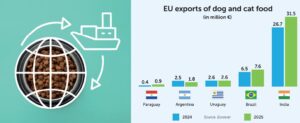
Among the four Mercosur markets, it is Brazil that has the most significant share of the trade. In 2025, EU exports of dog and cat food for retail sale in the country increased by almost 16%, reaching €7.6 million ($8.7M). The other Mercosur nations traded in smaller volumes with the EU.
Argentinian imports of dog and cat food fell by a quarter, totaling €1.8 million ($2M) last year. Uruguay, meanwhile, registered a small 1.6% increase in dog and cat food imports, which meant they remained at around €2.6 million ($3M). And despite representing the smallest quantity exported from Europe among the bloc, Paraguay accounted for the largest annual increases in 2025. Purchases of dog and cat food nearly doubled, reaching €869,627 ($1M).
Compared to Mercosur, the EU exports significantly more dog and cat food to India. In 2025 this amounted to €31.5 million ($36.2M), a 17.9% YoY increase. With trade already expanding between the major countries, these agreements have the potential to push growth further, strengthening premium offerings and improving access to technology in the medium to long term – with the proviso that companies act to comply with regulatory standards.
Share this story:
One click prioritizes GlobalPETS in your search results and AI answers.