How digestive health is rewriting the pet food playbook

As consumer demand and product innovation continue to align, manufacturers are looking at ways to expand the segment using the latest technology.
Modern medicine has long recognized the gut’s role in improving immunity, metabolism and overall wellbeing. This understanding now extends to pets, too. While prebiotics and probiotics have been used in pet healthcare for some time, they’re increasingly making their way into packaged pet food and treats.
Acknowledged benefits for humans
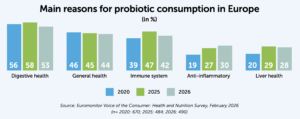
Long before modern nutritional science caught on, the age-old and cross-cultural practice of eating fermented foods was understood to offer benefits for the gut and for broader health. Findings from Euromonitor’s 2026 Consumer Health & Nutrition Survey, conducted among 490 Europeans, tell us why probiotics are being consumed today.
This year, digestive health (53% of the respondents) and general health (44%) are still the main reasons for consumption, followed by supporting the immune system (42%). While the importance of these benefits is virtually unchanged compared to previous studies, anti-inflammatory (30%) and liver health (28%) have gained in prominence, suggesting a desire for more targeted health improvements. Other benefits, such as improved energy, sleep and mood, plus joint health, also score between 20% and 30%.
A key to wellness
The gut is widely considered to be a pet’s health command center. Its pivotal role is driving a decisive shift towards gut-first formulations. Today, the benefits have expanded beyond the supplements aisle and become a cross-category growth lever, elevating daily feeding and treating occasions into wellness-delivering moments.
For category managers, this redraws the competitive scope as clinical credibility becomes increasingly important beyond the therapeutic aisle.
Tracking product claims
Through ingredients, functional benefits and on-pack claims, pet food brands indicate the expected health improvements to be gained from consumption. Within this functional landscape, digestive and gut health serve as high-value benefits, delivering visible validation in a relatively short timeframe. In doing so, digestive and gut health-oriented pet food innovations position everyday nutrition as the first line of defense in preventative pet health management.
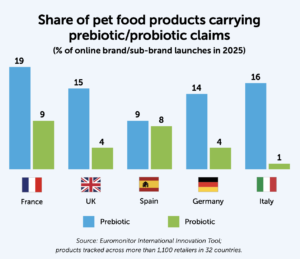
According to Euromonitor’s Passport Innovation tool, 32% of all new pet food launches tracked online during the first half of 2026 carried the claim ‘prebiotic’ and 14% mentioned ‘probiotic’ in their communication. This is a similar picture to 2025, suggesting continuing investment by manufacturers in biotic ingredients. The claims are found across the whole pet food and treats segment.
Prebiotics got there first
Traditionally, pet care products relating to digestive health were mostly found in the supplements category. Today, as pet food and treat formulations become more advanced, manufacturers are claiming digestive benefits through biotic strains in packaged pet food and treats.
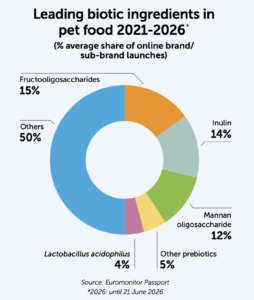
A five-year ingredient analysis using Euromonitor’s Ingredient Trend Spotter reveals the workhorse trio doing the heavy lifting in prebiotic formulation today. These leading ingredients in pet brand launches in the past five years are fructooligosaccharides (FOS –15%), inulin (14%) and mannan oligosaccharides (MOS – 12%). The data for this analysis was collected from more than 1,100 retailers across 80 countries, using back-of- pack information to identify established and emerging ingredients.
The stability of prebiotics during high-heat pet food processing technologies has made them the biotic of choice for innovation. Hill’s Pet Nutrition, for example, introduced its ActivBiome+ Multi-Benefit technology to certain lines for cats and dogs in its Hill’s Science Diet in 2025. The blend of prebiotic fibers and antioxidants is designed to promote digestive, immune and organ health. This kind of proprietary technology establishes strong clinical authority for a brand, while justifying premium pricing.
Dog treats that perform
In the functional dog treats category, UK brand THE PACK and German biotech startup MicroHarvest joined forces to create and launch Gut Bites in 2025. This is a microbial protein dog treat featuring MOS plus chicory root (containing inulin) to feed beneficial gut bacteria.
MicroHarvest’s Portuguese production base also indicates Iberia’s emergence as a hub for next-generation pet ingredient innovation. It is developments like these that expand pet treats from indulgence products into a performance category, while enhancing value proposition through multifunctional use.
Probiotic-friendly processing
To counter the effects of high-heat processing on probiotics, dry pet food formats used to have to rely on post-processing approaches such as spraying the kibble after extrusion. While an effective workaround, the viability for shelf life and transit to gut remains questionable. Today, innovative technologies like cold- pressed processing – plus formats like fresh – tend to be more probiotic friendly. They reduce the need for workarounds and offer more stable, better integrated probiotic delivery.
Dutch brand Dog Lovers Gold offers a cold-pressed formula that is enriched with the live probiotic strain Enterococcus faecium. The brand claims that this method enables the preservation of the nutrients in natural ingredients to the best extent possible.
New-age pet food processing technologies are changing the rules of the gut health category. They enable companies to move away from simply listing probiotics as ingredients to ensuring the survival and efficacy of a biotic strain – a critical lever to stand out from a crowd of overused pet food claims.
Vital role of ingredient suppliers
Format and processing are only one half of the probiotic story. The other half is written much earlier – by ingredient suppliers. Enhancing the viability and efficacy of probiotics in the gut is not limited to technologies and product categories. So the ingredient suppliers play a critical role in the research and development of newer, targeted and more efficient strains.
A recent innovation came from IFF Health Sciences, which has launched a targeted probiotic strain sourced from the canine microbiome. The company claims the strain – Limosilactobacillus reuteri – has demonstrated efficacy for canine health and wellness in a placebo-controlled study. Developments like these underline the depth of investment now flowing into gut microbiome science across the value chain.
Where the industry is heading
The next chapter of gut health in pet care will certainly involve fewer marketing claims and more measurable outcomes. Science-backed strains, smarter processing and visible efficacy will separate the credible from the commoditized. Two shifts will define the following phase: AI-led personalization and format innovation.
AI-led personalization will reset the formulation playbook. China is offering the earliest preview of what this looks like at scale. In 2025, Myfoodie launched WarmData, a system that gathers and interprets real feeding behavior to finetune recipe development. PETKIT is another example: embedding intelligence into feeders, litter boxes and water dispensers to recognize individual pets, track behavior and flag early signs of ill health.
For digestive and gut wellness specifically, this matters. Stool quality, water intake, meal patterns and gut transit cues can now be captured passively at home and fed back into product design. The opportunity for brands is to move from one-size-fits-all biotic blends to recipes calibrated to an individual pet’s microbiome, life stage and daily rhythm.
Solids to liquids and beyond
Format innovation will stretch the gut health segment. Pet food, treats and supplements have so far carried the category. The next wave is liquid, with functional pet drinks, broths and water enhancers carrying live cultures and fibers designed for gut support. The appeal is twofold: hydration is an under-addressed daily need, and liquid formats sidestep many of the heat-stability challenges that have constrained dry food innovation.
The next five years will bring rewards for three strategies: investing in clinical evidence, building AI-led personalization capability and expanding gut health support into new formats. Brands that can act on all three look likely to define the category.
Share this story:
One click prioritizes GlobalPETS in your search results and AI answers.