Industry barometer: China remains key for pet businesses

Despite economic slowdown and trade tensions, most companies are still actively working with the Chinese market, reflecting its enduring importance.
As the world’s second-largest economy, China has been the subject of global interest this year as growth slows and the country faces a trade war with the US alongside domestic issues in the property market.
Positive trade balance for China
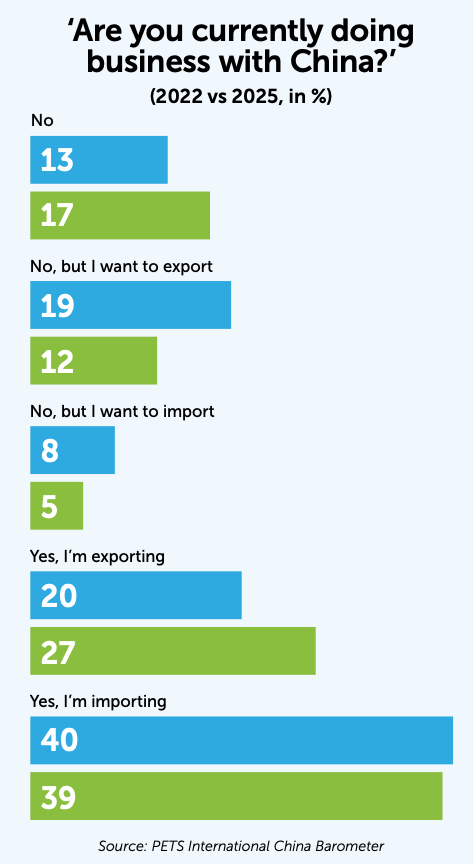
A new GlobalPETS industry barometer reveals that 66% of pet firms are currently engaging in some type of business with China. This shows a modest rise in comparison with research conducted in 2022, when the figure stood at 61%.
According to the findings from this survey, which was conducted among more than 40 pet industry players, the overall balance of trade is positive for China. Nearly 4 out of 10 respondents (39%) indicate that they are importing Chinese products, a similar figure to the 2022 barometer (40%). Meanwhile, 27% are exporting their pet products to China in 2025, an increase of 6% from 3 years ago.
The 2025 barometer also shows that 17% of the respondents who are not yet present in the Chinese market would like to start doing business with the country, while 17% say they have no plans to do so in the near future. The number of pet companies that are not looking to do business with China has increased by 4 percentage points since 2022.
The majority of pet companies importing from China (75%) expect the country will remain a valuable sourcing market for them, both now and in the foreseeable future. However, almost one fifth of respondents (19%) plan to look for more local suppliers in the future and do less business with China, and 6% are already looking for suppliers closer to home.
Keeping options open
An overall increase is visible in the number of firms that do not yet do business with China but might in the near future. Half of the respondents say it is “somewhat likely” that their companies will sell to or buy from China within the next couple of years (up from 21% in 2022). The degree of certainty has decreased significantly, however, with only 7% describing this possibility as “very likely” (down from 28% in 2022).
At the other end of the scale, the 2025 barometer also reveals a rise in the proportion of businesses that are “somewhat unlikely” (from 8.3% to 14%) or “very unlikely” (from 19.4% to 29%) to trade with the country.
Barriers to business
According to respondents, there have only been modest changes in the challenges associated with doing business with China since 2022. Companies continue to cite administrative and regulatory issues as their main concerns.
Compared with 3 years ago, however, more companies now see market competitiveness as a challenge (up from 16% to 26%). The survey also highlights concerns about finding local representatives or agents, marketing effectively towards Chinese consumers (18%) and addressing the language barrier (5%).
Of the respondents not currently doing business with China, 71% say they have never tried to set up a partnership. 14% have tried, but report encountering barriers due to bad partnerships. Another 14% indicate that the collaboration didn’t work out for other reasons.
Finally, 6 out of 10 respondents – coming mostly from Europe and North America – think that there will be a general shift to more local suppliers in the global chain, but that China will continue to have an important position in the future.
Tariffs may hit 3 out of 10 pet firms
In terms of the impact of the current tariff situation, 53% of the respondents foresee some kind of effect on their company’s trade with China. 23% of them expect to do more business with the Asian nation, and 30% expect to do less.
Despite the US and China having threatened each other with more than 100% tariffs on traded goods earlier this year, in August US President Donald Trump extended the truce between them for another 3 months. The countries have until November to try and negotiate an agreement.
Also in August, China reported that its export growth had slowed to the lowest level in 6 months, and its year-on-year shipments to the US had fallen by more than 33%. These figures led analysts to lower their projections for Chinese economic growth in 2025 and 2026.
The Asian country is a strategic trade partner for pet companies around the world. From a US perspective alone, it was the third largest export destination by value last year, representing $1.27 billion (€1.08B), behind only Canada and Mexico, according to the American Feed Industry Association (AFIA). Meanwhile, US pet firms imported $549 million (€467M) in ingredients and animal food products from China, with dog and cat food accounting for the third largest share.
Share this story:
One click prioritizes GlobalPETS in your search results and AI answers.