Kids vs pets: a growing gap

As birth rates decline globally and families become smaller, dogs and cats are increasingly at the heart of the household.
Data collected by PETS International reveals that in several countries around the globe, populations of companion animals now outnumber those of young people – by a factor of up to four. What are the reasons behind this phenomenon and what are its implications for the pet industry?
Contrasting global curves
Data provided by Euromonitor International helps to illustrate this global trend. With statistics from 47 countries in Europe, Asia, Oceania, the Middle East and North America, it shows two curves going in opposite directions: while birth rates tumbled from 2020 to 2025, the dog and cat population is continuously growing.
The market research firm’s analysis projects that the gap will widen further over the next five years. The compound rate of these 47 countries dropped from 17 births per 1,000 population in 2020 to 16 per 1,000 in 2025. By 2030, Euromonitor projects it will fall to just over 15.
In comparison, the total number of dogs and cats, which was just over 900 million in 2020, passed the one billion mark in 2025, and is expected to reach more than 1.1 billion by 2030. While Euromonitor’s data shows that the two trajectories were more pronounced during the pandemic, it indicates that these diverging trends may well continue.
What the figures reveal
Looking at the number of births relative to the total population helps us to understand the pace of demographic change, which is growing more slowly in many countries. But for the pet sector it’s particularly interesting to compare the effective population sizes of dogs and cats in different countries and regions to that of the numbers of children and young people that make up households.
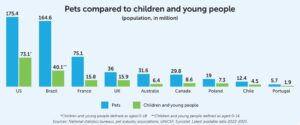
In Australia, for instance, as of March 2025 there are more than 31.6 million pets living across 7.7 million households. According to this Animal Medicines Australia data, 13.1 million of these pets are dogs and cats – twice as many as the number of children and young people in the nation: 6.4 million in June 2024 (Australian Bureau of Statistics).
Numbers of pets as well as young people and children have increased in the country in recent years, but at quite different rates. Between 2022 and 2025, the pet population grew by 10%, while the child and youth population increased by 2.5% from 2022 to 2024. Although this is a comparison between three- and four-year periods, the pet population is clearly growing at a faster pace.
Zooming in on Europe
France has a relatively high number of pets in total: 75.1 million in 2024, according to FACCO, the country’s Federation of Pet Food Manufacturers. The dog and cat population is smaller, at just over 26 million, but still enough to surpass the 15.8 million children and young people aged 0-19 living in the country in 2024, according to data from Eurostat.
In the UK, statistics from the industry association UK Pet Food put the number of cats and dogs in 2024 at 26 million – out of a total of 36 million pets in the country. This was more than double that of the Office of National Statistics data for UK youth aged 0-19, which was 15.9 million in the same year.
In Poland, both the numbers of dogs (8.5 million) and cats (7.5 million) are higher than the youth population registered in the country (7.3 million), according to data from Eurostat and FEDIAF, the trade body representing the European pet food industry. The most recent data for the total number of pets in the country, which includes birds, fish, small mammals and terraria, was 19 million in 2023.
Even in Portugal – a much smaller country – the number of pets, at 5.7 million according to FEDIAF, is almost three times higher than that of children and young people aged 0-19 (1.9 million, according to Eurostat).
Similar trends in the Americas
Brazil’s pet population numbered 164.6 million in 2025, according to data from the Brazilian association of pet companies Abempet. That’s four times the number of children and teenagers aged 0-14 counted in the country’s most recent census. This age group has seen a significant decline since 2010: from 45.9 million in 2010 (24.1% of the total population) to 40.1 million in 2022 (19.8%).
Chile shows similar patterns to Brazil, with 12.4 million dogs and cats recorded in the country in 2022, the most recent data released by the government, and 4.5 million children and teenagers aged 0-19 in 2024, according to official data.
In the US, more than 175.4 million pets (of which almost 87.3 million are dogs and 76.3 million cats, according to the American Veterinary Medical Association’s 2025 data) also outnumbered the 73.1 million young people under the age of 18 in 2024. The youth population in the US declined recently, by 1.7% from 2020 to 2024, according to the US’s Census Bureau.
More northerly, Agriculture and Agri-Food Canada data for 2024 gives approximately 29.8 million pets in the country (which includes 8.9 million cats and 8.3 million dogs) versus Statistics Canada’s 2025 figure of 8.6 million children aged 19 or under.
Declining human populations
In a study for the International Monetary Fund (IMF), professors David E. Bloom, Michael Kuhn and Klaus Prettner say the declines in fertility rates and total populations “hold for much of the world” from 2000-2025 and “will most likely continue over the next 25 years”, except for Africa and “low-income countries on other continents”.
The IMF researchers also say that the “world’s fertility rate stands at 2.24 and is projected to drop below 2.1 around 2050”, with only Africa presenting a positive replacement rate. Other international and national organizations also regularly express their concern about this trend, such as intergovernmental agency the Organisation for Economic Co-operation and Development (OECD).
Explanatory factors
In June 2025, the United Nations Population Fund (UNFPA) published The Real Fertility Crisis, a study in which it analyzes the causes of this phenomenon. Among them, the agency points to a lack of economic security and personal empowerment.
Together with YouGOV, UNFPA surveyed 14,000 adults in 14 countries between November and December 2024. Findings suggest that financial constraints are the biggest barrier to starting a family (39%), followed by unemployment or job insecurity (21%) and housing limitations (19%).
In addition to economic reasons, respondents also cited health and concerns about the future, but to a lesser extent. Reasons given include the lack of a suitable partner (14%), concerns about the political or social situation (14%), someone changing their mind (13%) or a partner who wants fewer children (13%).
Changing lifestyles
Lower numbers of children open other opportunities, as the IMF study points out, one of them being “less need for spending on housing and childcare” and another that these resources “could be reallocated”. Population decline may also reduce pressures on the environment.
“People having fewer kids is contributing toward pets becoming the subject of human caregiving. Lifestyle choices such as ‘DINKWADs’ – double income, no kids, with a dog – are enabling more time, money and attention to flow towards pets,” explains Sahiba Puri, Global Insight Manager, Pet Care at Euromonitor International.
“Factors like urban isolation, single person households and flexible work-from-home arrangements also contribute to pets finding their way into homes, as people look for companionship,” she adds.
Today’s pet parents
The effects for the pet industry go beyond premiumization, as demand is becoming “more sophisticated”, is Puri’s analysis. The increased focus on functional health benefits and high-quality nutrition will push innovation in the field, as owners look for the next step.
This new consumer will likely boost the industry, leading to even more investment in the coming years. “Over the forecast period 2025-2030, the global pet care industry is expected to grow at a CAGR of 3%,” Puri concludes.
The widespread global phenomenon of declining birth rates is becoming more pronounced every year. But while the number of children has been decreasing, the pet population continues to grow and occupy an increasingly central place in families of all shapes and sizes.
The shrinking youth population on the one hand, and increases in pet ownership on the other, point to a long-term shift in which companion animals will play an even more important role in households. It will be up to the industry to keep pace with the demand for human-grade pet products, services and care.
Share this story:
One click prioritizes GlobalPETS in your search results and AI answers.