Spain: Mature owners are shaping the next era of pet care

A new generation of engaged pet parents is refashioning consumption habits, raising expectations and creating new opportunities across food, retail and services.
Spain’s animal lovers are evolving, and so is the market around them. More households have pets, adoption is becoming the dominant route into ownership and consumers are taking a more considered approach to food, products and services.
More households with pets
At the same time, younger pet parents are turning to social media and other digital sources for advice, opening the door for pet players to engage with consumers in novel ways.
Pets remain popular in Spain, with more than half of households having at least one companion animal. According to the 3rd Pet Parents Barometer in Spain 2026, presented at Iberzoo Propet 2026 in Madrid, the share has reached 54%, up two percentage points compared with the previous year.
The research, conducted by the Spanish Association of Trade and Industry for the Companion Animal Sector (AEDPAC), was based on 713 online interviews with a representative sample of Spanish owners. The survey covered 879 pets, including 523 dogs and 356 cats.
Increasing diversity = new opportunities
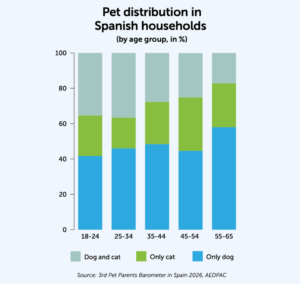
Besides the quantitative growth, the market is also becoming more diverse. The number of mixed-pet households (those with both dogs and cats) has grown significantly, reaching 27.3%. Meanwhile, the share of Spanish households keeping reptiles and turtles increased from 1.9% to 3% in just one year. A similar upward trend was observed among fish owners, rising from 4.9% to 6%.
In comparison, cat-only households remain stable at 24.5% and dog-only households have declined to 48.2%, although they remain the largest group. For the industry, this means more segmentation, increasingly complex needs and new opportunities for cross-category consumption and specialized communication.
Making the choice to adopt
Adoption is now the main way pets enter Spanish households. Direct purchases are declining, particularly for dogs, where numbers have fallen by nearly 10 percentage points compared to 2025.
Nowadays, seven in 10 dogs are adopted – either from shelters, private individuals or after being found – while six in 10 cats come from non-commercial sources.
Older pet parents are more selective
Another interesting finding from the survey is that pet parenting is maturing. The share of first-time pet parents has declined slightly to 23.6%. This suggests that many households are not just adopting or buying a pet once but are repeating the experience and integrating companion animals into their long-term way of life.
This is supported by the fact that the emotional bond remains very strong, with around eight in 10 respondents considering their pet a member of the family. Furthermore, four in 10 owners identify with the term ‘pet parent’.
This maturing demographic has direct implications for brands and manufacturers. A more experienced pet parent is often a more selective consumer: they compare, ask, read, listen to professional advice and are more aware of the impact of products on health, behavior and wellbeing. The value proposition must therefore go beyond functionality or price to include trust, expertise, safety and transparency.
Food as the cornerstone of spending
Food remains the foundation of the Spanish pet care market, accounting for 38.8% of the total monthly pet budget. This category remains highly resilient because it is perceived as essential care.
The average monthly spending on pet food is around €58 ($67), although over half of owners (51.1%) spend a maximum of €45 ($52) per month. Dog and cat owners in the 35-44 age category have the highest monthly food costs, spending an average of €60 ($69).
Balancing value and brand trust
However, the barometer shows that Spanish pet parents are not driven only by cost; they also value quality, health and expert guidance. Looking at the criteria on a scale of one to 10, food quality is the most important (8.6), followed by the pet’s taste or preference (8.2) and veterinary recommendations (8.1). Price and promotions remain relevant, but they do not dominate the purchasing decision.
The data also shows that known brands continue to lead over retailers’ own labels, with 65.9% of purchases corresponding to manufacturer brands, compared with 25.6% for private label and 8.5% for custom diets.
Moreover, among those who do not buy private label products, 64.3% of respondents say they would not switch to a lower-priced private label option even if they had to reduce household grocery expenses.
AEDPAC also found that more than half of Spanish pet owners (52.7%) combine brands when purchasing pet food, up from 48.9% in 2025. Those attached to specific brands decreased by more than five points, from 43.6% in 2025 to 38.2% this year.
Trend to watch: homemade pet food
Cooking for pets has entered Spanish households and, although not yet leading, it could be a trend to watch. On average, 2.1 pet meals in every 10 are currently home cooked, with 4.8% cooking frequently (six to nine times in 10) and 2.9% always preparing homemade food for their companion animals. On the other hand, 36.4% indicate that they never cook for their pet.
The results also vary by type of pet. Almost 10% of Spanish dog owners say they cook for their pets frequently or always, compared with 6% of cat owners. More than four in 10 (43.9%) cat owners never prepare homemade food for their pets, compared with 28.8% of dog owners.
The starkest difference is seen across age groups. Among 18-24-year-old pet owners, 14.7% cook for their pets frequently or always, compared with 6.9% of those aged 55-65.
In-store purchases hold firm against online
Despite the digital transition, only 1% of Spanish pet owners purchase all their pet food online. An average of 14.1% shop exclusively in-store, while the remaining 84.9% use both channels, but buy more in-store than online.
Supermarkets and hypermarkets dominate in-store purchases, accounting for 50.7%, followed by specialized chain stores at 27.6%. Online purchases, in contrast, are more evenly distributed among specialist platforms (26.2%), supermarkets and hypermarkets (25.7%) and online specialized chains (24.1%).
Pet nutrition: shifting sources of influence
Veterinary clinics account for 22% of in-store purchases, closely followed by pet specialty retailers (20.6%). These channels are also regarded as the main source of information on pet nutrition, especially among more mature pet parents. For example, 72.6% of owners in the 55-65 age range cite veterinarians as their main source of influence.
However, this predominance shows signs of shifting. While veterinarians or animal health professionals score an across-the-board average of 56.8%, this figure is only 38.9% in the 18-24 age range. Especially among younger consumers, it seems that social media (26.4%), podcasts (15.3%) and online training platforms (13.2%) are gaining in importance.
How welcome are pets?
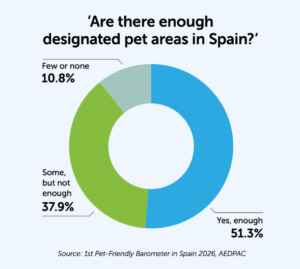
One interesting research question is whether Spain has a pet-friendly culture. According to AEDPAC’s 1st Pet-Friendly Barometer in Spain 2026, nearly half of pet parents in the country believe there are not enough pet-friendly spaces.
The other half (51.3%) believe that there are enough pet-friendly environments, nearly nine points more than in the 2025 report.
Travel and accommodation are particularly relevant assessment criteria. Nearly four in 10 pet parents always look for pet-friendly options when planning holidays, rising to more than half among those aged 25-35.
Perhaps unsurprisingly, this average percentage is higher among dog owners (42.9%) than cat owners (33.9%), with 37.6% of cat owners saying they never travel with their pet (compared to 23.4% of dog owners).
In terms of the demographics, owners in the 18-24 and 25-34 age ranges are the most likely to look for pet-friendly accommodation (43.8% and 54.9%, respectively). This opens up interesting opportunities for hotels and other types of accommodation to lead the pet-friendly revolution. These opportunities can also be extended to transport and perhaps even retail brands looking to become more strongly associated with pet-friendly positioning.
The next frontier
The evolution of Spain’s pet market is creating opportunities far beyond food and traditional pet retail.
The challenge for the industry will be to keep pace with these developments: serving more diverse households, communicating with successive generations of pet parents and responding to demand for pet-friendly experiences.
Share this story:
One click prioritizes GlobalPETS in your search results and AI answers.