The lowdown on pet allergies

With one in four owners reporting sensitivities in their pets, manufacturers are seizing opportunities in specialized nutrition, supplements and dermacosmetic products.
The global pet market is riding a new wave of functional products and medications, including those designed to address skin irritations and food intolerances. As recent data reveals trends across the world, businesses are responding with innovative treatments and pet food formulations.
A quarter of pets affected
Allergies and sensitivities affect over one in four pets worldwide, according to owners surveyed in Australia, the UK, the US, Canada, Mexico, France and Brazil. The study was conducted by Yummypets, powered by Loop, and PETS International. Pet parents in Australia, Latin America and North America report most signs of skin irritations or sensitivities in their dogs and cats, while Europeans see fewer symptoms.
Allergies or sensitivities seem more common in dogs (reported by 40% of owners) than cats (24%). Most owners consider their pets to have moderate (41%) or mild (31%) symptoms when triggered, with only 14% reporting reactions as severe or very severe.
Professional help remains the most common method for identifying such conditions, with 16% of respondents saying their pets have been diagnosed by a vet and a further 6% planning to seek a formal diagnosis.
When it comes to obtaining an assessment by a vet, there is a noticeable difference between dog owners (22%) and cat owners (11%). Only 5% of respondents state that their pet shows signs of allergy or sensitivity but that they do not plan to seek an official diagnosis.
Pet owners in Brazil and Australia are the most likely to consult veterinarians for this purpose (22% and 20%, respectively). North America has the highest proportion of owners planning to seek vets to properly assess their pets. The countries with the most pet parents who do not intend to seek professional help for their pet’s condition are Canada (11%) and the UK (7%).
Types of allergies
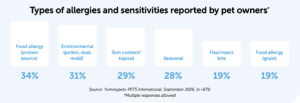
The most frequently reported pet allergy is food intolerance, with more sensitivities associated with proteins (34%) than grains (19%). The highest incidences of protein allergies are in Canada (58%), followed by the UK (40%).
Allergies related to the environment, such as to pollen, dust or mold, are indicated by 31% of respondents, with similar figures across all seven countries.
Skin contact/topical (29%) and seasonal (28%) irritations are also prevalent, but with different intensities per region. Brazil, for instance, leads in skin issues (38%), while Australia (42%) and the US (38%) have higher-than-average rates of seasonal allergy cases.
Flea or insect bites are the least common cause of allergies in the survey, accounting for 19% of the total. However, this figure is as high as 28% in the US and Brazil.
Treatment preferences
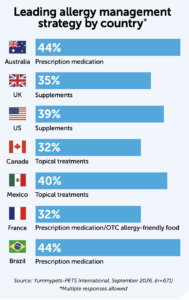
When it comes to managing their pets’ allergies and sensitivities, Brazilians and Australians lead in the use of prescription medications, with 44% of respondents in each country reporting this approach. This is 10 percentage points higher than the overall figure of 34% and exceeds the rate recorded in the UK (33%), the next highest market.
The use of topical treatments, by contrast, is more evenly distributed. While most prevalent in Australia (42%) and Mexico (40%), such products also have significant usage rates in Brazil (39%) and the US (35%).
Almost twice as many dog owners (35%) as cat owners (18%) report having pets suffering from skin contact/topical irritation. As a direct consequence of this, dog owners (42%) are more likely to use topical treatments than cat parents (17%).
Expanding the portfolio
This is driving a surge in dermacosmetic products focusing primarily on dogs. One recent example is a newly launched line of 10 dog shampoos designed for coat and skin needs by Italian pet care and hygiene brand Digma. Similarly, US-based dog beauty and skincare brand The Canine Project has released the Furvive Restorative Shampoo Body Wash.
Even mainstream, traditionally human-focused brands are moving into this segment. In September, global luxury brand Rituals extended its philosophy of wellbeing to the entire family with the launch of Rituals Dog Care. This premium positioned collection features seven dog care innovations – including shampoo and paw balm – created for bath time, grooming and daily care.
Meanwhile, British perfume brand Jo Malone has partnered with pet grooming company WildWash to launch a dog shampoo inspired by its Orange & Cedarwood fragrance. The product combines Jo Malone’s branding with WildWash’s grooming expertise.
Adapting the pet’s environment
The range of strategies to combat allergies goes beyond medical or topical treatments. For instance, 24% of those surveyed implement environmental changes, such as purchasing air filters or adopting specific cleaning routines. This option is particularly popular in Brazil, with 35% of respondents trying this approach.
Consequently, some manufacturers are offering hypoallergenic pet products, such as cat litter made from olive pits to tackle dust allergies.
Rise of functional supplements
According to the Yummypets-PETS International survey, supplements are the most used approach to managing pet allergies, cited by 35% of respondents in total. Although survey respondents in the US are more inclined to use supplements (39%), there is no statistically significant difference between the regions. Even in France, which has the lowest rate of supplement use, adoption still stands at 30%.
Market intelligence from NielsenIQ confirms that the supplements sector is booming in the US. Sales in 2025 were around $1.6 billion (€1.4B), signaling an increase of 9.3% compared to 2024. In particular, the figures show that gut health is emerging as a key growth area, with sales of pet care products carrying microbiome claims increasing by 8% in the 52 weeks to 27 July 2026.
Within this segment, revenue from products with prebiotic claims rose by 6.5% year over year (YoY), while probiotics grew by 5.7%. Postbiotics recorded the strongest growth, with revenue surging by 148% in 2025 compared with 2024.
In response to this rising demand, many major brands are investing in supplements for skin and food allergies. This is leading to the emergence of new prebiotic, probiotic and postbiotic products, as well as those containing omega-3 and omega-6 fatty acids.
For instance, Hill’s Pet Nutrition has launched a product targeting skin and gastrointestinal sensitivities with a blend of prebiotic fiber “shown to activate a pet’s gut microbiome to reduce harmful waste products”, according to the company.
Allergy-friendly nutrition
Adjusting a pet’s diet is another way owners manage skin irritations and food sensitivities. A total of 23% of respondents are likely to try over-the-counter (OTC) allergy-friendly food. Meanwhile, 19% turn to prescription diets, with pet parents in Mexico (28%) and Australia (27%) driving up this average. Cat owners are more likely to adopt prescription diets than dog parents (25% vs 16%).
Bangkok-based Betagro, an integrated food company, has introduced the Perfecta Veterinary Diet line for dogs with food allergies at pet hospitals, veterinary clinics and authorized distribution channels. It features Anallergenic and Hypoallergenic formulas, both of which contain hydrolyzed protein with very small molecules – with the goal of being virtually undetectable by the immune system.
The formulation aims to reduce or eliminate allergic symptoms such as itching, skin infections, vomiting and diarrhea. Additionally, the recipes are free of gluten, corn and wheat, and are enriched with omega-3 and omega-6 fatty acids, an antioxidant complex and prebiotics to promote healthy skin and coat, and strengthen gastrointestinal health.
For the same channel, Royal Canin launched its Fresh Veterinary Diets in the US in July. Formulated to support dogs with specific health conditions, including gastrointestinal needs, food sensitivities and reduced appetite, this is the brand’s first fresh, fully cooked therapeutic diet portfolio available exclusively through veterinarians.
On the OTC allergy-friendly food front, in September the pet food brand IAMS expanded its Sensitive Skin & Stomach line to feature a recipe with salmon and brown rice, targeting dogs with chicken sensitivities.
Single-protein recipes
For pets with suspected allergies or digestive issues, limiting recipes to one animal protein can simplify exclusion diets. Concerns around food sensitivity are therefore driving a surge in single-protein dog food.
“Having high-quality, single-protein, grain-free options makes it significantly easier for owners to completely avoid specific ingredients that might trigger a reaction,” Fiona Firth, Animal Nutritionist at British food manufacturer Tails.com, tells PETS International.
The brand launched five new single-source protein recipes – spanning beef, chicken, duck, lamb and turkey – as both wet and dry dog food products earlier in the year. The company now plans to expand the concept within its range.
Complete and balanced recipes can also remove the need for additional supplements that may unintentionally introduce other animal proteins during an elimination diet, explains Melanie Sainsbury, Veterinary and Breeder Manager at Natures Menu. The company offers raw and cooked single-protein food containing venison, rabbit, beef or wild boar.
In line with this trend, Hill’s Pet Nutrition debuted its Science Diet Single Protein Dog Food Rolls in the refrigerated section in July this year. The launch signifies Hill’s entry into the fresh dog food category.
According to the company, these single-animal protein recipes offer the triple benefits of high digestibility for a balanced gut, omega-6 fatty acids and vitamin E for healthy skin and coat, and a science-backed formula for overall health. The rolls are currently available in three recipes: Chicken and Brown Rice, Beef and Carrot, and Lamb and Pumpkin.
Boosting sales velocity and volume
Another company tailoring its recipes is US manufacturer Nulo, having launched limited ingredient diet (LID) cat food formulas made with chicken, salmon, turkey or whitefish.
“It’s important that retailers know that when LID products are added to the shelf set, we’ve seen velocity and volume lift across the board,” says Eric Emmenegger, Head of Product and Retail Marketing for Nulo.
According to the company, food sensitivity diets are preferred by 23% of pet food shoppers. Smallbatch Pets and JustFoodForDogs have also added or expanded single-protein options within their portfolios in 2026.
Data shows that awareness of pet allergies and sensitivities is growing, and the industry is responding with a broadening range of solutions. For manufacturers, the opportunity lies in addressing specific needs with targeted products that support pets’ health and owners’ demand for convenient care – whether through medications, supplements or food.
Share this story:
One click prioritizes GlobalPETS in your search results and AI answers.